⚡ Quick Answer
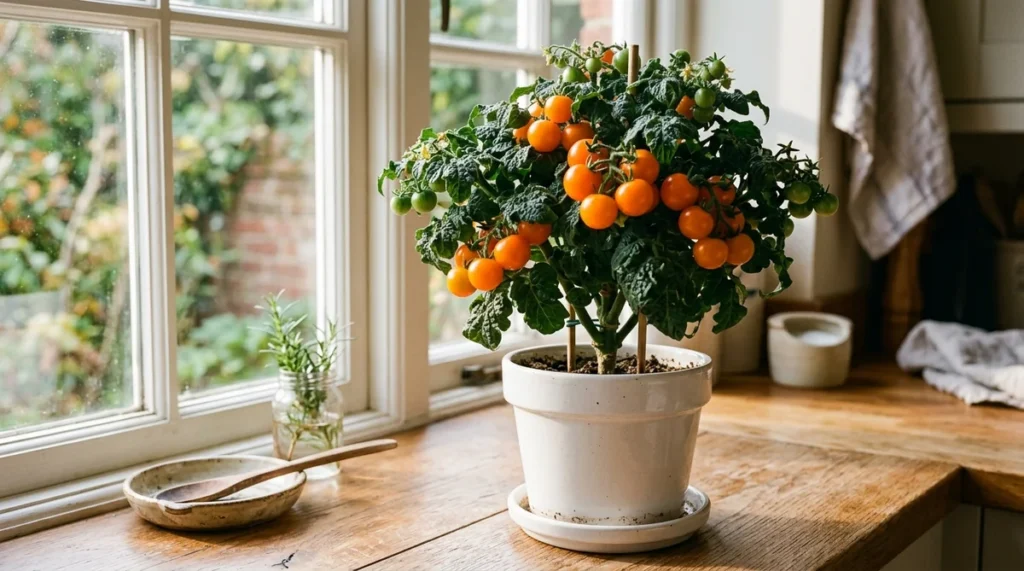
Orange Hat is a true micro-dwarf tomato cultivar bred to mature at just 6–9 inches tall. It thrives in 6-inch to 1-gallon pots or countertop hydroponic gardens like AeroGarden, requires 14–16 hours of LED light, and produces clusters of sweet, bright orange cherry tomatoes in 55–65 days with zero staking required.
What exactly is that tiny orange tomato plant no taller than a coffee mug? Indoor gardeners and small-space growers who spot clusters of brilliant orange cherry tomatoes packed onto an eight-inch bush have discovered the orange hat tomato.
Bred specifically for cramped windowsills, desktop planters, and indoor hydroponic pods, this determinate micro-dwarf variety produces abundant yields in spaces where traditional sprawling tomatoes cannot survive.
In this comprehensive guide, we examine everything specific to growing the orange hat tomato: botanical lineage, container physics, hydroponic nutrient formulas, buzz-pollination protocols, and troubleshooting the heat-induced leaf curl that surprises so many first-time growers.
What Is an Orange Hat Tomato? Botanical Heritage & Morphology
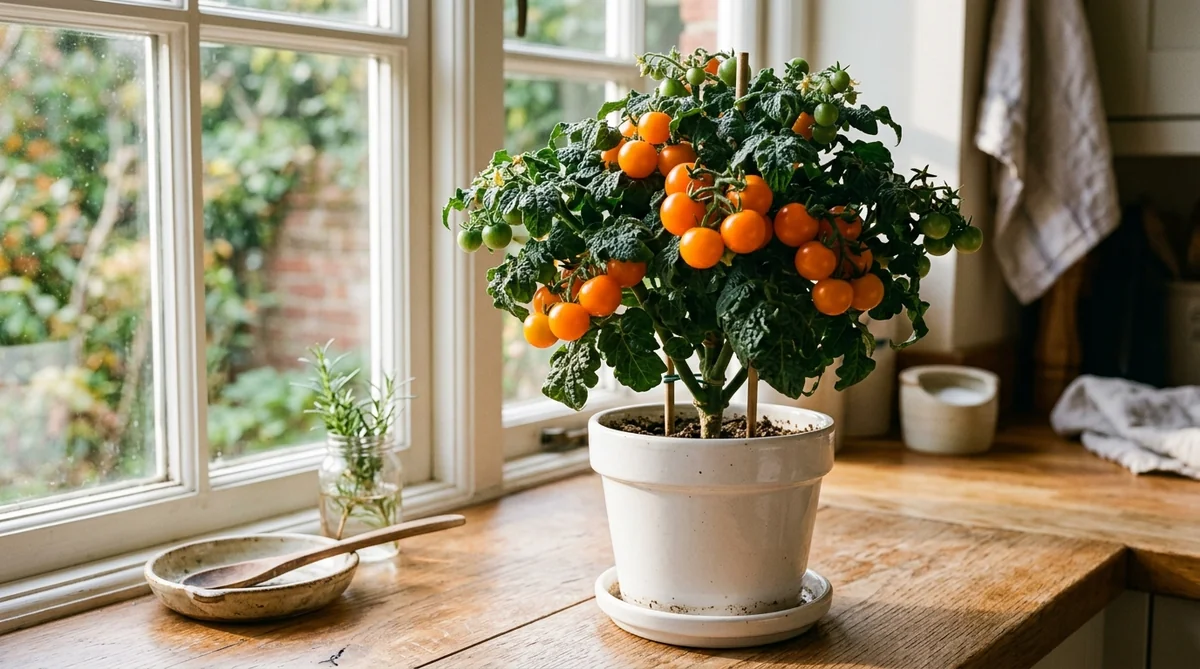
The orange hat tomato is a determinate micro-dwarf cultivar belonging to the nightshade family, Solanum lycopersicum. Believed to carry Russian breeding origins, this cultivar was selected over generations to compress the expansive growth habit of indeterminate cherry tomatoes into a dense, tabletop-friendly silhouette.
While standard cherry tomato vines sprawl six to ten feet and require heavy trellising, the Orange Hat tops out at a modest 6 to 9 inches tall, rarely exceeding 12 inches under any condition. Its architecture features thick, stocky main stems supporting dark green rugose foliage—crinkled, thick leaves that resist mechanical damage and maximize light absorption in tight canopies.
Understanding its genetic designation is critical for home growers:
- F1 Hybrid Classification: Orange Hat is commercially distributed primarily as an F1 hybrid. Seeds saved from your harvest will segregate genetically in future generations and will not grow true to type.
- Determinate Flowering Cycle: The plant produces terminal flower buds once reaching its mature height, setting its primary crop over a synchronized 3-to-4-week window.
- Rapid Fruit Maturation: Cymes yield 15 to 30 round, vibrant orange cherry tomatoes per plant, ripening within 55 to 65 days from transplant.
- Flavor Balance: Fruit exhibits mild acidity and pleasant sweetness with a firm, tender skin, perfect for fresh tabletop snacking.
Because of its diminutive stature, the orange hat tomato has rapidly emerged as one of the most reliable cultivars for growing tomatoes indoors and desktop micro-gardening. To expand your indoor fruiting garden with sweet perennial berries, explore our complete grower guides on growing strawberries indoors and closed-loop hydroponic strawberries.
Indoor vs. Outdoor Growing: Microclimate Dynamics
Does the orange hat tomato behave differently indoors versus outside? Most generic gardening guides overlook this nuance, yet microclimate placement is where Orange Hat diverges sharply from standard dwarf tomatoes.
Outdoors, Orange Hat can be grown in small patio pots, but it demands careful shade management. Unlike robust outdoor beefsteak varieties that crave all-day baking sun, Orange Hat foliage is susceptible to thermal shock and physiological leaf roll when ambient temperatures exceed 85°F (29°C) under intense midday sun. Providing filtered morning light and afternoon shade outdoors prevents canopy scorch.
Indoors, this variety truly shines. Placed near an unshaded south-facing window or beneath an LED grow light fixture in a room maintained between 72°F and 78°F, the plant experiences ideal vegetative development without weather-induced moisture stress.
Container Sizing, Root Physics & Ideal Soil Formulations
Selecting the proper container is the foundational step in raising a healthy orange hat tomato. Because micro-dwarf tomatoes maintain compact fibrous root architectures, they do not require deep ten-gallon pots.
A 6-inch diameter container (approximately 0.5 to 0.75 gallons) represents the functional minimum for fruiting. However, an 8-inch pot or a 1-gallon fabric pot delivers substantial horticultural advantages. Larger soil volumes provide greater moisture buffering, preventing the sudden root dehydration that triggers blossom end rot on sunny afternoons.
Horticultural Substrate Recipe for Micro-Dwarfs
Blend a lightweight, high-porosity potting medium that maintains rapid drainage while retaining sufficient cation-exchange nutrients:
- 50% Premium Sphagnum Peat Moss or Buffered Coco Coir: Provides base water retention and root anchorage.
- 30% Coarse Horticultural Perlite: Ensures continuous macropore aeration to prevent root hypoxia.
- 20% Screened Worm Castings or Aged Organic Compost: Supplies beneficial biological microbes and gentle trace minerals.
- 1 Tbsp Dolomitic Garden Lime per Gallon: Buffers peat acidity to pH 6.0–6.5 while providing essential slow-release calcium and magnesium.
Seed Starting, Germination Biology & Thinning Protocol
Starting the orange hat tomato from seed requires an understanding of micro-dwarf germination biology. Seeds should be sown approximately 1/8 inch deep in pre-moistened, sterile seed starting mix.
Maintaining a root-zone substrate temperature of 75°F to 80°F (24°C to 27°C) using a seedling heat mat accelerates enzymatic activation, driving emergence within 4 to 7 days. At cooler room temperatures (65°F), germination can lag by up to 14 days.
Grower data clusters around a 70 percent germination rate for Orange Hat seed lots. Because micro-dwarf seed lines experience moderate viability variation, planting two seeds per cell or pod is an essential best practice rather than an optional precaution.
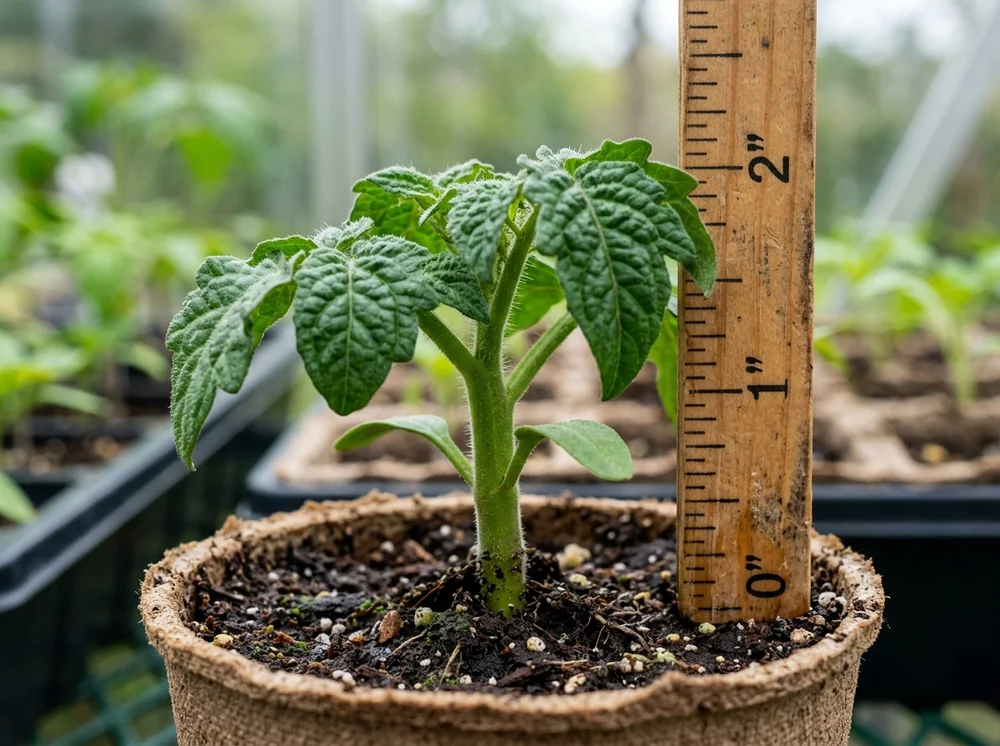
Once both seedlings emerge and develop their first pair of true leaves (around Day 10 to 14), inspect their vigor. Using sterilized micro-tip snips, clip the weaker seedling at the soil line. Never pull the rejected seedling by hand, as disturbing fragile root hairs can stun the remaining plant’s early growth momentum.
Hydroponic Cultivation: AeroGarden Pods & Kratky Systems
The orange hat tomato is arguably the premier tomato variety in existence for countertop hydroponics. While standard determinate tomatoes outgrow compact desktop units within four weeks, Orange Hat remains comfortably beneath 12-inch light hoods for its entire life cycle.
In pod-based systems like the AeroGarden or Click & Grow, insert one primed seed sponge per pod. Because tomato root systems expand aggressively, leave adjacent pods empty or plant low-profile culinary herbs to prevent root entanglement inside the water basin.
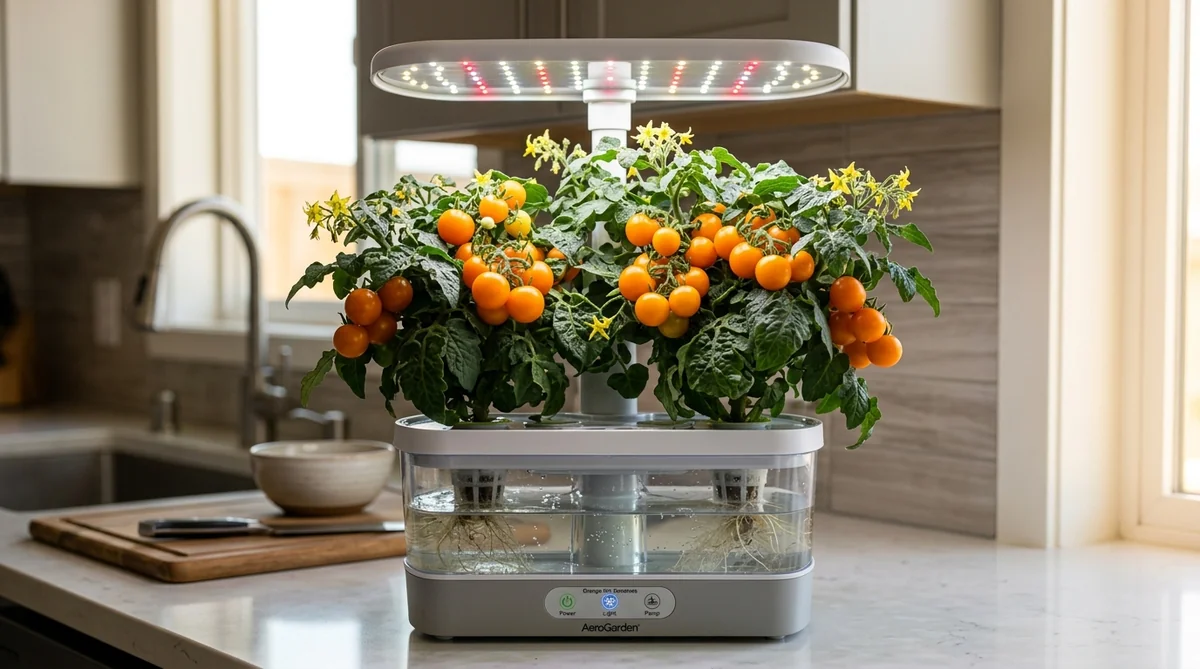
For passive growers utilizing the non-circulating Kratky hydroponic method, Orange Hat performs exceptionally well in a wide-mouth 64-ounce (half-gallon) glass mason jar fitted with a 3-inch net cup and LECA pebbles. Maintain the nutrient parameters outlined below:
- Electrical Conductivity (EC): Maintain 1.2 to 1.5 mS/cm during vegetative growth, elevating to 1.8 to 2.2 mS/cm once flower clusters appear to support osmotic pressure for sugar loading.
- Solution pH: Maintain between 5.8 and 6.3 to ensure full bioavailability of iron, phosphorus, and calcium.
- Nutrient Formulation: Use a specialized tomato formula (such as MasterBlend 4-18-38 plus Calcium Nitrate and Epsom Salt) to prevent nitrogen toxicity while providing robust potassium levels.
Indoor Lighting Dynamics: PPFD, DLI & Spectrum Requirements
Light intensity is the single greatest determinant of whether your orange hat tomato stays compact and productive or stretches into a leggy, barren stem.
Micro-dwarf tomatoes require a Daily Light Integral (DLI) of 14 to 18 mol/m²/day for continuous flower induction and fruit ripening. On a residential windowsill, natural sunlight must be unobstructed and south-facing, providing at least 6 to 8 hours of direct exposure.
When supplementing with LED grow lights, target a Photosynthetic Photon Flux Density (PPFD) of 250 to 350 µmol/m²/s across an 14-to-16-hour daily photoperiod. Keep modern broad-spectrum white-and-red LED panels positioned 6 to 10 inches above the top foliage canopy to deliver intense energy without thermal scorching.
Buzz Pollination: The Secret to Heavy Tabletop Fruit Set
Tomato blossoms are self-fertile, containing both male anthers and female stigmas within the same flower. However, tomato anthers are poricidal—they hold pollen tightly enclosed inside microscopic tubular pores that require vibration to release.
In outdoor garden beds, wind currents and the resonant flight frequencies of foraging bumblebees (approximately 200 to 400 Hz) trigger this release effortlessly. Indoors, where stagnant air and absence of pollinators prevail, unvibrated blossoms will dry up, turn brown, and drop from the plant without setting fruit.
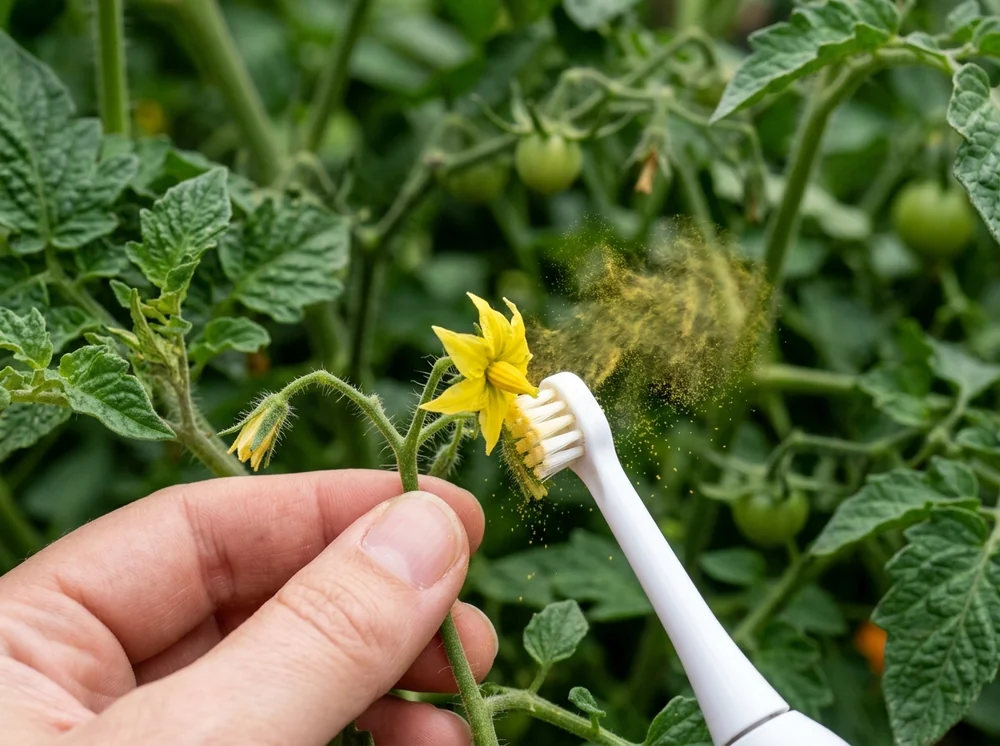
To achieve 100 percent fruit set indoors on your orange hat tomato, execute mechanical buzz pollination using these clinical steps:
- Optimal Timing Window: Pollinate between 10:00 AM and 2:00 PM, when relative humidity is moderate and pollen grains are dry and shed easily.
- Mechanical Vibration Technique: Touch the back of an electric toothbrush or a battery-operated sonic pollinator to the flowering stem directly behind the open yellow blossom.
- Visual Confirmation: A three-second vibration will dislodge a miniature cloud of golden pollen dust onto the central stigma, guaranteeing fruit development.
The 70-Day Lifecycle & Developmental Milestones
Tracking the growth timeline of the orange hat tomato enables growers to anticipate nutritional shifts and environmental adjustments as the plant transitions from vegetative mass into heavy fruiting.
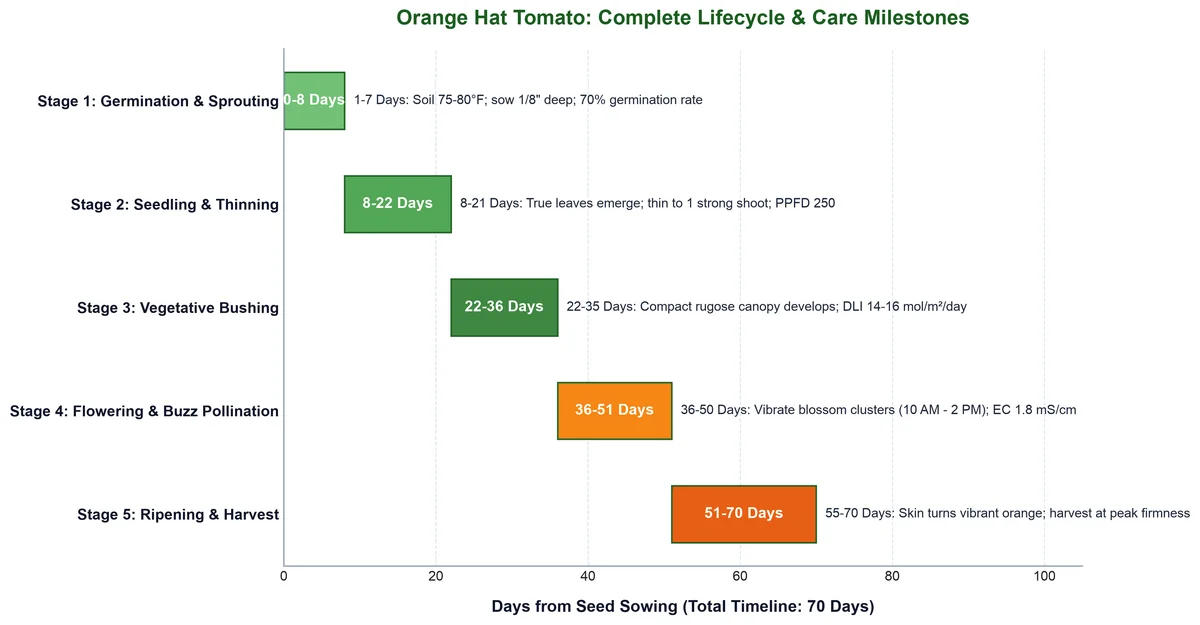
From initial seed germination on a heat mat to the final bowl of sweet, golden cherry tomatoes, each phase features precise environmental targets:
- Days 1–7 (Germination): Maintain 75°F to 80°F with high humidity under a humidity dome until radical emergence.
- Days 8–21 (Seedling Establishment): Introduce PPFD 250 µmol/m²/s light; thin cells to single robust seedling; begin quarter-strength nutrition.
- Days 22–35 (Vegetative Bushing): Transplant into permanent 6-inch or 1-gallon container; provide DLI of 14–16 mol/m²/day; bottom-water consistently.
- Days 36–50 (Flowering & Fruit Set): Yellow flower clusters open; perform daily buzz pollination; shift nutrient ratio toward potassium.
- Days 51–70 (Color Break & Harvest): Green marble-sized fruit transitions to brilliant glowing orange; harvest when fruit gives gently to thumb pressure.
Micro-Dwarf Cultivar Benchmark: Orange Hat vs. Competitors
While the orange hat tomato is a standout micro-dwarf, evaluating it alongside other leading compact cultivars highlights its unique balance of height, timing, and flavor.
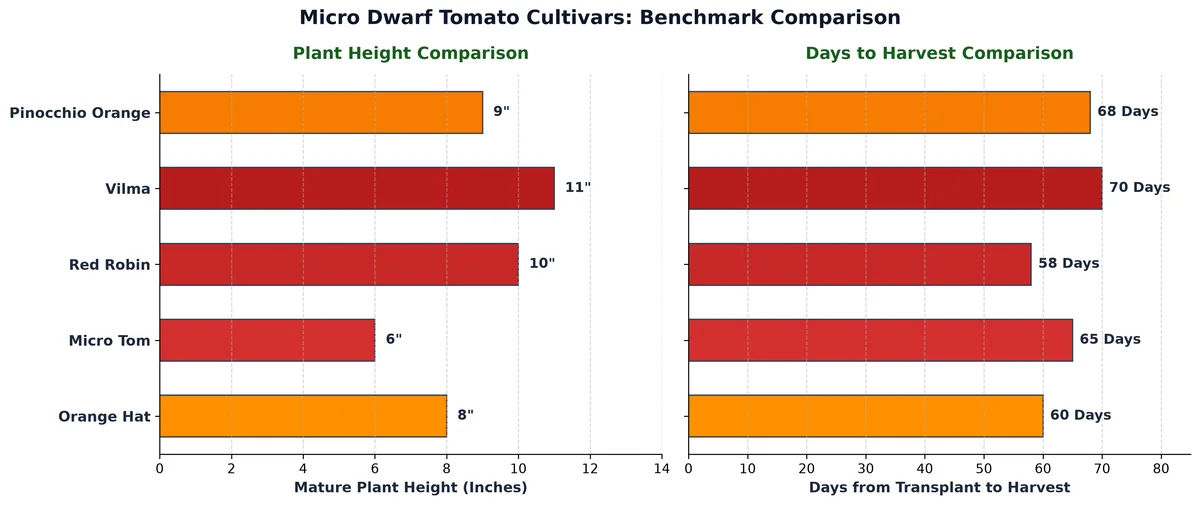
| Cultivar | Mature Height | Days to Harvest | Fruit Profile | Flavor Character | Primary Best Use |
|---|---|---|---|---|---|
| Orange Hat | 6–9 Inches | 55–65 Days | Bright Orange Cherry | Sweet, Mild Acidity | Windowsills & AeroGardens |
| Micro Tom | 5–8 Inches | 65–70 Days | Small Deep Red | Acidic, Tart, Thick Skin | Ornamental Desk Display |
| Red Robin | 8–12 Inches | 55–60 Days | Classic Red Cherry | Very Sweet, Classic Tomato | Patio Pots & Balconies |
| Vilma | 10–12 Inches | 68–75 Days | Plump Red Cherry | Rich, Tangy, Firm | Small Container Gardens |
| Pinocchio Orange | 8–10 Inches | 65–70 Days | Golden-Orange Cherry | Fruity, Mellow Sweet | Indoor Grow Tents |
Troubleshooting Common Problems: Heat Stress, Leaf Curl & BER
While the orange hat tomato is a hardy and genetically stable micro-dwarf, indoor and container conditions occasionally provoke specific physiological stresses.
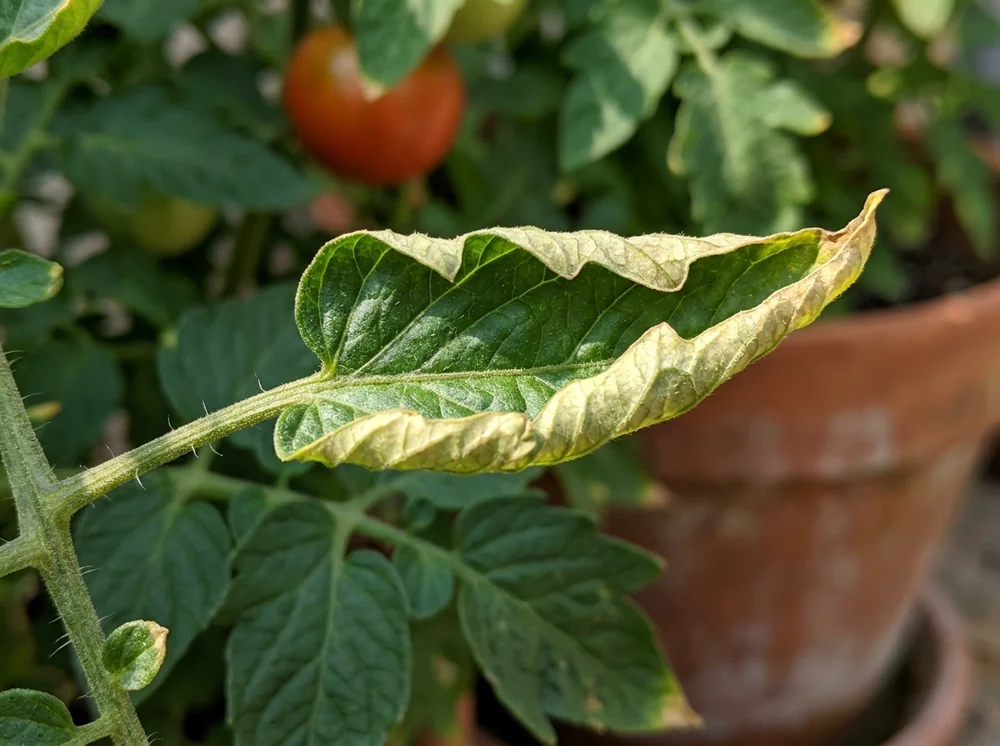
Understanding the root cause of these symptoms prevents misdiagnosing environmental stress as infectious disease:
- Upward Leaf Curl & Cupping: Almost always an environmental reaction to elevated temperatures (>85°F) combined with direct sun or hot grow lights. The plant curls its leaf margins inward to reduce transpirational water loss. Move the container slightly away from glass or increase room ventilation.
- Stem Legginess & Weak Internodes: Caused by inadequate light intensity (PPFD < 200 µmol/m²/s). The plant expends energy stretching upward toward the light source instead of developing stocky lateral branching. Lower your grow light fixture or upgrade to a higher-output LED panel.
- Blossom Drop Without Fruit Set: Caused either by excessive nitrogen fertilizer inhibiting reproductive development, high ambient heat (>90°F) sterilizing pollen, or failure to mechanically vibrate the flowers indoors.
- Blossom End Rot (Dark Sunken Spots on Fruit): Triggered by localized calcium deficiency caused by irregular watering cycles rather than a lack of soil calcium. Consistent moisture delivery ensures steady calcium transport via the xylem.
Harvesting, Flavor Evaluation & Seed Saving Realities
Harvesting the orange hat tomato at optimal maturity is essential for experiencing its intended flavor balance. As fruit ripens around Day 60, green pigments give way to a soft yellow-orange that deepens into a mirror-glossy, rich orange hue.
Pick individual tomatoes by gently twisting the fruit upward from the calyx stem or snipping the stem with clean scissors. Ripe fruit yields slightly to a soft thumb squeeze. If left on the bush past peak ripeness, the skin can soften and the pulp may lose its crisp snap.
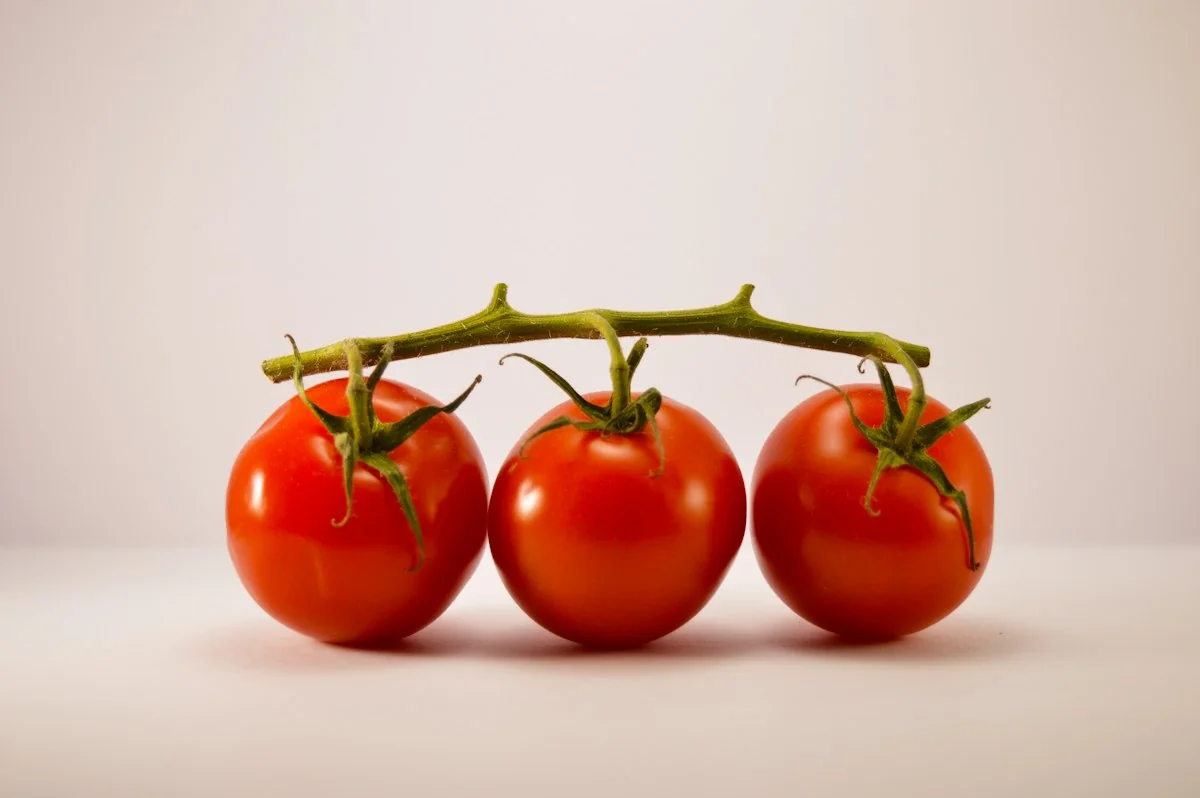
In the kitchen, Orange Hat tomatoes provide an appealing visual contrast in fresh salads, grazing platters, and micro-caprese bites alongside fresh mozzarella and garden basil. Because the skin is naturally tender and thin, peeling is completely unnecessary.
Regarding seed saving: because commercial Orange Hat seed lines are F1 hybrids, saving seeds from your homegrown fruit will yield unpredictable plants in subsequent generations. For dependable, identical 8-inch plants loaded with orange cherry tomatoes, always acquire fresh certified seed stock each growing season.
Frequently Asked Questions: 25 Common Queries Answered
01
Can Orange Hat tomatoes grow indoors year-round?
Can Orange Hat tomatoes grow indoors year-round?
Yes. When provided with adequate lighting (14 to 16 hours of broad-spectrum LED grow light) and stable room temperatures between 70°F and 78°F, Orange Hat plants fruit year-round indoors without requiring seasonal outdoor cycles.
02
Is the Orange Hat tomato an heirloom or a hybrid?
Is the Orange Hat tomato an heirloom or a hybrid?
Orange Hat is commercially distributed as an F1 hybrid micro-dwarf cultivar. Seeds harvested from its fruit will not reliably reproduce identical plants in subsequent generations, so buying fresh certified seed delivers the most consistent results.
03
What size container is best for an Orange Hat tomato?
What size container is best for an Orange Hat tomato?
A 6-inch diameter container (0.5 to 0.75 gallons) is the minimum functional volume. An 8-inch pot or a 1-gallon fabric container provides greater moisture buffering and reduces watering frequency during heavy fruit set.
04
Can I grow Orange Hat tomatoes in an AeroGarden or countertop hydroponic unit?
Can I grow Orange Hat tomatoes in an AeroGarden or countertop hydroponic unit?
Yes, absolutely. Because the plant tops out at 6 to 9 inches tall, it fits comfortably under compact desktop grow hoods where standard full-sized tomato varieties quickly overgrow and scorch.
05
Do Orange Hat tomato plants need staking or pruning?
Do Orange Hat tomato plants need staking or pruning?
No pruning or staking is necessary. As a determinate micro-dwarf, Orange Hat naturally stops vertical growth and develops a strong, woody central stem that self-supports heavy clusters of fruit without falling over.
06
Why are my Orange Hat tomato leaves curling upward?
Why are my Orange Hat tomato leaves curling upward?
Upward leaf curl on this variety is a physiological defense mechanism triggered by high temperatures (>85°F) or excessive direct midday sunlight. Move the plant away from hot window glass or increase room airflow to resolve the cupping.
07
How do you hand-pollinate Orange Hat tomatoes indoors?
How do you hand-pollinate Orange Hat tomatoes indoors?
Gently touch the back of an electric toothbrush or vibrating tuning fork to the flowering cluster stem for 3 seconds between 10 AM and 2 PM. The high-frequency vibration releases trapped pollen from the tubular anthers onto the stigma.
08
How many tomatoes does a single Orange Hat plant produce?
How many tomatoes does a single Orange Hat plant produce?
Under optimal lighting and consistent nutrition, a healthy plant yields between 20 and 40 bright orange cherry tomatoes across its primary fruiting flush.
09
What does an Orange Hat tomato taste like?
What does an Orange Hat tomato taste like?
The fruit delivers a mild, pleasant sweetness balanced by subtle acidity and juicy pulp. Unlike some micro-dwarfs that have thick, leathery skins, Orange Hat features tender skin and a clean, refreshing tomato flavor.
10
How long does it take from seed to harvest?
How long does it take from seed to harvest?
Plants reach harvest maturity approximately 55 to 65 days after transplanting, or roughly 70 to 80 days directly from seed sowing under warm indoor lighting conditions.
11
Why is my Orange Hat tomato plant getting leggy?
Why is my Orange Hat tomato plant getting leggy?
Legginess indicates low light intensity (PPFD below 200 µmol/m²/s). Lower your artificial grow light closer to the foliage canopy or move the container to an unobstructed southern windowsill to encourage compact branching.
12
What is the best fertilizer for Orange Hat tomatoes in soil?
What is the best fertilizer for Orange Hat tomatoes in soil?
Use a balanced organic liquid tomato fertilizer with an N-P-K ratio around 4-6-6 or 3-5-7. Avoid high-nitrogen formulas, which promote excessive leaf growth at the expense of blossom and fruit development.
13
What is the ideal electrical conductivity (EC) in hydroponics?
What is the ideal electrical conductivity (EC) in hydroponics?
Maintain an EC of 1.2 to 1.5 mS/cm during the vegetative stage, increasing to 1.8 to 2.2 mS/cm once flower clusters appear to provide the potassium and calcium needed for fruit filling.
14
Can you grow Orange Hat tomatoes outdoors in garden beds?
Can you grow Orange Hat tomatoes outdoors in garden beds?
While possible, outdoor in-ground beds are not recommended. Orange Hat is so short (6 to 9 inches) that garden weeds, soil splashes, and heavy rain easily overwhelm the plant. Dedicated patio pots or raised planters are vastly superior.
15
Why are my flowers falling off without making tomatoes?
Why are my flowers falling off without making tomatoes?
Blossom drop occurs when flowers fail to receive mechanical vibration indoors, when daytime temperatures exceed 90°F (sterilizing pollen), or when root zones experience dry spells during bloom. Daily buzz pollination easily remedies this.
16
How often should I water an Orange Hat tomato in a pot?
How often should I water an Orange Hat tomato in a pot?
Water whenever the top 0.5 inch of potting mix feels dry to the touch. In a 6-inch pot during full fruit load, the plant typically requires thorough watering every 2 to 3 days depending on room humidity and temperature.
17
What causes black sunken spots on the bottom of the fruit?
What causes black sunken spots on the bottom of the fruit?
This is Blossom End Rot (BER), caused by inconsistent moisture levels that restrict calcium uptake during rapid fruit expansion. Keep soil moisture steady and incorporate agricultural lime into your potting mix before planting.
18
How does Orange Hat compare to the Micro Tom cultivar?
How does Orange Hat compare to the Micro Tom cultivar?
Micro Tom produces red fruit on a slightly smaller plant (5–8 inches) but is widely regarded as having an inferior, acidic, tart flavor with tough skin. Orange Hat produces sweeter, much more palatable orange fruit with thinner skin.
19
Can you take cuttings to propagate Orange Hat tomatoes?
Can you take cuttings to propagate Orange Hat tomatoes?
Propagating through stem cuttings is difficult and generally unproductive. Because Orange Hat is a determinate micro-dwarf, side suckers are practically nonexistent and stem tissue is genetically programmed to flower rather than root vegetatively.
20
What Daily Light Integral (DLI) is needed for fruit production?
What Daily Light Integral (DLI) is needed for fruit production?
A DLI of 14 to 18 mol/m²/day ensures robust photosynthesis and consistent fruit ripening. This can be met with 14 hours under a 300 µmol/m²/s LED grow light panel.
21
Are Orange Hat tomato leaves rugose?
Are Orange Hat tomato leaves rugose?
Yes. The foliage is distinctly rugose—thick, puckered, crinkly, and dark forest green. This characteristic genetic feature allows the plant to pack dense chlorophyll into a tightly compressed canopy.
22
How do you know when an Orange Hat tomato is fully ripe?
How do you know when an Orange Hat tomato is fully ripe?
The skin transitions from light yellow to an even, glossy, rich golden-orange. Ripe fruit yields slightly to gentle thumb pressure and separates cleanly from the stem with a soft upward twist.
23
Does bottom watering really prevent indoor plant pests?
Does bottom watering really prevent indoor plant pests?
Yes. Bottom watering keeps the top half-inch of potting mix dry while delivering moisture directly to deep roots. This completely deprives fungus gnats of the moist surface peat needed for egg-laying and larval feeding.
24
Can you grow multiple Orange Hat plants in one container?
Can you grow multiple Orange Hat plants in one container?
Yes, in a long windowsill planter box (such as a 24-inch trough) or a wide 3-gallon shallow bowl, you can plant 2 to 3 Orange Hat plants spaced 8 inches apart for a stunning tabletop harvest hedge.
25
Will the plant continue producing fruit after the first harvest?
Will the plant continue producing fruit after the first harvest?
As a determinate variety, its main harvest flush matures together over 3 to 4 weeks. With continued fertilization, plants often produce a smaller secondary flush of blossoms, but most indoor growers sow succession batches every 60 days for nonstop fresh picking.
The Bottom Line: Is Orange Hat Worth Growing?
Is the orange hat tomato worth growing over a standard cherry tomato? For tabletop indoor gardeners, windowsill hobbyists, and hydroponic pod owners, the answer is an unqualified yes.
The plant asks only for modest warmth, bright artificial or natural light, and a daily touch of buzz pollination in exchange for a bounty of golden fruit from an 8-inch bush that comfortably occupies a coffee table.
By providing consistent moisture wicking, avoiding intense midday heat scorch, and monitoring the milestones in your personal grow log, you will enjoy fresh tabletop tomatoes every season of the year.