A Forensic Entomological Guide to Indoor Plant Pests, Household Pest Myths, and Clinical Eradication Protocols.
⚡ Quick Answer
Indoor houseplants do not spontaneously generate bugs; infestations occur exclusively via open windows, contaminated nursery soil, unquarantined outdoor plants, or infested produce. Most common pests (fungus gnats, spider mites, thrips) are easily prevented by using soilless potting media, allowing topsoil to dry between waterings, and using targeted biological BTI drops.
The Biological Reality: Do Indoor Plants Attract Bugs?
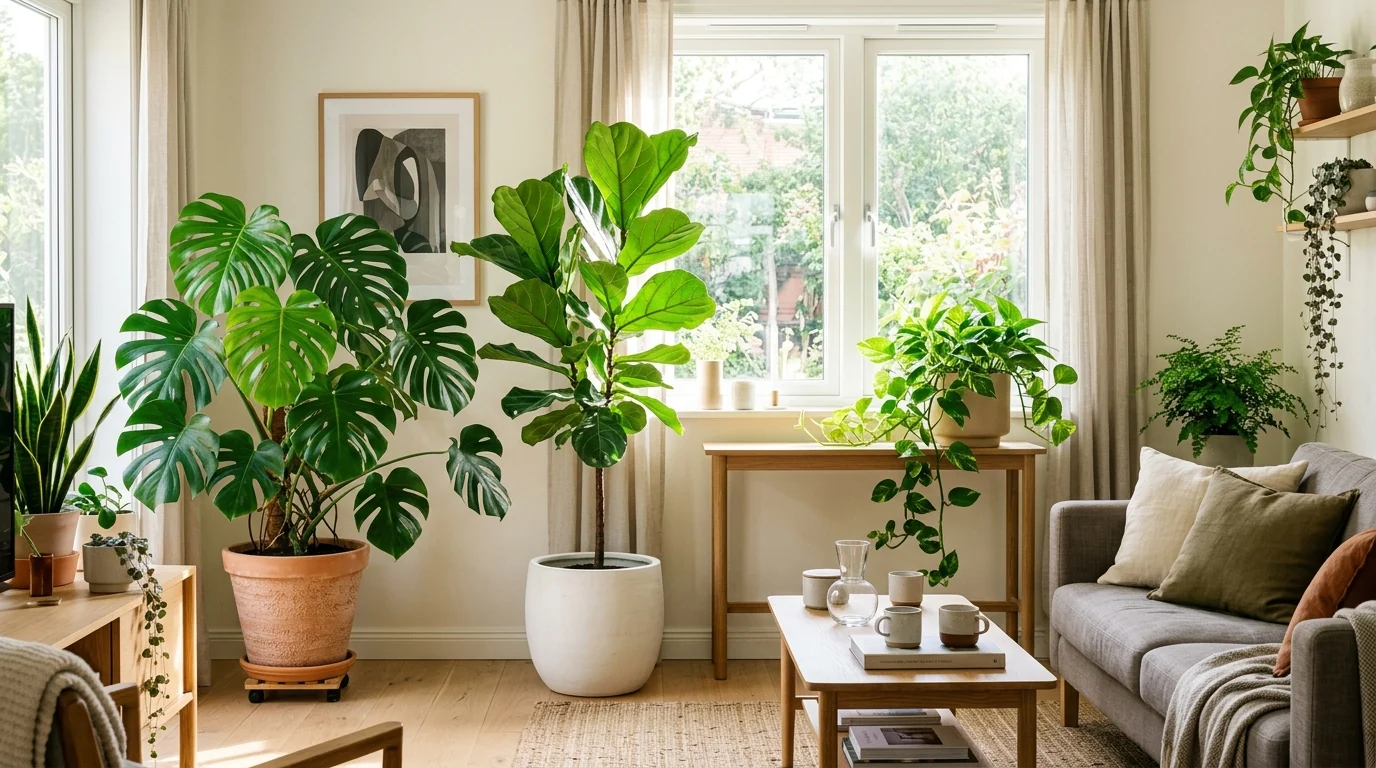
Do indoor plants attract bugs into your home? The short answer is nuanced: indoor plants do not attract bugs out of thin air, nor do they possess magical properties that draw insects from across your neighborhood.
A widespread misconception among new plant collectors is that bringing a potted ficus or monstera into a home will suddenly cause cockroach infestations, spider invasions, or fly swarms. To understand the science of indoor entomology, we must establish a foundational biological distinction between two completely separate insect groups:
- Obligate Plant Organisms: Insects that feed exclusively on living plant vascular fluid (phloem sap), cell contents (mesophyll), or decaying potting soil organic matter. These include fungus gnats, two-spotted spider mites, thrips, mealybugs, aphids, and scale insects. These creatures have zero biological interest in human food, pantry goods, clothing fabrics, or pets.
- Household Structural and Food Pests: Insects that seek lipid-rich human food waste, open grease, stagnant plumbing moisture, or cardboard cellulose. Cockroaches, German roaches, carpenter ants, bed bugs, and fruit flies belong to this category. Houseplants do not generate, attract, or sustain these domestic pests.
Can indoor plant bugs bite humans or domestic pets? Absolutely not. Common houseplant pests lack the piercing mouthparts or digestive enzymes required to penetrate mammalian dermal tissue. Their stylets are physically engineered to pierce microscopic plant cell walls.
The Four Vectors: How Insects Actually Invade Indoor Spaces
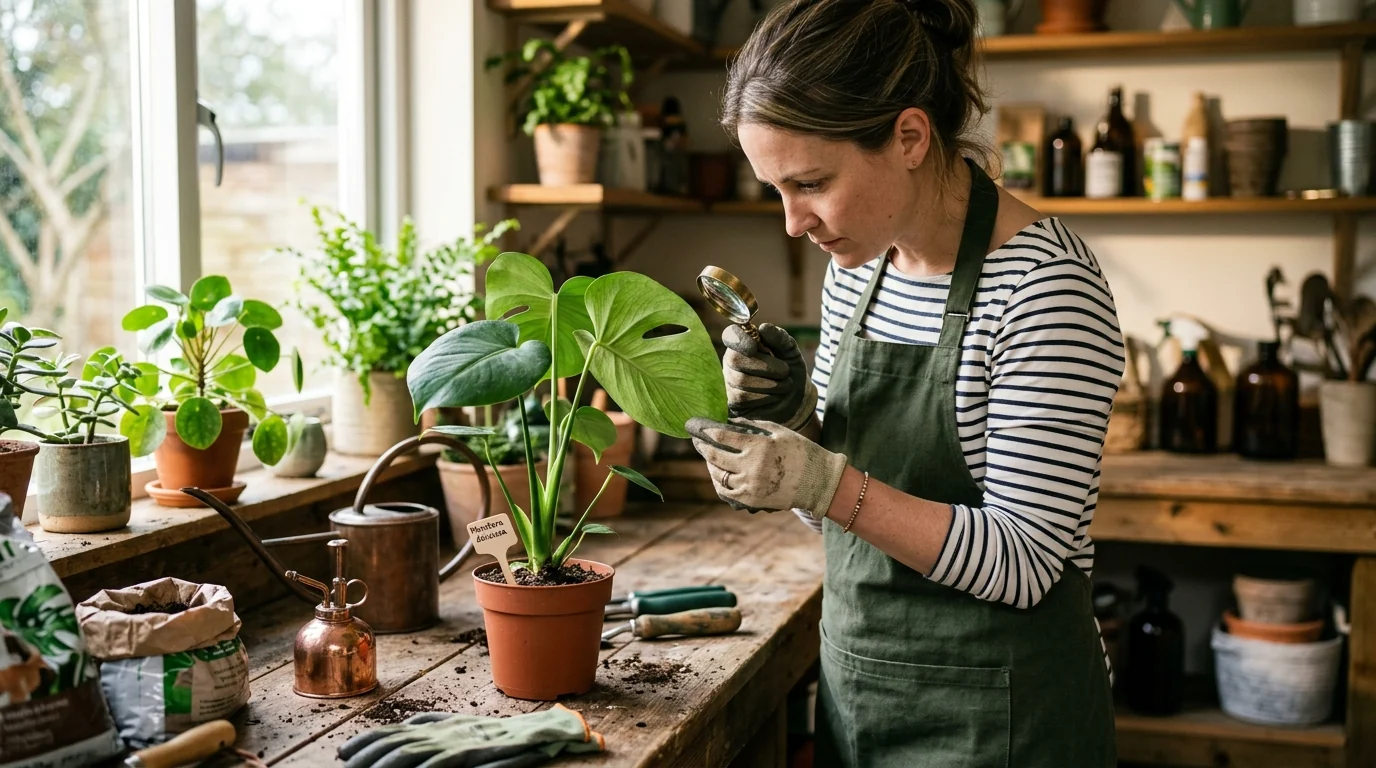
If healthy plants do not spontaneously generate insects, how does an indoor plant collection end up crawling with pests? In commercial horticulture, we track insect dispersal through four definitive vectors:
Vector 1: The Commercial Greenhouse Trojan Horse
The overwhelming majority of houseplant infestations originate directly at commercial nurseries and big-box garden centers. Commercial greenhouses maintain warm temperatures (75°F to 85°F) and 70 to 80 percent relative humidity—ideal reproductive conditions for arthropods.
While commercial growers apply broad-spectrum chemical rotations, sub-lethal applications often leave microscopic eggs or pesticide-resistant juveniles hidden inside petiole axils, unfurling leaves, and soil crevices. When you purchase that lush plant and bring it into your warm, predator-free home, those dormant eggs hatch into an uncontained population boom.
Vector 2: Contaminated Commercial Bagged Potting Mix
Novice growers often assume that buying a sealed bag of commercial indoor potting soil guarantees sterility. In reality, commercial potting mixes contain peat moss, shredded bark, composted forest products, and perlite—all rich in organic carbon.
If soil bags are stored outdoors at garden centers, pallet wrapping punctures allow female fungus gnats (*Bradysia*) to slip inside and lay hundreds of eggs in the damp medium. When you open that brand-new bag at home and repot your plants, you unknowingly inoculate your living room with dormant larvae.
Vector 3: The Autumn Patio Migration
Gardeners love giving their houseplants a summer vacation outdoors on patios, balconies, and shaded decks. Outdoor exposure stimulates vigorous growth thanks to natural sunlight and gentle breezes.
However, when autumn temperatures dip below 55°F (13°C) and you bring those containers back indoors, you import hitchhiking spider mites, scale crawlers, and thrips. Worse, you leave behind outdoor beneficial predators (ladybugs, hoverflies, lacewings, and predatory mites) that previously kept pest populations in check.
Vector 4: Window Screens, Exterior Doors, and Fresh Grocery Produce
Tiny pests like western flower thrips and two-spotted spider mites measure between 0.5 and 1.5 millimeters in length. Standard residential window screens feature a 16×18 mesh weave, which easily allows micro-pests to slip through on windy summer afternoons.
Additionally, store-bought grocery produce—such as fresh organic celery, strawberries, head lettuce, and fresh-cut floral bouquets—routinely carries live aphids and thrips directly onto your kitchen countertops.
The Chemical Ecology of Pest Attraction: Stressed Plants vs. Resistant Plants
Insects do not attack all plants equally. In botanical ecology, plants communicate through volatile organic compounds (VOCs) and secondary metabolites. A robust, thriving plant with strong cellular turgor actively defends itself through thick waxy cuticles, structural silica deposits, and toxic defensive compounds like alkaloids and phytoalexins.
When an indoor plant suffers from environmental stress (such as chronic overwatering, root suffocation, light starvation, or excessive synthetic nitrogen fertilizer), its cellular metabolism alters dramatically:
- Free Amino Acid Accumulation: When a plant is placed in low light or given too much water, it cannot synthesize complex proteins efficiently. Instead, unassimilated free amino acids and simple reducing sugars accumulate in the vascular phloem sap. This nutrient-dense sap acts as a chemical magnet for sap-sucking pests like aphids, mealybugs, and spider mites, accelerating their reproductive rates.
- Thin Epidermal Cell Walls: Under-lit houseplants produce thin, etiolated cell walls lacking structural lignin. Sap-feeding insects equipped with piercing-sucking stylets can puncture these weakened leaves with minimal physical resistance.
- Anoxic Root Zone Decay: Overwatered soil rapidly turns anaerobic. Lack of oxygen causes tender root hairs to die and decompose, releasing sweet-smelling decay gasses that signal adult female fungus gnats from across the room to lay eggs.
The Rogues’ Gallery: Definitive Indoor Pest Identification Profiles
Accurate identification is the foundation of successful integrated pest management. Misdiagnosing a pest leads to wasted time and ineffective treatments. Use these clinical profiles to identify indoor pests with forensic precision:
1. Fungus Gnats (Bradysia spp.)
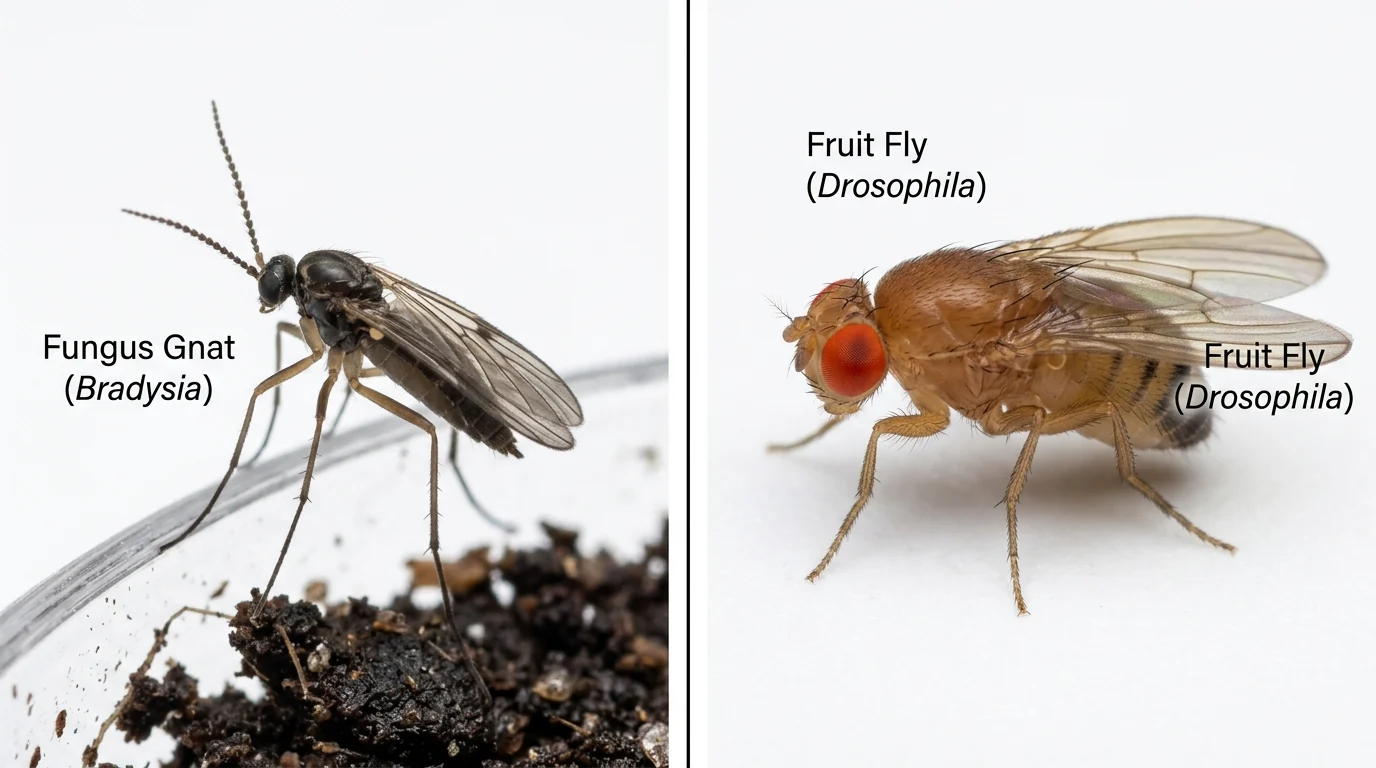
- Morphology: Small, slender, mosquito-like flies measuring 1.5 to 3 millimeters with long legs and distinct Y-shaped wing vein patterns. Weak, erratic flyers that hover near the soil surface or walk across pot rims.
- Larval Stage: Translucent, worm-like larvae measuring up to 5 millimeters with shiny black head capsules. They inhabit the top 1 to 2 inches of moist soil, feeding on fungal hyphae and decaying organic matter. In severe infestations, larvae strip delicate root hairs, stunting growth and causing lower foliage to yellow.
- Critical Diagnostic Difference: Homeowners routinely confuse fungus gnats with fruit flies (*Drosophila melanogaster*) and drain flies (*Psychodidae*). Fruit flies have stout tan bodies and prominent red eyes, gathering near fermenting fruit. Drain flies possess fuzzy moth-like rounded wings and breed inside plumbing pipe slime. Fungus gnats breed strictly in damp plant soil.
2. Two-Spotted Spider Mites (Tetranychus urticae)
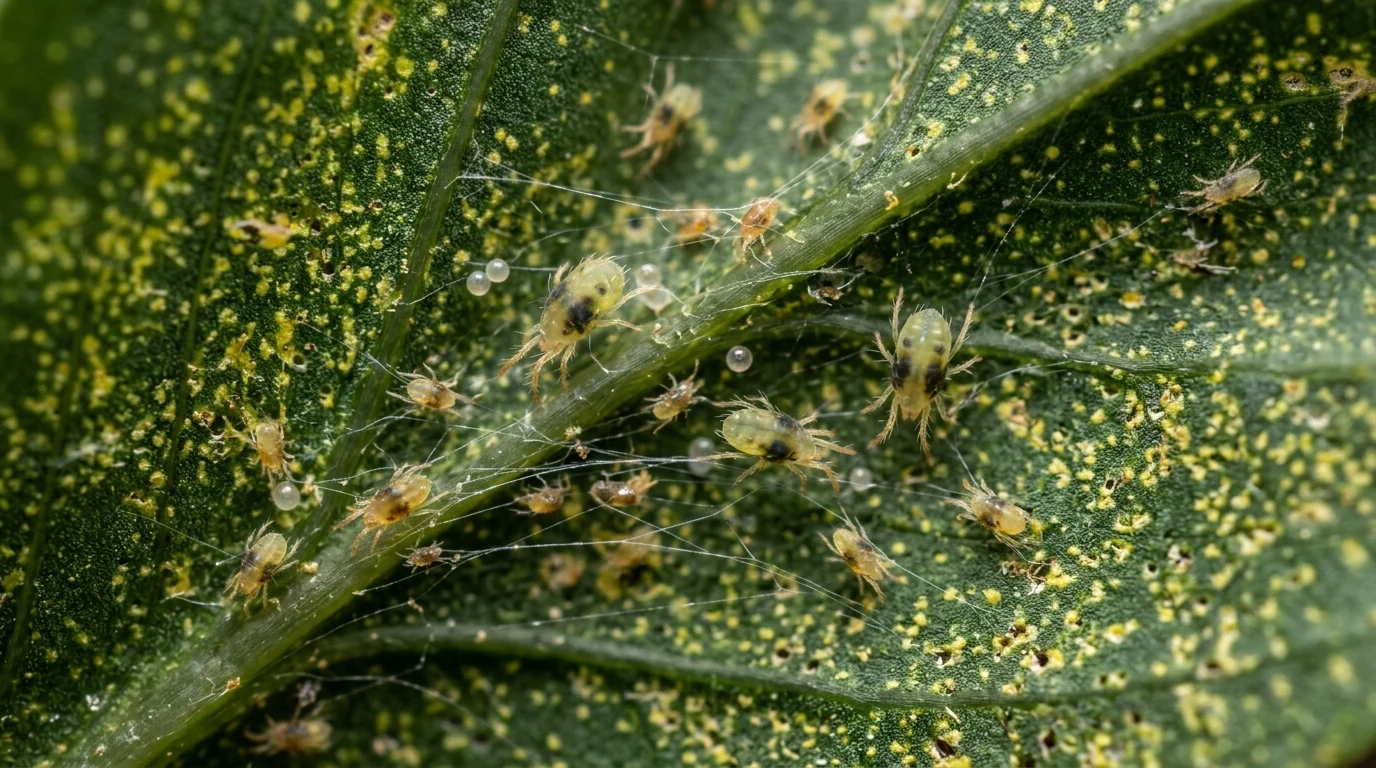
- Morphology: Microscopic arachnids measuring 0.4 to 0.5 millimeters, ranging from pale yellow to greenish-amber with two dark lateral patches on their bodies. In late autumn, overwintering females turn reddish-orange.
- Damage Signs: The first visible sign is chlorotic micro-stippling (fine yellow or silver pinprick dots on the leaf surface). As colonies explode, fine silken webbing drapes across leaf axils, petiole joints, and growing tips. In dry indoor air (below 40% relative humidity), a single female produces 20 eggs per day, resulting in complete leaf desiccation within 14 days.
3. Thrips (Western Flower Thrips & Greenhouse Thrips)
- Morphology: Slender, cigar-shaped insects measuring 1 to 1.5 millimeters. Adults are dark brown or black with fringed hair-like wings; nymphs are translucent creamy-yellow and crawl rapidly across leaf undersides.
- Damage Signs: Thrips possess asymmetrical raspy mouthparts. They scrape open individual epidermal cells and suck out the chlorophyll, creating characteristic silvery-grey bleached patches speckled with tiny, shiny, tar-black droplets of frass (fecal waste). Emerging new foliage appears twisted, crinkled, and permanently deformed.
4. Citrus Mealybugs (Planococcus citri)
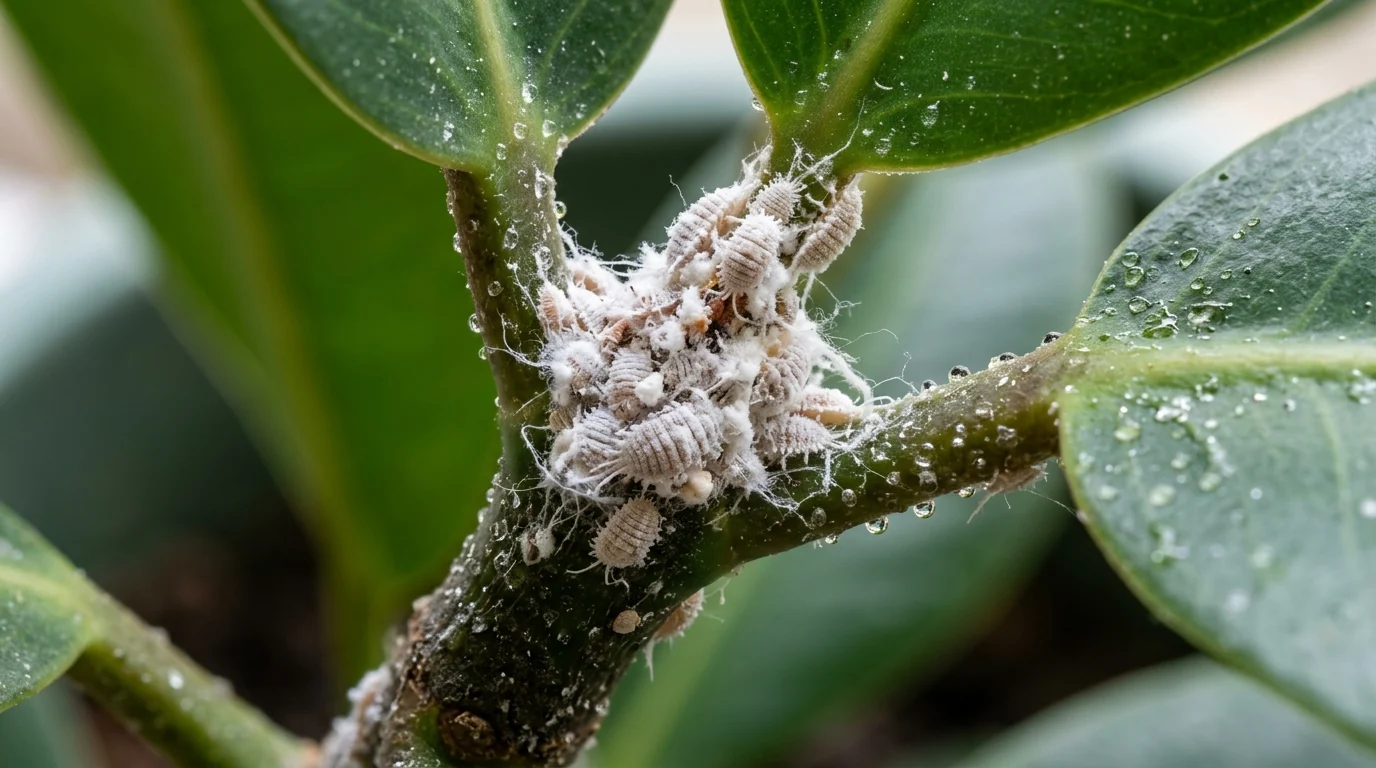
- Morphology: Oval, soft-bodied, segmented scale insects measuring 2 to 4 millimeters, coated in a hydrophobic, powdery white wax. They produce filament fringes along their margins and gather in cottony white masses.
- Damage Signs: Mealybugs feed on phloem sap, excreting copious amounts of clear, sticky liquid known as honeydew. This honeydew coats foliage and flooring, frequently colonizing secondary black sooty mold fungus. Unchecked feeding causes severe leaf chlorosis, premature defoliation, and stem dieback.
5. Soft Brown Scale (Coccus hesperidum) & Armored Scale
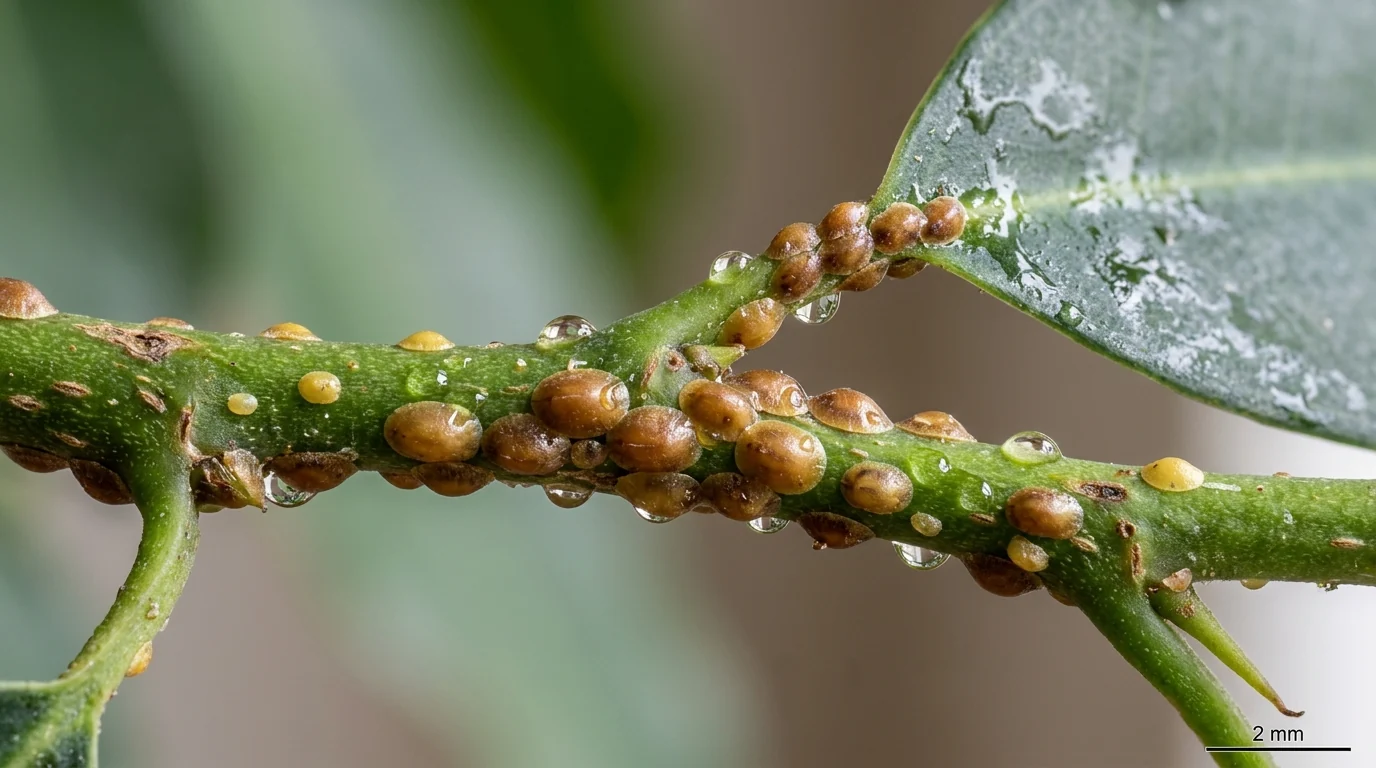
- Morphology: Immobile, oval, waxy or shell-like discs measuring 2 to 5 millimeters, ranging from light yellowish-amber to dark mahogany brown. They cement themselves permanently to woody stems, petiole joints, and along primary leaf veins.
- Damage Signs: Immature nymphs (‘crawlers’) move briefly before settling permanently to secrete a protective waxy armor plate that repels standard contact sprays. Scale siphons massive quantities of sap, causing overall plant chlorosis, branch dieback, and dripping sticky honeydew onto furniture.
6. Aphids (Aphis gossypii & Myzus persicae)
- Morphology: Pear-shaped, soft-bodied insects measuring 1 to 3 millimeters, appearing in green, black, yellow, or pink. Distinguishable by two tubular exhaust pipes (cornicles) protruding from the rear of their abdomen.
- Damage Signs: Aphids reproduce parthenogenetically indoors (females give birth to live female clones without mating). They cluster in dense colonies on tender apical shoots, flower buds, and leaf undersides, draining sap and causing dramatic leaf puckering, stunted shoot growth, and honeydew accumulation.
7. Springtails (Collembola): The Harmless Friend
- Morphology: Minute, wingless hexapods measuring 1 to 2 millimeters, appearing creamy-white, silver, or charcoal grey. They possess a specialized tail-like appendage (furcula) folded under their abdomen that catapults them several inches when disturbed.
- Ecological Function: Springtails are entirely beneficial detritivores. They feed strictly on decaying plant tissue, soil molds, and fungal spores. They possess no chewing mouthparts capable of damaging living plant roots and cause zero harm to humans or homes. Never apply pesticides to eradicate springtails; their presence indicates rich, biologically active organic soil.
Master Pest Diagnostic and Treatment Matrix
Use this comprehensive technical reference matrix to match physical symptoms with targeted botanical controls:
| Pest Common Name | Visual Appearance | Key Diagnostic Symptoms | Favorite Indoor Hosts | Optimal Eradication Method |
|---|---|---|---|---|
| Fungus Gnats (Bradysia spp.) | Slender black flies (2 mm); clear larvae with black heads in topsoil | Flies hovering over soil; larvae chewing root hairs; yellowing lower leaves | Peace Lily, Monstera, Calathea, any overwatered plant | BTI (Mosquito Bits) drench + yellow sticky cards; dry top 2 inches |
| Spider Mites (Tetranychidae) | Microscopic dots (0.4 mm); pale yellow/red with two dark spots | Fine stippling dots; silken webbing across axils; brittle yellow leaves | Alocasia, Calathea, English Ivy, Palm, Croton | Cold water foliage blast + 1% castile neem emulsion + predatory mites |
| Thrips (Thripidae) | Slender needle-like bodies (1.2 mm); black adults, yellow nymphs | Silvery-grey bleached leaf patches with tar-black frass spots; curled leaves | Monstera, Philodendron, Anthurium, Ficus | Spinosad foliar spray + systemic granules (or Amblyseius cucumeris) |
| Mealybugs (Pseudococcidae) | Oval segmented bugs (3 mm) coated in powdery white cotton wax | Sticky honeydew drops; black sooty mold; cottony masses in leaf axils | Pothos, Jade, Hoya, Aglaonema, Orchids | 70% isopropyl alcohol swab + horticultural soap wash; systemic drench |
| Brown Soft Scale (Coccidae) | Immobile waxy brown discs (3-4 mm) fixed to stems and leaf veins | Sticky floors/foliage; stem encrustation; premature leaf drop | Ficus lyrata, Citrus, Schefflera, Ferns | Manual scraping + 1% horticultural mineral oil spray + systemic drench |
| Aphids (Aphidoidea) | Soft pear-shaped green/black bugs (2 mm) with rear cornicles | Clustered on soft apical shoots; puckered, curled new growth; honeydew | Hibiscus, Hoya, Pilea, Herbs (Mint, Basil) | Vigorous tap water rinse + insecticidal soap spray every 5 days |
| Springtails (Collembola) | Tiny white/grey specks (1-2 mm) catapulting when disturbed | Zero plant damage; activity strictly confined to wet soil and drain tray | Any moisture-retentive organic potting mix | Beneficial detritivore: No chemical treatment needed; reduce watering |
The Plant Vulnerability Spectrum: Bug Magnets vs. Pest-Resistant Species
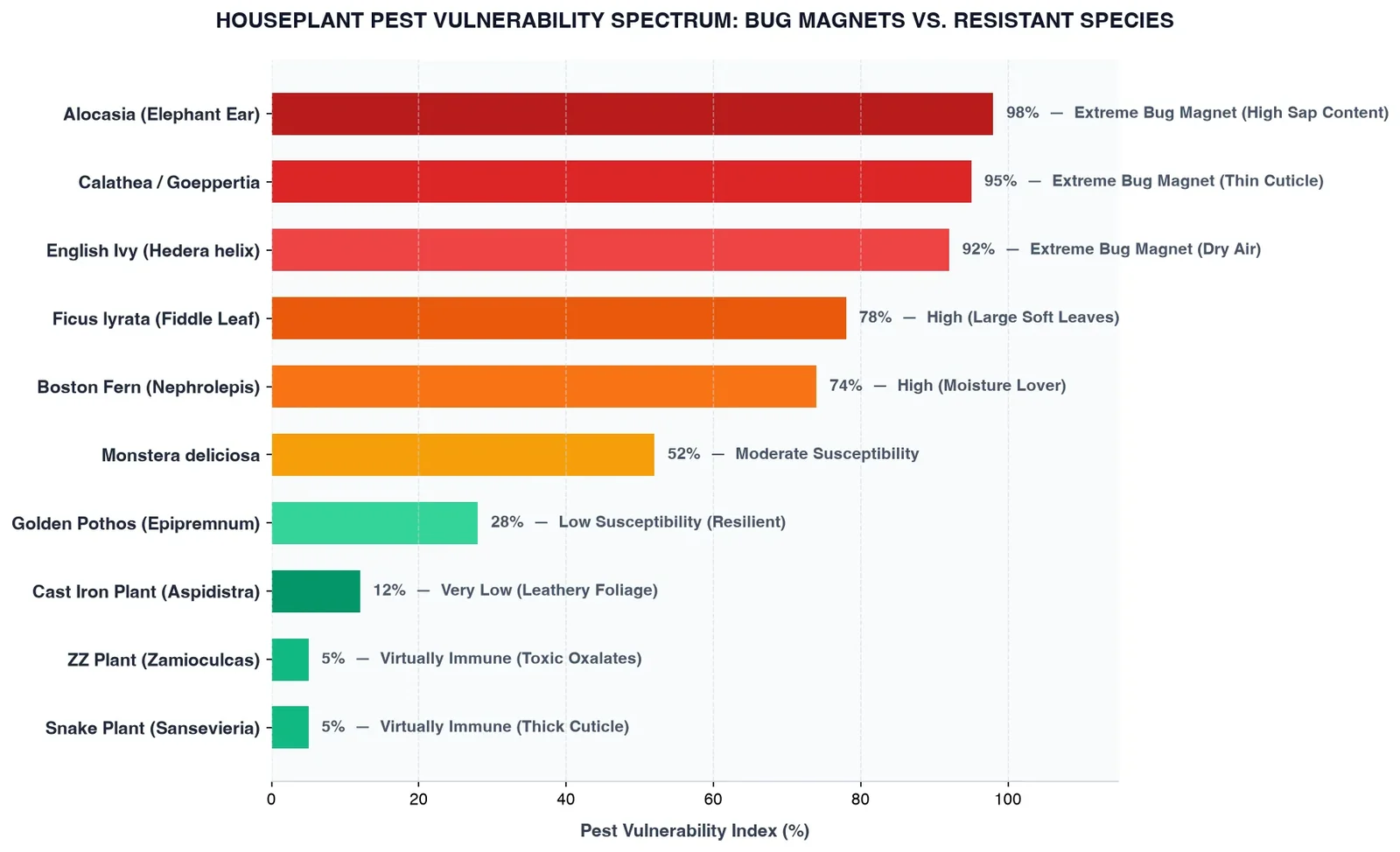
Not all houseplants carry the same pest risk profile. Evolutionary adaptations—such as cuticular thickness, sap chemistry, and glandular trichomes—dictate whether a plant acts as an insect magnet or naturally repels invaders:
| Plant Species | Vulnerability Level | Primary Pest Threat | Botanical Reason & Defense Mechanism |
|---|---|---|---|
| Alocasia (Elephant Ear) | Extreme Bug Magnet | Two-Spotted Spider Mites | High stomatal conductance and thin leaf tissue; rapid transpiration creates warm boundary layers mites love. |
| Calathea / Goeppertia | Extreme Bug Magnet | Spider Mites & Thrips | Delicate papery foliage; high humidity requirements mean indoor specimens suffer stress, raising free amino acids. |
| English Ivy (Hedera helix) | Extreme Bug Magnet | Spider Mites & Scale | Thin cuticles and dense trailing foliage create microclimates that trap stagnant, dry air indoors. |
| Ficus lyrata (Fiddle Leaf) | High Susceptibility | Mealybugs & Thrips | Large broad leaves accumulate indoor dust, blocking stomata and stressing roots, welcoming piercing pests. |
| Boston Fern (Nephrolepis) | High Susceptibility | Fungus Gnats & Mealybugs | Requires constantly damp soil; dense interior fronds provide sheltered breeding pockets for gnats and mealybugs. |
| Monstera deliciosa | Moderate Susceptibility | Thrips & Scale | Durable leaves with moderate wax cuticle, but juvenile leaves remain vulnerable to thrips during unfurling. |
| Golden Pothos (Epipremnum) | Low Susceptibility | Mealybugs (Rare) | Tough, resilient foliage; tolerates drought and low light without accumulating defensive-lowering stress. |
| Cast Iron Plant (Aspidistra) | Very Low (Resistant) | Occasional Scale | Extremely thick fibrous leaf blades and dense lignified vascular tissue repel piercing mouthparts. |
| ZZ Plant (Zamioculcas) | Virtually Immune | Negligible | High cuticular wax prevents desiccation and repels pests; rhizomes store water, eliminating damp soil requirements. |
| Snake Plant (Sansevieria) | Virtually Immune | Negligible | Heavily lignified fibrous sword-like foliage; thick outer waxy epidermal barrier makes stylet penetration impossible. |
| Ponytail Palm (Beaucarnea) | Virtually Immune | Negligible | Caudex stores water for months; leathery leaves with razor-sharp silica margins deter all common indoor pests. |
| Peppermint / Rosemary | Active Bug Repellent | Natural Deterrent | Glandular trichomes secrete high concentrations of menthol and camphor; volatile terpenes deter spider mites and gnats. |
Room-by-Room Risk Assessment: Where Pests Flourish
Indoor microclimates vary drastically from room to room. Understanding residential zones allows growers to position susceptible species strategically:
The Bedroom: Low Risk, High Psychological Anxiety
Placing plants in a bedroom frequently triggers concerns about sleeping with insects. Because bedrooms generally maintain stable, dry temperatures with minimal organic food waste, they represent very low environmental risk.
Stick to virtually immune species such as Snake Plants and ZZ Plants. These species release oxygen at night via Crassulacean Acid Metabolism (CAM) while requiring monthly watering that completely denies fungus gnats a breeding habitat.
The Bathroom: The High-Humidity Tropical Oasis
Bathrooms with natural light offer elevated relative humidity from showers, making them prime environments for tropical ferns and Calatheas.
However, warm stagnant bathroom humidity combined with poor airflow creates an ideal habitat for fungus gnats and mealybugs. Always run an exhaust fan for 30 minutes following showers to circulate air and dry wet soil surfaces.
The Kitchen: The Fruit Fly Confusion Zone
The kitchen is the epicenter of pest misdiagnosis. Ripe bananas, composting apple cores, and damp sink disposal traps generate fruit flies (*Drosophila*), which homeowners mistakenly blame on their windowsill herbs.
If you see flying insects around your kitchen herbs, inspect the soil: if nothing flies out when you tap the rim, you are dealing with kitchen fruit flies attracted to sugars, not houseplant pests. For sterile culinary cultivation, consider a clean passive water reservoir or soilless Kratky method system that eliminates soil pests altogether.
Clinical Eradication Protocols: Tested Formulations and Step-by-Step Recipes
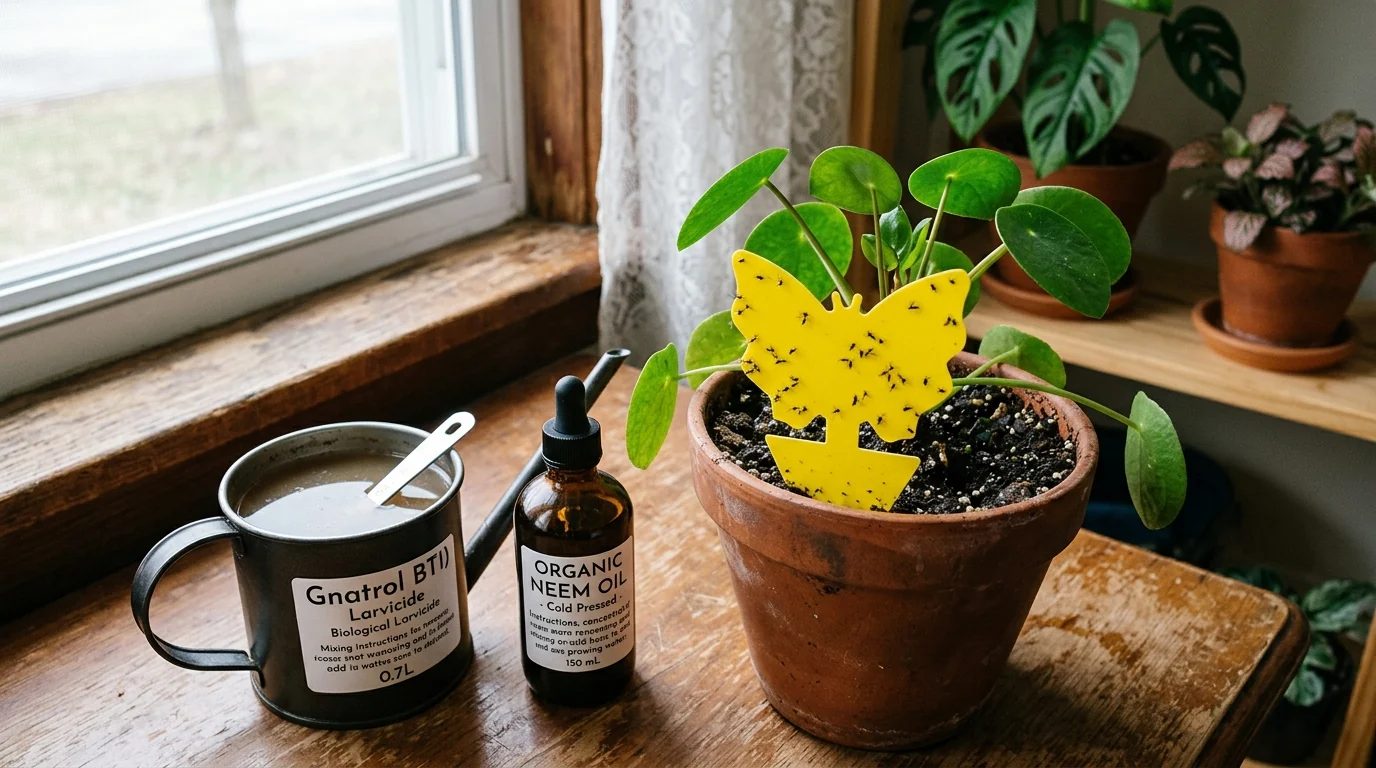
When an infestation is detected, vague advice like ‘spray with soap’ often causes more harm than good. Standard kitchen dish detergents contain degreasers that strip the protective wax cuticle off houseplant leaves, causing severe chemical burn.
Always execute these four field-tested, scientifically verified botanical formulations:
🧪 Formulation 1: Cold-Pressed Neem Oil Emulsion
Target Pests: Spider Mites, Thrips Nymphs, Aphids, Mealybugs.
Recipe: 1 quart lukewarm water + 1 level teaspoon 100% pure cold-pressed neem oil + 1/2 teaspoon pure liquid castile soap (e.g., Dr. Bronner’s Unscented Baby-Mild).
Step-by-Step Protocol:
- Step 1: Emulsification is vital. Neem oil is hydrophobic. Dissolve castile soap into lukewarm water first, then add neem oil and shake vigorously for 60 seconds until a milky, uniform emulsion forms.
- Step 2: Spray thoroughly. Coat leaf undersides, petiole joints, and stems until dripping wet.
🧪 Formulation 2: 3% Hydrogen Peroxide Soil Drench
Target Pests: Fungus Gnat Larvae & Soil Pupae, Root Rot Fungi.
Recipe: 4 parts room-temperature tap water + 1 part standard 3 percent pharmaceutical-grade hydrogen peroxide (H2O2).
Protocol: Allow the top 2 inches of potting mix to dry out thoroughly. Pour the diluted peroxide solution slowly over the soil until it runs freely from the bottom drainage holes.
Botanical Action: The peroxide fizzes vigorously on contact with organic matter, releasing an extra oxygen atom. This oxidizes and destroys fungus gnat larvae, pupae, and root-rot fungi (*Pythium*) instantly while releasing beneficial oxygen into the root zone without harming plant vascular tissue.
🧪 Formulation 3: Biological BTI Microbial Tea
Target Pests: Eradication of Fungus Gnat Larvae (Bradysia).
Recipe: 1 gallon room-temperature water + 2 tablespoons biological Mosquito Bits (solid corn cob granules impregnated with Bacillus thuringiensis israelensis (BTI), strain H-14).
Protocol: Steep the granules in water for 30 to 45 minutes, stirring occasionally to create a biological ‘tea’. Strain out the solid corn granules (never let wet granules mold on the soil surface).
Biological Mechanism: Use this strained water exclusively for all houseplant watering for three consecutive cycles (21 days). BTI produces delta-endotoxin crystal proteins. When microscopic gnat larvae ingest the bacteria, the alkaline environment of their gut activates the toxin, perforating the gut wall and killing the larvae within 24 to 48 hours without affecting plants, humans, or pets.
🧪 Formulation 4: 70% Isopropyl Alcohol Spot Treatment
Target Pests: Armored Scale, Soft Scale, Clustered Mealybugs.
Protocol: Dip a cotton swab (Q-tip) directly into standard 70 percent isopropyl rubbing alcohol. Lightly press the soaked tip against individual white mealybugs or brown scale insects.
Mechanism: Alcohol instantly denatures the protective waxy epicuticle and dissolves the insect’s outer shell, dehydrating and killing it within seconds. The alcohol evaporates cleanly into the air without leaving toxic soil residues. For dense leaf axils, test a single lower leaf first to confirm the species tolerates spot contact.
Biological Warfare: Beneficial Insects for Residential Living Rooms
For large indoor plant collections (50 to 100+ specimens) or stubborn thrips and spider mite infestations, chemical sprays often fail because pests develop resistance. Controlled environment agriculture relies on biological controls (good bugs eating bad bugs). You can safely deploy these microscopic predators inside a home:
- Amblyseius swirskii & Neoseiulus cucumeris: Microscopic predatory mites (0.5 mm) packaged in slow-release paper breeding sachets that hang inconspicuously on plant stems. A single sachet releases hundreds of predator mites over 4 to 6 weeks. They actively patrol leaf surfaces, consuming 5 to 10 first-instar thrips nymphs or juvenile spider mites daily.
- Phytoseiulus persimilis: Obligate spider mite predators. They do not consume pollen or plant tissue; they hunt two-spotted spider mites exclusively. A release of 500 *P. persimilis* into an indoor grow tent or plant room will eradicate an active spider mite webbing infestation within 14 days, starving to death naturally once the prey is wiped out.
- Beneficial Entomopathogenic Nematodes (Steinernema feltiae): Microscopic, unsegmented roundworms applied via watering cans. Nematodes enter the root zone, actively hunt fungus gnat larvae, enter their natural body openings, and release symbiotic bacteria that liquefy the pest internally within 48 hours.
The 30-Day Intake Quarantine and Soil Pasteurization Protocol
Professional botanical conservatories maintain zero pest tolerances through strict intake biosecurity. Implement this 4-step protocol for every new plant and bag of soil brought into your home:
- Step 1: The 30-Day Air-Gap Isolation: Never place a newly purchased nursery plant directly alongside your existing collection. Isolate the newcomer in a separate room (such as a guest bedroom, sunlit bathroom, or office) at least 15 feet away from other foliage for 30 continuous days. This window covers the complete lifecycle of thrips, scale crawlers, and spider mites.
- Step 2: High-Pressure Mechanical Washdown: Carry the new plant into your shower or outdoor hose station. Using lukewarm water, spray the upper and lower surfaces of every leaf with gentle but firm water pressure. This mechanically dislodges up to 90 percent of loose spider mites, aphid nymphs, and thrips.
- Step 3: Prophylactic Foliar Coating: Following the wash, apply an insecticidal soap or emulsified cold-pressed neem oil spray to the entire plant at dusk. Repeat this foliar application on Day 7 and Day 14 of the quarantine period to eliminate any newly hatched nymphs.
- Step 4: Oven Soil Pasteurization: If using commercial bagged potting soil for repotting, pasteurize the mix. Spread damp soil onto a baking sheet, cover tightly with aluminum foil, insert a meat thermometer, and bake at 180°F (82°C) for 30 minutes. This thermal threshold kills all fungus gnat eggs, thrips pupae, and root rot spores without volatilizing beneficial soil organic matter.
Frequently Asked Questions:
01
Do indoor plants attract bugs into your house from outside?
Do indoor plants attract bugs into your house from outside?
No. Indoor plants do not draw insects into your home through closed windows and doors. Exterior pests are attracted to outdoor security lights, kitchen food waste, and structural warmth.
The vast majority of houseplant pests enter your home as hidden eggs on nursery plants or in contaminated commercial bagged potting soil.
02
Can indoor plant bugs bite humans or pets?
Can indoor plant bugs bite humans or pets?
No. Common houseplant pests (fungus gnats, spider mites, thrips, mealybugs, and scale) are phytophagous, meaning their mouthparts are adapted exclusively to pierce plant tissue and siphon vascular sap.
They lack the physical structures or biological impulse to bite humans or domestic animals.
03
What is the difference between fungus gnats and fruit flies?
What is the difference between fungus gnats and fruit flies?
Fungus gnats (*Bradysia*) have slender, mosquito-like black bodies with long legs and breed strictly in damp houseplant soil. They do not visit human food.
Fruit flies (*Drosophila*) have stout, rounded tan bodies with distinct bright red eyes. They breed in fermenting kitchen fruit, compost bins, and garbage disposals.
04
Do houseplants attract cockroaches, spiders, or bed bugs?
Do houseplants attract cockroaches, spiders, or bed bugs?
No. Houseplants do not attract cockroaches, spiders, or bed bugs. Cockroaches seek grease, starchy food crumbs, and structural heat. Bed bugs feed exclusively on mammalian blood.
Spiders may occasionally build a web in a large houseplant to hunt stray insects, but the plant itself does not attract them.
05
Can bugs live in brand-new, unopened bags of potting soil?
Can bugs live in brand-new, unopened bags of potting soil?
Yes. Commercial potting soil bags feature micro-perforations to allow gas exchange. When pallets of soil sit outdoors at garden centers, female fungus gnats crawl through these ventilation holes and lay hundreds of eggs.
Always inspect or pasteurize commercial soil before using it indoors.
06
Which indoor houseplants attract the most pests?
Which indoor houseplants attract the most pests?
The three biggest bug magnets are Alocasia (spider mites), Calathea (spider mites and thrips), and English Ivy (spider mites and scale).
These species feature thin cuticular layers and high stomatal transpiration rates that create ideal feeding environments for sap-sucking pests.
07
Which houseplants are completely immune or resistant to bugs?
Which houseplants are completely immune or resistant to bugs?
Snake Plants (*Sansevieria*), ZZ Plants (*Zamioculcas zamiifolia*), Cast Iron Plants (*Aspidistra*), and Ponytail Palms are virtually immune to indoor pests.
Their heavily lignified, waxy, fibrous foliage physically prevents piercing-sucking insect mouthparts from penetrating.
08
Do any indoor plants naturally repel insects and mosquitoes?
Do any indoor plants naturally repel insects and mosquitoes?
Yes, aromatic herbs like Peppermint, Rosemary, Lavender, and Lemon Thyme contain volatile terpenes (menthol, camphor, linalool) that actively deter insects.
However, they require high light levels (6+ hours of direct sun or LED grow lights) to produce these defensive compounds indoors.
09
Why are there tiny white bugs crawling in my houseplant soil when I water?
Why are there tiny white bugs crawling in my houseplant soil when I water?
These are almost always Springtails (*Collembola*). They are harmless, beneficial micro-arthropods that feed on decaying roots and soil fungus.
They do not damage living plant tissue, bite, or leave the soil. No chemical eradication is necessary.
10
How do I get rid of fungus gnats permanently without repotting?
How do I get rid of fungus gnats permanently without repotting?
Use a two-pronged strategy: stake yellow sticky traps in the soil to catch flying adults, and water the plant with a biological BTI microbial drench (Mosquito Bits tea) for three consecutive waterings.
BTI kills the larvae in the soil, breaking the reproductive cycle within 21 days.
11
Does hydrogen peroxide hurt plant roots when used as a soil drench?
Does hydrogen peroxide hurt plant roots when used as a soil drench?
No, provided it is properly diluted. A 1:4 ratio of standard 3% pharmaceutical hydrogen peroxide to water kills fungus gnat larvae on contact.
As it fizzes, it breaks down into water and pure oxygen, which aerates roots and combats root rot (*Pythium*).
12
How do I make a DIY insecticidal spray that will not burn my leaves?
How do I make a DIY insecticidal spray that will not burn my leaves?
Mix 1 quart of lukewarm water with 1 teaspoon of 100% pure cold-pressed neem oil and 1/2 teaspoon of liquid castile soap (such as Dr. Bronner’s).
Always shake thoroughly to emulsify, and never apply under direct sunlight or grow lights to prevent phytotoxic leaf scorching.
13
Why did neem oil make my houseplant leaves turn black and drop?
Why did neem oil make my houseplant leaves turn black and drop?
This is caused by oil-induced phytotoxicity. Horticultural oils concentrate photons under direct sunlight or intense LED grow lights, cooking the foliage.
Additionally, applying oil to water-stressed, wilted plants causes severe tissue burn. Apply neem oil strictly at dusk on well-hydrated plants.
14
What are the tiny black lines crawling inside my monstera leaves?
What are the tiny black lines crawling inside my monstera leaves?
These are thrips nymphs and adults. Thrips scrape the leaf surface and insert eggs directly into plant tissue, leaving behind bleached silvery-grey patches speckled with black frass droplets.
Treat aggressively with Spinosad foliar spray or systemic imidacloprid granules.
15
Can I use 70% rubbing alcohol directly on mealybugs?
Can I use 70% rubbing alcohol directly on mealybugs?
Yes. Dip a cotton swab (Q-tip) in 70% isopropyl alcohol and touch it directly to individual mealybugs.
The alcohol dissolves their protective white wax shell and denatures their body proteins instantly. Test a single leaf first to verify sensitivity.
16
How long do I need to quarantine a new plant before placing it with others?
How long do I need to quarantine a new plant before placing it with others?
Quarantine every new plant for a minimum of 30 continuous days in a separate room at least 15 feet away from existing houseplants.
This isolation window guarantees that any dormant insect eggs will hatch and reveal themselves before spreading.
17
Does bottom watering prevent bugs in indoor plants?
Does bottom watering prevent bugs in indoor plants?
Yes, specifically for fungus gnats. Adult female fungus gnats lay eggs in the top 1 to 2 inches of moist soil.
Bottom watering draws moisture into lower roots while leaving the topsoil dry, eliminating their primary breeding zone.
18
Can sticky yellow traps alone eliminate a bug infestation?
Can sticky yellow traps alone eliminate a bug infestation?
No. Yellow sticky traps capture adult flying gnats, but do not affect hundreds of microscopic larvae and eggs feeding inside the soil.
Sticky traps are monitoring and control tools; you must combine them with a biological soil drench (like BTI) to eliminate the root-dwelling larvae.
19
Are indoor plant bugs a sign that my house is dirty?
Are indoor plant bugs a sign that my house is dirty?
Not at all. Houseplant pests are obligate plant parasites that feed on chlorophyll, phloem sap, and peat moss.
They have nothing to do with household cleanliness or sanitation.
20
How do you sterilize potting soil before planting?
How do you sterilize potting soil before planting?
Spread moist potting soil on a baking sheet, cover with foil, and bake at 180°F (82°C) for 30 minutes using a meat thermometer to monitor core temperature.
Alternatively, microwave damp soil in a microwave-safe container with ventilation holes for 90 seconds per quart.
21
Can cinnamon powder on houseplant soil kill fungus gnats?
Can cinnamon powder on houseplant soil kill fungus gnats?
Cinnamon is a mild natural antifungal agent, not an insecticide. Dusting Ceylon cinnamon on the soil surface suppresses surface mold, depriving gnat larvae of a minor food source.
However, it will not kill larvae deeper in the pot and cannot eradicate an established infestation on its own.
22
Do self-watering pots attract more bugs?
Do self-watering pots attract more bugs?
Yes, if managed incorrectly. Self-watering planters with open, exposed water reservoirs can become breeding sites for fungus gnats and mosquitoes.
Keep reservoir fill ports covered, and allow the potting medium to dry between reservoir refills.
23
Why do spider mites appear during the winter months?
Why do spider mites appear during the winter months?
Indoor winter heating drops relative humidity down to 20 to 30 percent. Two-spotted spider mites thrive in hot, dry, stagnant air.
Their lifecycles compress from 20 days down to just 7 days at low humidity, triggering rapid population explosions.
24
What happens if you ignore houseplant pests?
What happens if you ignore houseplant pests?
Pests multiply exponentially indoors without natural predators. Sap-sucking insects drain vital photoassimilates, causing yellowing, defoliation, and stunted growth.
Left untreated, heavy infestations will eventually kill the plant and spread across every room in your home.
25
Is it safe to use systemic insecticide granules indoors around pets?
Is it safe to use systemic insecticide granules indoors around pets?
Systemic granules containing imidacloprid are safe indoors if mixed thoroughly into the subsurface potting soil and covered with fresh medium or decorative pebbles.
This prevents curious dogs or cats from coming into contact with the granules. The chemical remains locked inside plant vascular tissue.