⚡ Quick Answer: How Often to Water Sunflowers?
Established in-ground sunflowers require 1 to 2 inches of water per week, delivered as one or two slow, deep root soakings (every 5–7 days in mild weather, or every 2–3 days during 85°F+ heatwaves). Never water in-ground sunflowers daily, as shallow watering stunts taproot depth and causes plants to topple. Container-grown sunflowers, however, dry out rapidly and need water every 1–2 days (twice daily above 90°F).
Section 1: The Biology of Sunflower Hydration: Taproot Mechanics and the Drought-Tolerance Myth
When gardeners evaluate how often to water sunflowers (Helianthus annuus), they frequently encounter one of the most persistent misconceptions in residential horticulture: the belief that they are bulletproof desert plants requiring little to no supplemental water. While established in-ground sunflowers possess formidable drought-evasion mechanisms, they are physiologically classified as high-water-consumption annuals. A single mature mammoth sunflower transpires between 0.5 and 1.5 gallons of water every day through its immense leaf canopy during hot, dry summer weather, according to University Extension agronomic research on plant evapotranspiration.
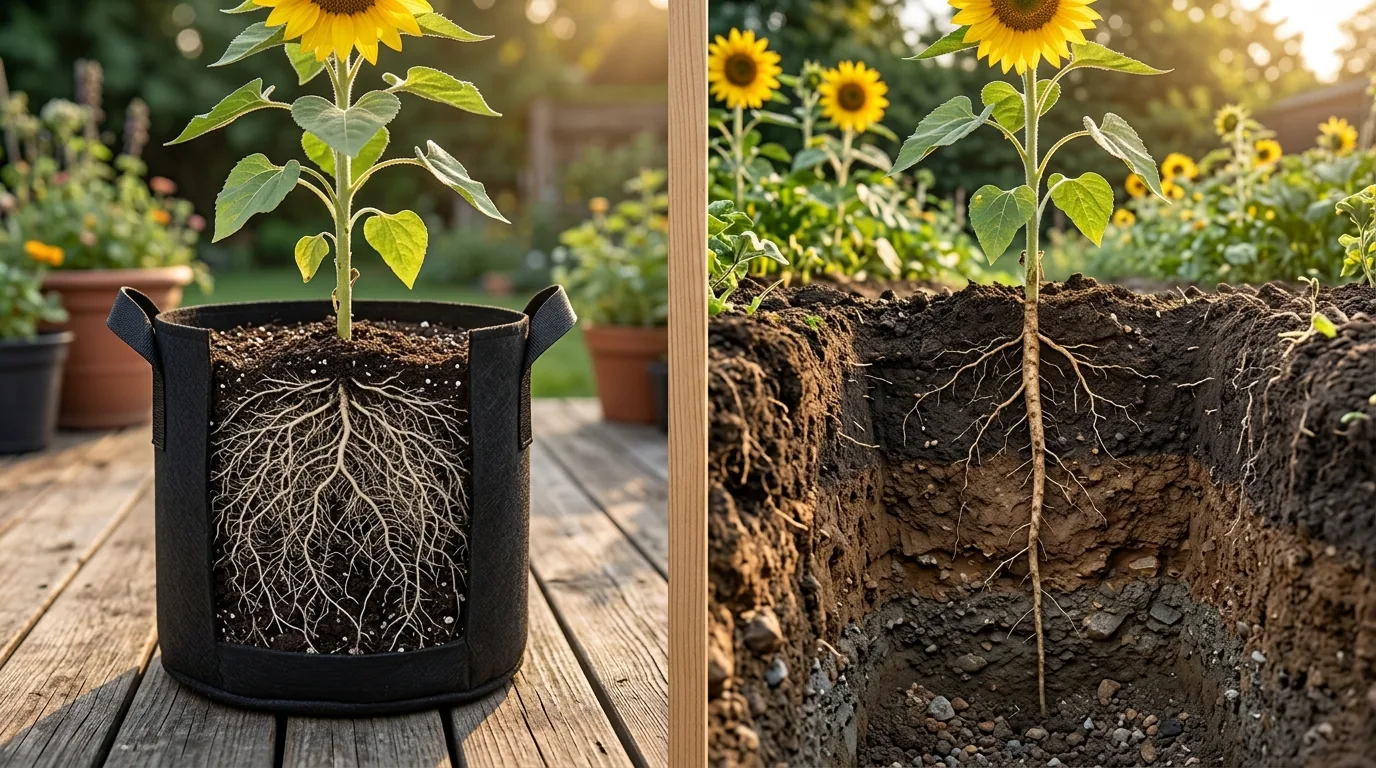
The plant’s apparent drought tolerance stems entirely from its root architecture. Given loose, unobstructed soil, a sunflower produces a vigorous central taproot that plunges 3 to 5 feet (0.9 to 1.5 meters) into the subsoil within eight weeks of germination. Surrounding this vertical anchor is an extensive web of lateral feeder roots concentrated in the upper 12 to 18 inches of soil, spanning 2 to 3 feet radially from the main stem. This dual-zone root system allows the plant to scavenge deep moisture reserves when surface layers dry out.
However, accessing deep moisture is a survival mechanism, not an optimal growth strategy. When root zone moisture drops below 40 percent field capacity, the plant enters water-stress triage. It closes leaf stomata to halt transpiration, halts cell elongation, and aborts auxiliary flower buds. If moisture deficits occur during flower head initiation, disk floret count drops drastically, resulting in stunted, hollow-seeded blooms. Understanding how to support this intense hydraulic system requires looking past generic schedules and mastering root zone physics.

Section 2: The Core Question: How Often to Water Sunflowers? (The Universal Decision Rule)
When determining how often to water sunflowers, the foundational rule of irrigation is straightforward: deliver water deeply and infrequently rather than providing light, daily surface sprinklings.
How often do you water sunflowers?
Established in-ground sunflowers require 1 to 2 inches (2.5 to 5 centimeters) of water per week, applied as one or two slow, deep root soakings. In mild weather with daytime temperatures between 70°F and 80°F (21°C to 27°C), water once every 5 to 7 days. During midsummer heatwaves with temperatures exceeding 85°F to 90°F (29°C to 32°C), increase watering to once every 2 to 3 days. Always factor in natural rainfall: a rain gauge placed in the garden bed reveals whether nature has already met the weekly 1 to 2-inch quota.
Do sunflowers need water every day?
No, in-ground sunflowers do not need water every day. In fact, watering in-ground plants daily is one of the quickest ways to destroy them. Daily surface watering saturates the top 2 inches of soil while leaving deeper layers bone dry. This trains roots to stay near the surface where moisture is continually supplied. When intense summer heat arrives, surface-bound roots quickly cook, and top-heavy mature stems snap or topple in light winds because they lack a deep vertical taproot anchor. The only exception to the no-daily-watering rule is container-grown sunflowers during extreme summer heatwaves.
How much water does a sunflower need in gallons?
Water volume must scale directly with plant biomass and root volume. Rather than guessing, apply these precise liquid volume targets per watering session:
- Seedlings (Weeks 1 to 2): Deliver 2 to 4 fluid ounces (60 to 120 ml) of water per seedling, keeping the top inch of soil consistently damp but never waterlogged.
- Small & Dwarf Cultivars (2 to 4 Feet Tall): Deliver 0.75 to 1.5 gallons (2.8 to 5.7 liters) per plant per watering session, saturating the soil down to 8 inches.
- Standard Garden Varieties (5 to 8 Feet Tall): Deliver 2 to 3 gallons (7.5 to 11.4 liters) per plant per watering session, saturating a 12-inch radial zone around the stem down to 12 inches.
- Giant & Mammoth Cultivars (9 to 14+ Feet Tall): Deliver 3 to 5 gallons (11.4 to 19 liters) per plant per watering session, soaking a 15 to 18-inch radius around the massive trunk down to 18 inches.
Section 3: Growth Stage Watering Schedule: From Seedling to Harvest
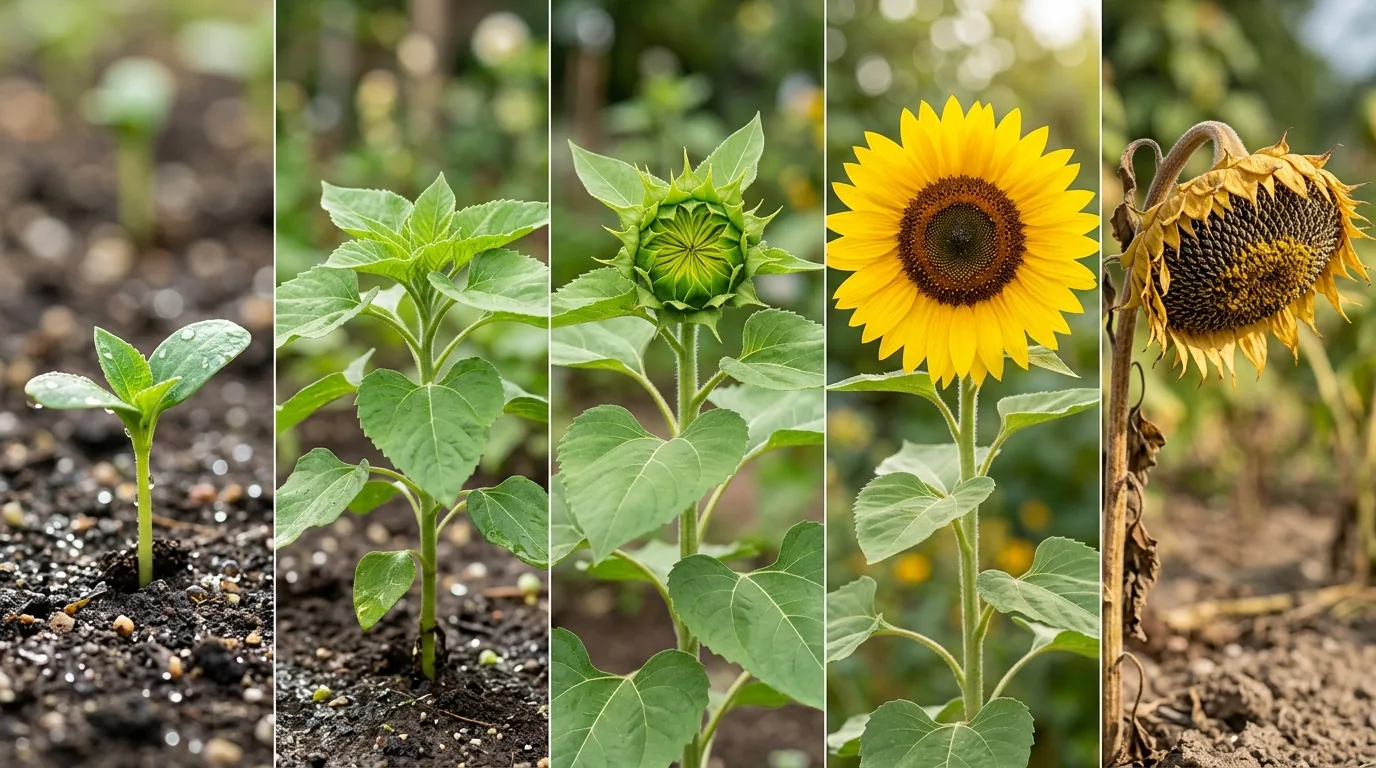
When calibrating how often to water sunflowers, a plant’s water demand changes dramatically across its four distinct developmental phases. Applying the same irrigation schedule from seed to bloom inevitably leads to root rot early in the season or stunted flower heads later on.
How often should you water sunflower seedlings?
When deciding how often to water sunflowers at the seedling stage, deliver moisture every 1 to 2 days during the first two weeks following germination. During this initial stage, the developing radicle and embryonic taproot are only 1 to 3 inches long and cannot reach subsoil moisture. If the upper inch of soil dries out completely, delicate root hairs desiccate and the seedling collapses within hours.
Apply water gently using a fine-rose watering can or a low-pressure misting nozzle directed at the soil base. Never blast young seedlings with a high-pressure hose, which dislodges delicate stems. Maintain soil moisture similar to a wrung-out sponge. If growing seedlings indoors in cell trays (as covered in our master guide on how to start a vegetable garden from seed), water from the bottom by pouring 1/2 inch of water into the bottom tray for 20 minutes, then discard standing runoff to prevent damping-off disease caused by Pythium and Rhizoctonia fungi.
Vegetative Canopy Development (Weeks 3 to 8)
Once the sunflower develops two to three pairs of true leaves, shift immediately from frequent light watering to deep, infrequent irrigation. Water every 4 to 6 days in average weather, applying 1.5 to 2.5 gallons of water per plant.
Allow the top 2 inches of soil to dry out between waterings. This controlled top-layer drying forces the taproot to drive downward in search of moisture reserves, establishing the structural foundation that will later support heavy stems and wind loads.
Do sunflowers need more water when budding and blooming?
Yes, sunflowers need significantly more water during bud formation and blooming than at any other point in their life cycle. This reproductive window, spanning from the appearance of the small star-like bud cluster (reproductive stage R1) through full petal opening (stage R5), represents the plant’s peak water requirement.
Understanding how often to water sunflowers during bud formation is critical: water stress during bud development directly reduces the final diameter of the flower head. Stomata close to conserve moisture, which reduces photosynthetic carbon assimilation and starves the rapidly expanding disc florets. Water every 3 to 4 days during this phase, supplying 3 to 5 gallons of water per plant per session. Never let the root zone dry out while the flower head is swelling.
Seed Fill and Seed Maturation (Weeks 13 to 16)
Once pollination concludes and petals begin to wilt and drop, water needs taper downward. Maintain moderate soil moisture during initial seed fill (weeks 13 to 14) so kernels plump properly inside their hulls, applying 1 to 2 gallons every 6 to 8 days.
As the back of the green flower head transitions to yellow and finally to dark golden-brown (weeks 15 to 16), stop supplemental irrigation entirely. Cutting off water accelerates seed dry-down, hardens hulls, and prevents fungal head rot (Rhizopus and Sclerotinia) from ruining the harvest before cutting. Gardeners can also align their succession planting dates with our interactive growing cycle planner to optimize harvest timing.
| Growth Stage | Plant Age | Watering Frequency | Water Volume per Plant | Target Soil Moisture Depth |
|---|---|---|---|---|
| Germination & Sprout | Days 1 to 14 | Daily or every 2 days | 2 to 4 fl oz (surface mist) | Top 1 inch constantly moist |
| Vegetative Canopy | Weeks 3 to 8 | Every 4 to 6 days | 1.5 to 2.5 gallons | Dry top 2 inches, moist at 8 inches |
| Bud Formation (Peak) | Weeks 9 to 11 | Every 3 to 4 days | 3 to 5 gallons | Evenly moist down to 12 to 18 inches |
| Full Flowering | Weeks 11 to 13 | Every 4 to 5 days | 2.5 to 4 gallons | Top 2 inches dry between soakings |
| Seed Maturation | Weeks 14 to 16 | Every 7 to 10 days, then stop | 1 to 2 gallons, tapering to zero | Dry top 4 inches to hasten dry-down |
Section 4: In-Ground, Raised Beds, and Container Cultivation Dynamics
The physical environment enclosing a sunflower’s root system dictates how often to water sunflowers and how quickly the surrounding soil loses moisture reserves.
How often to water sunflowers in pots and containers?
Container-grown sunflowers require watering every 1 to 2 days under normal summer conditions, and twice daily during intense heatwaves exceeding 90°F (32°C). In a container, the root zone is physically severed from subsoil moisture reserves. The confined volume of potting mix dries out rapidly through a combination of plant transpiration and solar evaporation baking the container walls. For container setups featuring grow lights or automated reservoirs, review our comprehensive indoor hydroponic gardening guide.
Pot volume is the critical variable. Attempting to grow a sunflower in a small 6 or 8-inch pot restricts root mass and forces the plant into severe moisture swings within hours. Select container dimensions based on cultivar genetics:
- Dwarf Cultivars (e.g., Teddy Bear, Sunspot): Requires a minimum 1.5 to 2.5-gallon pot with at least an 8-inch diameter and 8-inch depth.
- Standard Branching Varieties (e.g., Autumn Beauty): Requires a 5-gallon container (or 5-gallon fabric grow bag) per plant, with a 12-inch diameter.
- Giant Varieties (e.g., Russian Mammoth): Requires a minimum 7 to 10-gallon container with a 14 to 16-inch base diameter to supply root volume and counterbalance wind shear.
Container Drainage Non-Negotiables: The container must have at least 3 to 4 unobstructed drainage holes. Never allow containers to sit in standing water trays or saucers. If runoff collects in the saucer, dump it within 30 minutes; standing water suffocates lower roots and causes rapid anaerobic root rot.
Raised Beds vs. In-Ground Garden Soil
Raised garden beds occupy an intermediate position between containers and open ground. Because raised bed soil mixes are rich in compost and coarse perlite, they drain far more freely than native mineral soils (see our spatial guide to raised bed garden spacing). In raised beds, water sunflowers every 3 to 4 days during warm weather, delivering 2 to 3 gallons per plant.
In native garden beds, dense subsoil retains moisture longer, allowing established plants to thrive on deep soakings every 5 to 7 days. However, heavy native clay requires careful monitoring to prevent waterlogging.
| Cultivation Setting | Typical Summer Rhythm | Root Depth Freedom | Water Volume per Session | Primary Hydration Risk |
|---|---|---|---|---|
| In-Ground Native Beds | Every 5 to 7 days (deep soak) | Full 3 to 5 ft taproot descent | 3 to 5 gallons per plant | Shallow watering causing toppling in wind |
| Raised Garden Beds | Every 3 to 4 days | Moderate (12 to 24 inches depth) | 2 to 3 gallons per plant | Rapid edge evaporation and nutrient leaching |
| Patio Pots & Grow Bags | Daily to every 2 days (twice daily in heat) | Restricted to pot dimensions | 1 to 2 gallons until drainage flows | Sudden root desiccation or saucer waterlogging |
Section 5: Variety-Specific Hydration Requirements: Giants vs. Dwarfs
A common mistake among home gardeners is treating all sunflower cultivars alike. In reality, water demand is governed by the total leaf area index (LAI) of the variety.
How often to water giant sunflowers like Russian Mammoth and Titan?
Giant sunflowers such as Russian Mammoth, Titan, Skyscraper, and Mongolian Giant require 3 to 5 gallons of water every 3 to 4 days during warm summer weather, and up to 5 gallons every 2 days during peak flowering in dry heat. These varieties grow between 10 and 14+ feet tall, developing massive stems 2 to 3 inches in diameter and enormous leaves spanning over 18 inches across.
Because of this vast foliage surface area, giant sunflowers have extraordinary transpiration rates. On a sunny 90°F day with a light breeze, a single mammoth plant pulls gallons of moisture out of the root zone. If water is restricted, the plant sacrifices the lower third of its canopy, causing leaves to brown and drop prematurely. In addition, delivering insufficient water depth prevents the taproot from developing the anchorage needed to keep a top-heavy 12-foot stalk upright under summer wind storms.
Hydration Needs for Dwarf and Branching Cultivars
Dwarf varieties such as Teddy Bear, Sunspot, Elf, and Firecracker grow only 1.5 to 3.5 feet tall. With substantially less leaf surface area, their transpiration rates are modest. Dwarf sunflowers thrive on 0.5 to 1 gallon of water applied every 4 to 6 days in garden soil, or every 2 days in containers (for companion indoor flowering strategies, explore our guide on how to grow flowers and indoor plants at home).
Branching varieties such as Autumn Beauty, Soraya, and Ring of Fire reach 5 to 7 feet tall and produce dozens of secondary flower stems over a 6-week period. These plants require consistent, moderate moisture (2 gallons every 4 days) throughout the entire flowering season to sustain multiple continuous blooms.
| Sunflower Variety | Classification | Mature Height | Weekly Water Demand | Key Hydration Guidance |
|---|---|---|---|---|
| Russian Mammoth | Single-head Giant | 10 to 12 feet | 4 to 6 gallons / week | Requires deep soaking in wide 18-inch radius to anchor giant stalk |
| Titan / Skyscraper | Single-head Giant | 12 to 14+ feet | 5 to 7 gallons / week | Peak water demand during bud swelling; stake to prevent wind snap |
| Autumn Beauty | Multi-branching | 6 to 8 feet | 2.5 to 3.5 gallons / week | Requires steady moisture to fuel secondary flower flushes for 6 weeks |
| Teddy Bear | Dwarf Double-bloom | 2 to 3 feet | 1 to 1.5 gallons / week | Excellent container candidate; avoid wetting fluffy pompom petals |
| Sunspot | Dwarf Single-head | 1.5 to 2.5 feet | 1 to 1.5 gallons / week | Large 10-inch flower on short stem; monitor pot moisture closely |
Section 6: Soil Texture, Drainage, and Environmental Drivers
Soil texture directly dictates how often to water sunflowers, governing the infiltration rate, water retention capacity, and aeration of the root zone. Two gardens experiencing identical summer temperatures will require radically different watering intervals based entirely on soil composition.
What type of soil drains best for sunflowers, and how does soil type affect watering frequency?
The optimal soil for sunflowers is a deep, well-draining sandy loam with a neutral to slightly alkaline pH between 6.0 and 7.5, aligned with USDA Natural Resources Conservation Service (NRCS) soil moisture and drainage standards. Sandy loam combines the rapid drainage of sand particles with the nutrient and moisture retention of silt and organic matter, allowing roots to breathe while maintaining consistent hydration.
How soil types dictate irrigation intervals:
- Sandy Soils: Water every 2 to 3 days. Sandy soils possess large pore spaces that drain rapidly. Water flows straight down past the root zone, retaining only 0.5 to 1.0 inch of water per foot of soil depth. Gardeners working with sandy soil must apply smaller water volumes more frequently, or incorporate compost to increase water holding capacity.
- Loamy Soils: Water every 5 to 7 days. Loamy soil holds between 1.5 and 2.0 inches of water per foot of depth, providing the ideal balance of moisture availability and oxygen exchange.
- Heavy Clay Soils: Water every 7 to 10 days. Heavy clay holds over 2.0 to 2.5 inches of water per foot, but has microscopic pore spaces that drain very slowly. Clay soils easily become waterlogged and compacted when wet, creating anaerobic conditions that trigger Pythium root rot. When watering clay soil, apply water very slowly to prevent runoff, and allow top layers to dry thoroughly before irrigating again.
How to Perform a Simple Garden Percolation Test
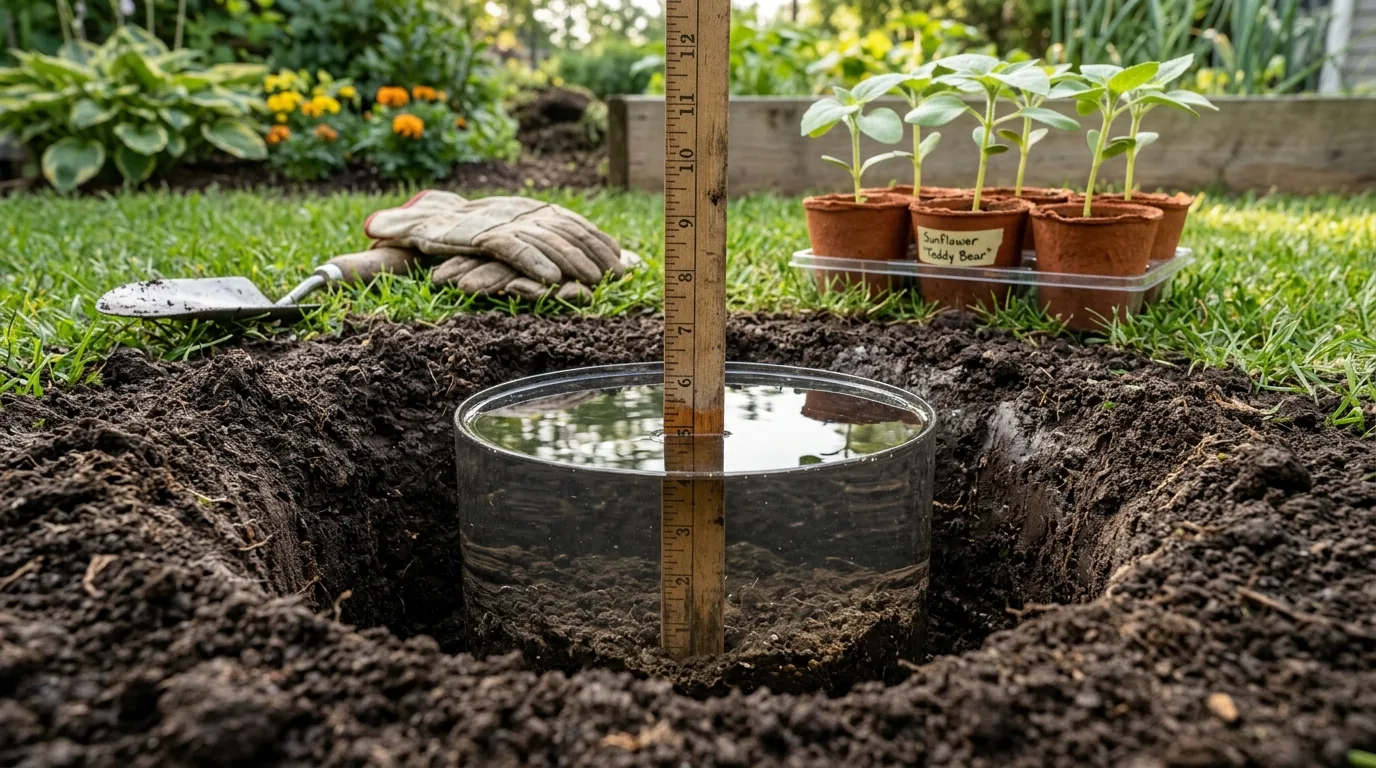
To determine your soil’s true drainage velocity before planting sunflowers, dig a hole 12 inches deep and 12 inches wide in your garden bed. Fill the hole completely with water and let it drain overnight to saturate surrounding soil. The next morning, refill the hole with water and measure the drop in water level every hour with a ruler:
- Faster than 4 inches per hour: Drainage is excessive; soil is sandy and will require watering every 2 days.
- Between 1 and 3 inches per hour: Drainage is ideal; soil is well-draining loam suitable for standard 5 to 7-day watering intervals.
- Less than 1 inch per hour: Drainage is poor; heavy clay or hardpan detected. Sunflowers in this soil risk root rot and should be planted in raised beds or mounded rows amended with organic matter.
The Role of Organic Mulch in Water Conservation
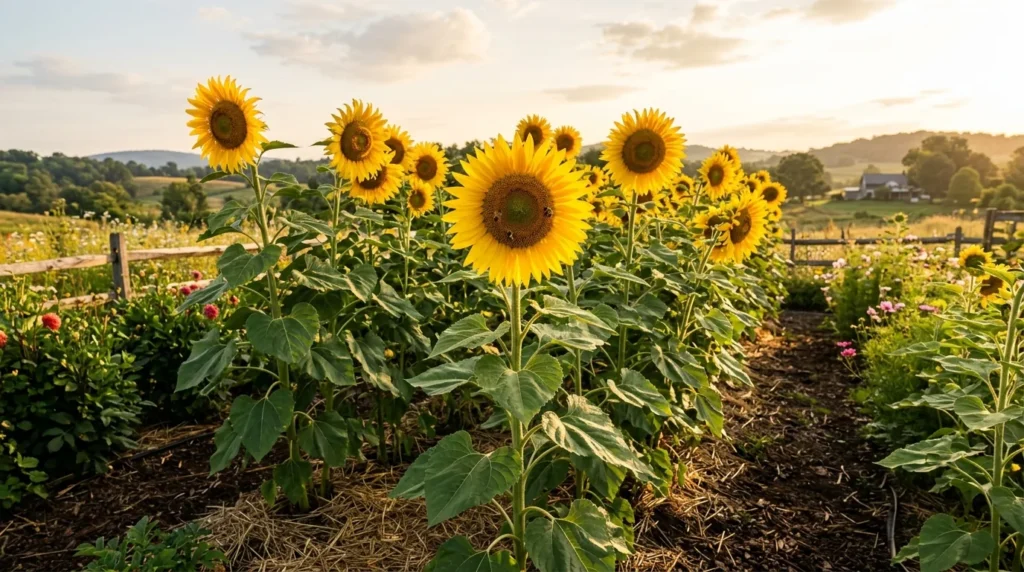
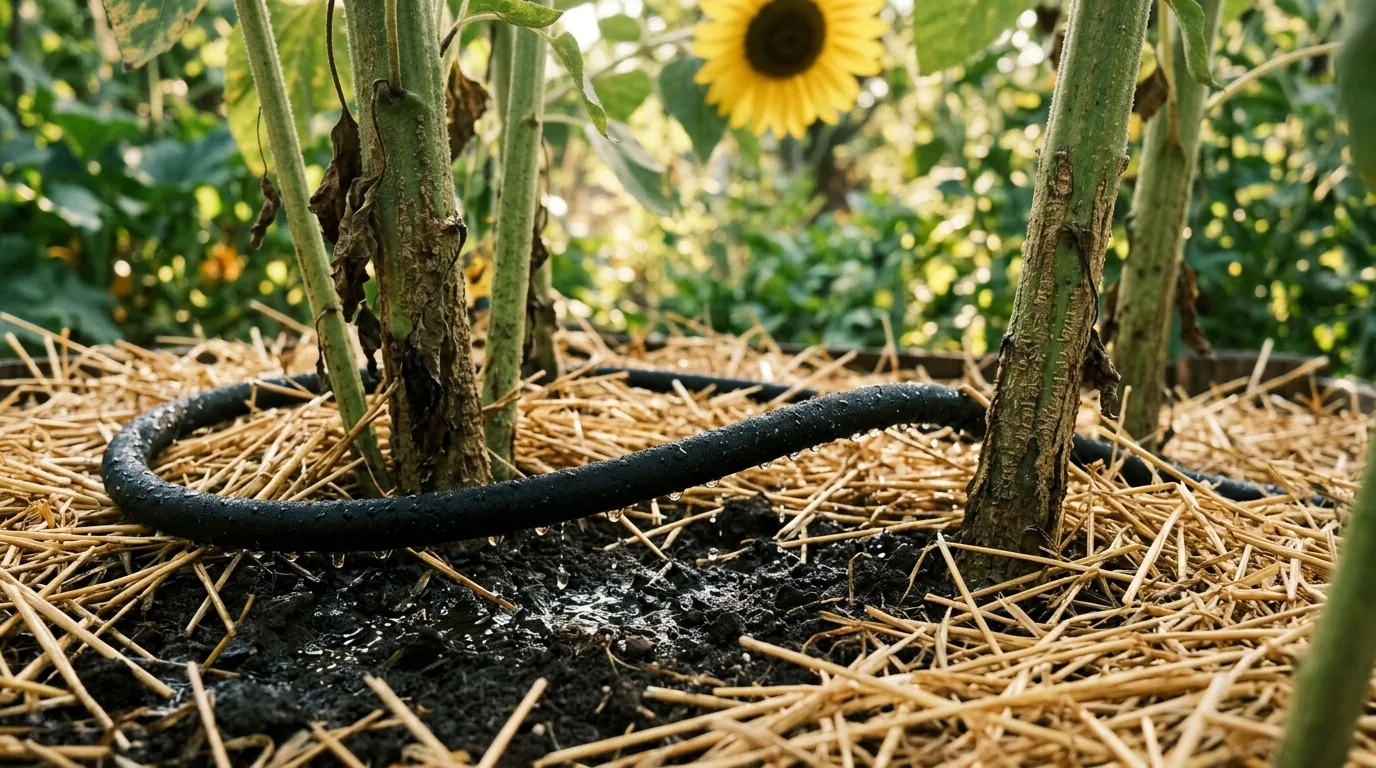
Applying a 2 to 3-inch layer of clean organic mulch around sunflowers is one of the most effective cultural practices in gardening. A layer of clean wheat straw, shredded hardwood bark, or composted leaves moderates soil temperature by 10°F during midsummer heat, reduces surface water evaporation by up to 50 percent, and prevents soil crusting. Keep mulch 2 inches away from the direct base of the sunflower stem to prevent moisture buildup against the stem collar.
Section 7: Timing and Delivery Methods: Preventing Leaf Scorch and Fungal Disease
How and when you apply water is just as critical as how much you deliver. Applying water incorrectly encourages destructive foliar pathogens that defoliate sunflowers before blooms open.
When is the best time of day to water sunflowers?
The best time of day to water sunflowers is early morning, between 6:00 AM and 9:00 AM. Watering in the early morning offers three decisive horticultural advantages:
- Maximum Infiltration with Zero Evaporation Loss: During early morning hours, soil is cool and ambient humidity is relatively high, allowing water to soak deep into the root zone with minimal loss to surface evaporation.
- Turgor Defense Against Midday Heat Stress: Morning watering charges plant cells with turgor pressure before intense midday sunlight and heat arrive, preventing afternoon wilt and leaf scorch.
- Pathogen Suppression: Any accidental moisture splashed onto lower leaves evaporates rapidly as the sun rises, denying fungal spores the continuous 4 to 6 hours of surface moisture needed to germinate.
Avoid watering during the heat of midday (12:00 PM to 3:00 PM), when up to 30 percent of water evaporates before reaching roots. Avoid watering late in the evening (after 6:00 PM), as wet leaves and cool night temperatures create the perfect environment for powdery mildew (Golovinomyces cichoracearum), rust (Puccinia helianthi), and white stem rot (Sclerotinia sclerotiorum).
Water Delivery Methods: Base Soaking vs. Overhead Sprinklers
Always apply water directly to the soil at the base of the plant, keeping foliage, stems, and flower buds completely dry. Choose from these three high-efficiency delivery systems:
- 1. Soaker Hoses: The gold standard for sunflower rows and borders. A porous soaker hose snaked along the base of plants delivers slow, weeping water directly into the soil over 45 to 60 minutes with zero foliar wetting.
- 2. Drip Irrigation Rings: Ideal for specimen plants, giant cultivars, and raised beds. Install two 0.5 to 1.0 gallon-per-hour (GPH) pressure-compensating drip emitters on opposite sides of each sunflower stalk, positioned 6 to 8 inches away from the stem.
- 3. Low-Pressure Watering Wand: Use a long watering wand equipped with a gentle shower rose held directly above the ground. Apply water at low pressure in a circular pattern around the root zone, pausing between passes to allow water to soak in without ponding.
Never use oscillating overhead lawn sprinklers on sunflowers. Overhead watering coats leaves in moisture, washes away beneficial pollen from opening blooms, and splatters fungal spores from the soil onto lower foliage.
Section 8: Diagnostics: Underwatering vs. Overwatering Symptoms
Because both underwatering and overwatering cause plants to droop, diagnosing the underlying cause accurately before reaching for the hose is vital.
How do you know if a sunflower is underwatered vs overwatered?
The definitive way to differentiate underwatering from overwatering is to inspect the soil moisture 3 inches below the surface and examine the physical texture of the foliage and stem:
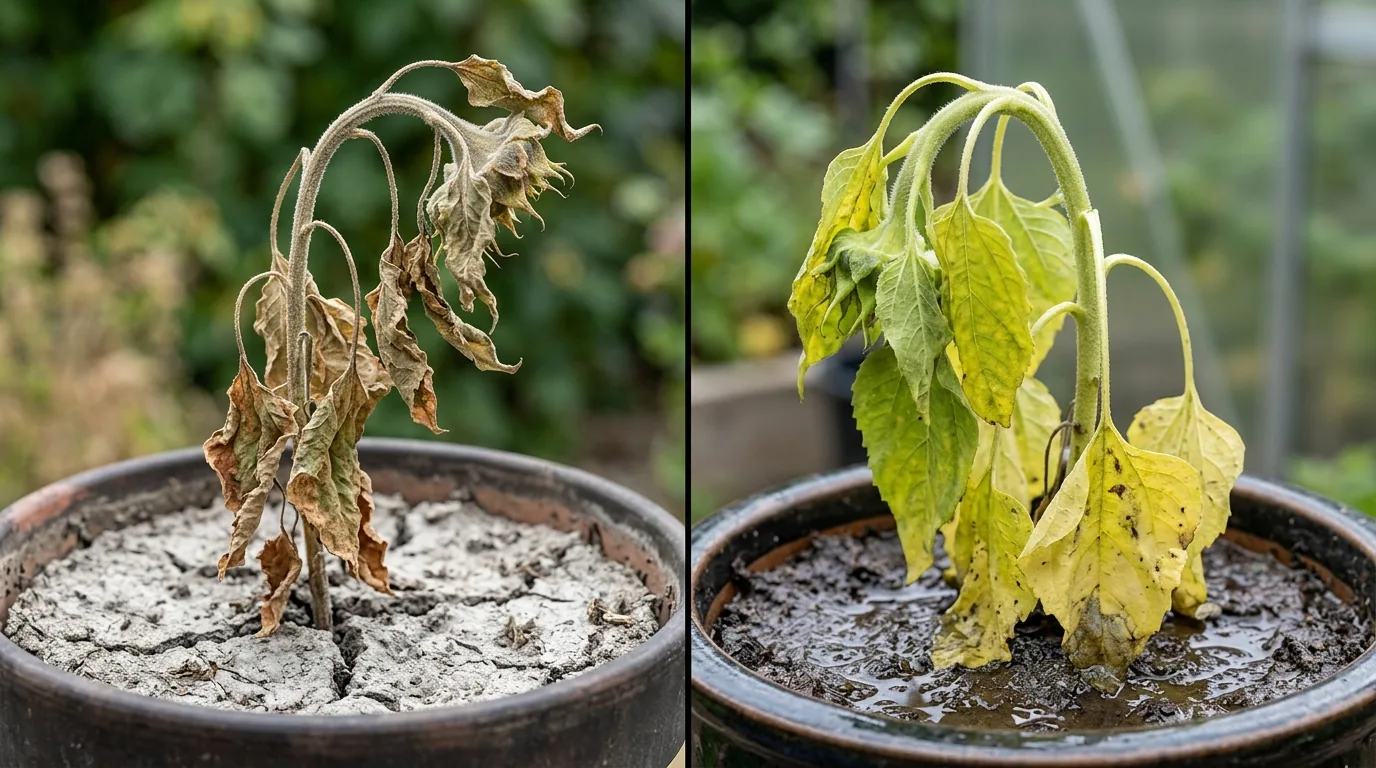
- Underwatered Sunflower: Leaves feel dry, crisp, papery, and brittle. The entire plant wilts uniformly from top to bottom. The soil is visibly cracked, hard, or pulled away from container walls. When watered, the plant recovers firmness within 2 to 4 hours.
- Overwatered Sunflower: Leaves feel soft, limp, and water-soaked. Lower leaves turn pale yellow while remaining soft. The soil is muddy, wet, and emits a sour or swampy odor. The stem at the soil line feels soft, mushy, or discolored. Adding water causes the plant to wilt further.
Why are my sunflower leaves drooping or wilting in the afternoon?
If your sunflower droops on hot afternoons between 1:00 PM and 4:00 PM but recovers completely by dusk or early morning, the plant is experiencing temporary transpiration lag, not true soil drought. In intense heat and direct sun, large leaves transpire moisture faster than roots can absorb it, even in moist soil. The plant temporarily reduces turgor pressure to protect itself.
Check the soil 3 inches down before reacting. If the soil is moist, do not add more water. Adding water to already moist soil during midday heat suffocates roots and causes permanent damage. Only water if the foliage remains wilted after sunset or early the following morning.
Why are the bottom leaves of my sunflower turning yellow and falling off?
Yellowing lower leaves stem from three distinct causes:
- Overwatering & Soil Compaction: If the soil is continually damp and lower leaves turn pale yellow before rotting, the root system is suffocating from excess water and poor drainage.
- Natural Lower-Canopy Shading: As giant sunflowers grow 8 to 12 feet tall, the massive upper canopy casts deep shade on the lowest leaves. Lacking sufficient sunlight to perform photosynthesis, the plant naturally recycles mobile nitrogen from the lowest foliage and sheds those leaves. This is normal and harmless.
- Nitrogen Deficiency from Leaching: Nitrogen is a mobile plant nutrient. In sandy soils subjected to heavy watering or rainfall, nitrogen leaches past the root zone, causing uniform chlorosis across lower foliage. Apply a balanced organic liquid fertilizer (such as fish emulsion or compost tea) to restore nitrogen levels.
Why is my sunflower leaning or toppling over?
A sunflower leans or topples when shallow, surface-level watering prevents the taproot from developing deep anchoring roots. Combined with soggy, saturated topsoil that turns to soft mud under a heavy rain, the immense weight of a blooming flower head pulls the stem sideways. To prevent toppling, water deeply to force roots down, mound 3 inches of soil around the base of the stem at week 6, and stake tall varieties with bamboo canes or t-posts early in the season.
| Observed Symptom | Soil State at 3 Inches | Foliage & Stem Texture | Root Condition | Actionable Solution |
|---|---|---|---|---|
| Dry crisp wilt, curled leaf tips | Bone dry, hard crust | Papery, brittle leaves, stiff stem | Healthy white fibrous roots | Apply slow, deep root soak immediately; repeat in 48 hours |
| Limp soggy droop, yellowing lower leaves | Saturated, muddy, foul odor | Soft, rubbery leaves, mushy stem base | Brown, slimy, decaying roots | Halt watering completely; aerate soil; drench with biofungicide |
| Afternoon wilt, morning recovery | Cool, evenly moist | Soft limp midday droop, firm at dusk | Firm white roots functioning normally | Normal heat response; do not water; mulch soil to cool roots |
| Lower leaves yellowing & shedding cleanly | Moderately moist | Soft yellow leaves, upper canopy green | Healthy root network | Natural canopy shading; prune dead leaves; feed mild organic nitrogen |
| Stalk leaning 30 degrees after wind/rain | Waterlogged, soft mud | Stem intact but tilted at root crown | Roots shifting in loose soil | Stake immediately; pack dry compost around base; water deeper |
Section 9: Triage and Recovery Protocols: Rescuing Struggling Plants
When plants suffer severe moisture stress, following a structured recovery protocol restores health without causing secondary shock.
Can you revive an overwatered sunflower with root rot?
Yes, you can revive an overwatered sunflower if caught before fungal decay girdles the main stem collar. Follow this 5-step botanical rescue protocol:
Step 1 (Halt All Irrigation): Stop watering immediately. Remove any mulch surrounding the stem to allow sunlight and airflow to dry the soil surface.
Step 2 (Eliminate Standing Water): If growing in a container, dump standing runoff from saucers immediately. Ensure drainage holes are not clogged with soil or roots. Raise the container on pot feet or bricks to promote gravity drainage.
Step 3 (Soil Aeration): In garden beds, take a clean garden fork and gently push it 6 to 8 inches into the soil around the plant drip line (avoiding the main stem). Rock the fork backward slightly to open air fissures in the waterlogged soil, reintroducing oxygen into the suffocating root zone.
Step 4 (Container Root Surgery): For severely affected potted sunflowers, slide the root ball from the pot. Inspect the roots: healthy roots are firm and creamy-white, while rotted roots are dark brown, black, and slimy. Using sterilized shears, trim away all decaying roots. Repot the plant into fresh, dry potting mix amended with 30 percent perlite.
Step 5 (Biological Fungicide Drench): Drench the soil with a biological fungicide containing beneficial Bacillus amyloliquefaciens or Trichoderma fungi. These beneficial microbes outcompete Pythium and Rhizoctonia pathogens, allowing surviving root tips to regenerate.
Can you revive an underwatered, severely wilted sunflower?
Yes, severely underwatered sunflowers possess remarkable rebound capability if rehydrated correctly. When a plant is completely desiccated, soil often turns hydrophobic (repelling water), causing moisture to run down cracks and bypass the root ball entirely.
Follow this 4-step graduated rehydration protocol:
Step 1 (The Initial Primer Soak): Apply 0.5 to 1 gallon of water slowly around the base of the plant to break surface hydrophobicity. Allow the water to soften the soil crust for 20 minutes.
Step 2 (The Deep Saturating Soak): Deliver the full target volume (2 to 4 gallons) slowly using a soaker hose or low-flow wand over a 30-minute period, allowing water to infiltrate down to the deep taproot.
Step 3 (Temporary Sun Protection): If growing in a container, move the pot into bright, indirect shade for 24 hours while cells regain turgor pressure. If in the ground during a 95°F heatwave, erect a temporary 30 percent shade cloth to lower transpiration demand.
Step 4 (Foliar Refresh): Mist the foliage lightly with cold water in early evening to reduce vapor pressure deficit. Within 4 to 8 hours, leaves will re-inflate and stand upright.
Section 10: Special Care: How to Water Cut Sunflowers in a Vase
Sunflower hydration does not end in the garden. For cut-flower enthusiasts, florists, and home decorators, properly managing vase water physics extends cut sunflower vase life from 4 days to nearly two weeks.
How should you water cut sunflowers in a vase to make them last?
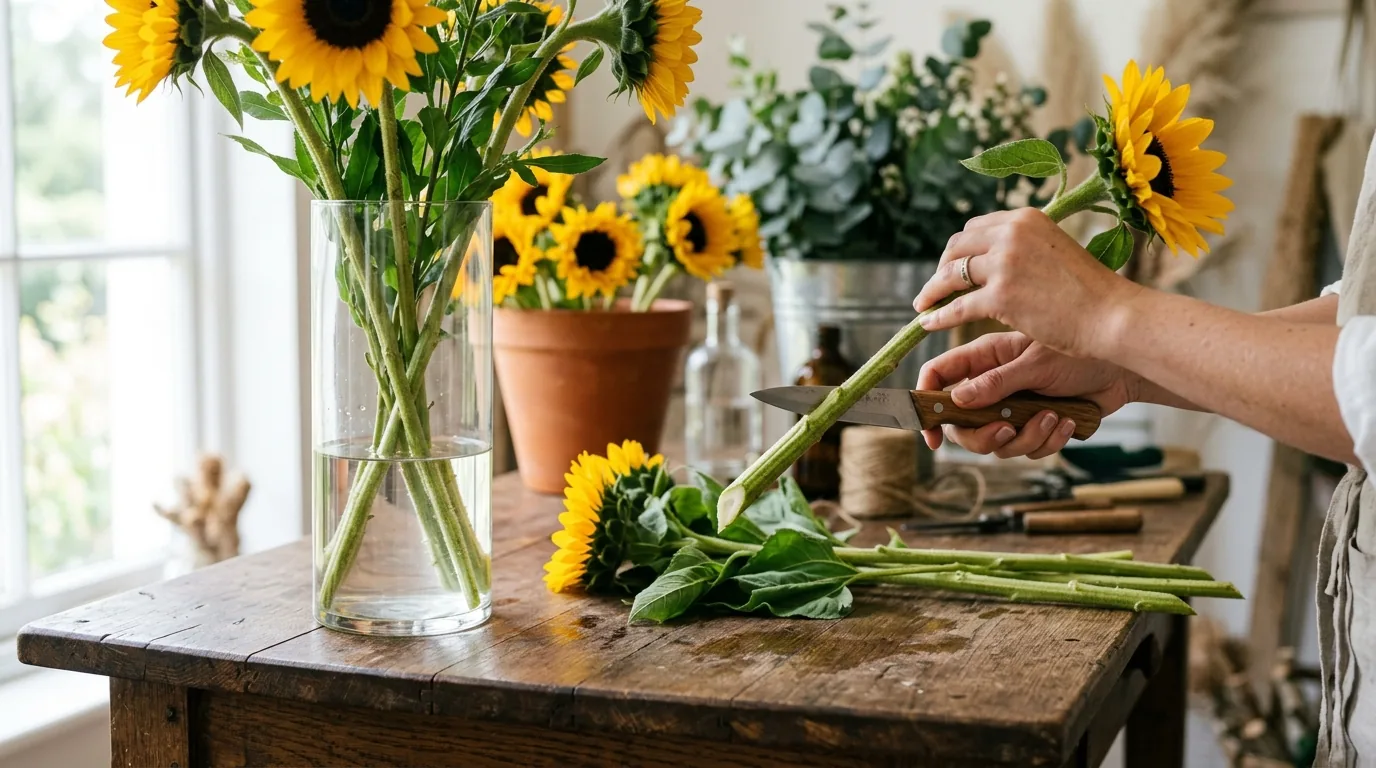
Harvest stems in the early morning when blooms are fully hydrated. Select stems whose ray petals have just opened at a 90-degree angle from the central disc, but before disc florets begin shedding pollen. Cut stems at a sharp 45-degree angle using a clean, razor-sharp floral knife or bypass shears. A 45-degree cut prevents the stem bottom from sealing flat against the vase base and maximizes surface area for water uptake.
Follow these cut-flower vase water management rules:
- 1. Use Lukewarm Water for Initial Filling: Fill a clean vase with lukewarm water (100°F to 105°F / 38°C to 40°C). Lukewarm water contains fewer dissolved air bubbles than cold water and flows through vascular xylem tubes much faster, rapidly rehydrating stems.
- 2. Strip Lower Leaves: Strip all leaves from the lower two-thirds of the stem. Any foliage submerged underwater decays rapidly, breeding millions of bacteria that clog xylem tubes and cause flower heads to droop.
- 3. Acidify and Nourish the Water: Add commercial floral preservative, or prepare an effective homemade recipe: 1 quart of warm water + 1 tablespoon granulated sugar (nourishes opening petals) + 1 teaspoon citric acid or lemon juice (lowers pH to 3.5-4.0 to accelerate water flow) + 3 drops of household bleach (suppresses bacterial slime).
- 4. Refresh Water Every 48 Hours: Cut sunflowers are heavy drinkers, consuming up to 2 inches of vase water daily. Check the water level every morning. Empty the vase, rinse it thoroughly, recut 1/2 inch from the stem bottoms at a 45-degree angle, and refill with fresh water every two days.