⚡ Quick Answer
Starting vegetables from seed saves money and gives you access to hundreds more varieties than transplants. Most seeds germinate in 3–10 days when kept at 65–75°F with consistent moisture. Start seeds 6–8 weeks before your last frost date for outdoor gardens, or anytime for indoor hydroponic setups.
You do not need forty seed packets. You need about eight that will actually grow in your space, and I will show you how to pick them.
Every home gardener knows the mid-January daydream. The holiday decorations are packed away, the ground outside is frozen solid, and the first glossy seed catalogs arrive in your mailbox. You sit down with a cup of coffee and a red pen, circling heirloom melons, giant brand-name beefsteak tomatoes, three types of kale, and four colors of carrots. You order forty dollars worth of seeds with grand visions of feeding your family all summer.
Then June arrives. Half of those packets sit untouched in a drawer. The varieties you did plant are fighting for elbow room in a single raised bed that only receives four hours of direct sun. The sprawling winter squash vines have smothered your bush beans, and your prize tomatoes are dropping their blossoms because your regional growing season is three weeks too short for that particular cultivar. You spent fifty dollars on seeds and ended up with twenty dollars worth of stunted produce.
Most seed-buying advice starts at the wrong end. It hands you a list of websites and tells you to browse before you know what your garden can physically support. The secret to a high-yield garden is treating seed selection as the final step of a deliberate planning system, not the first.
✓ Key Takeaways for Seed Planning
- Audit your square footage before shopping: The physical dimensions and sunlight hours of your beds dictate your seed list. A standard 4×8 raised bed accommodates 8 to 12 productive vegetable plants, not an entire seed catalog.
- Seed catalogs are free agronomic textbooks: Use catalogs to research days to maturity, disease resistance codes, and regional adaptability before visiting an online checkout cart.
- Seed categories carry real functional trade-offs: Hybrids provide reliable vigor and disease resistance for beginners; open-pollinated heirlooms deliver heritage flavor and true-to-type seed saving.
- Choose regional seed companies over massive generic re-packers: Seeds bred and trialed in your climate zone outperform national catalog varieties every single time.
- Cap your first garden at eight to ten varieties: Focus on heavy-producing staples you love to eat and expensive grocery crops, leaving room for one or two fun experiments.
Planning Your Growing Space Before You Buy Seeds
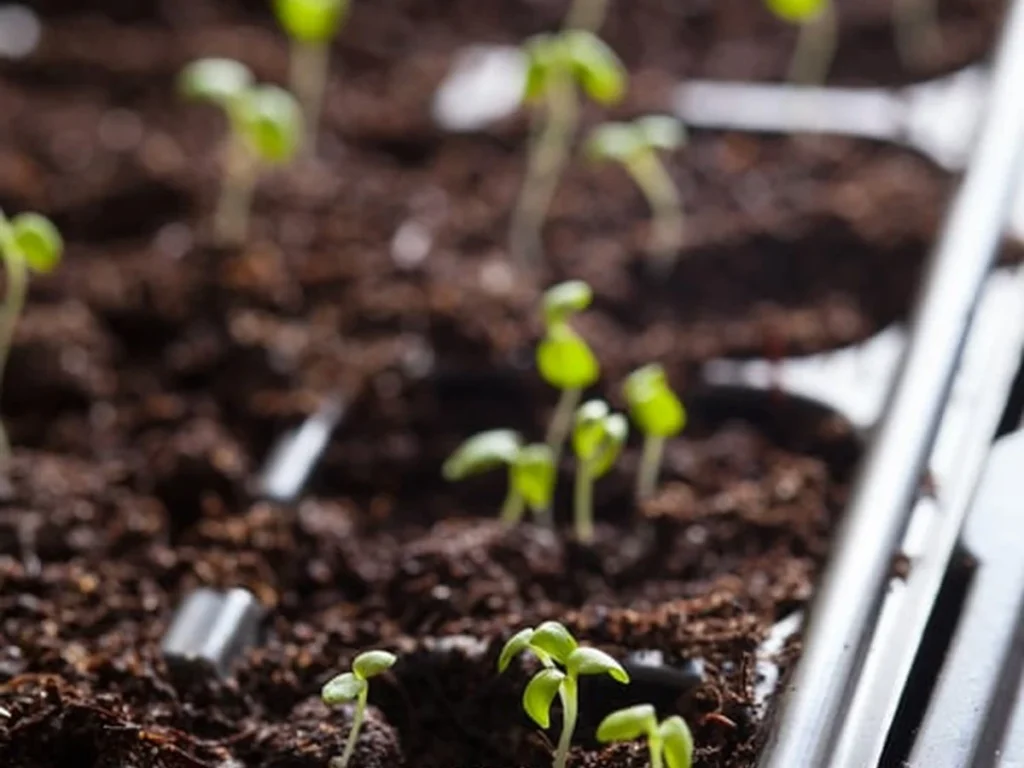
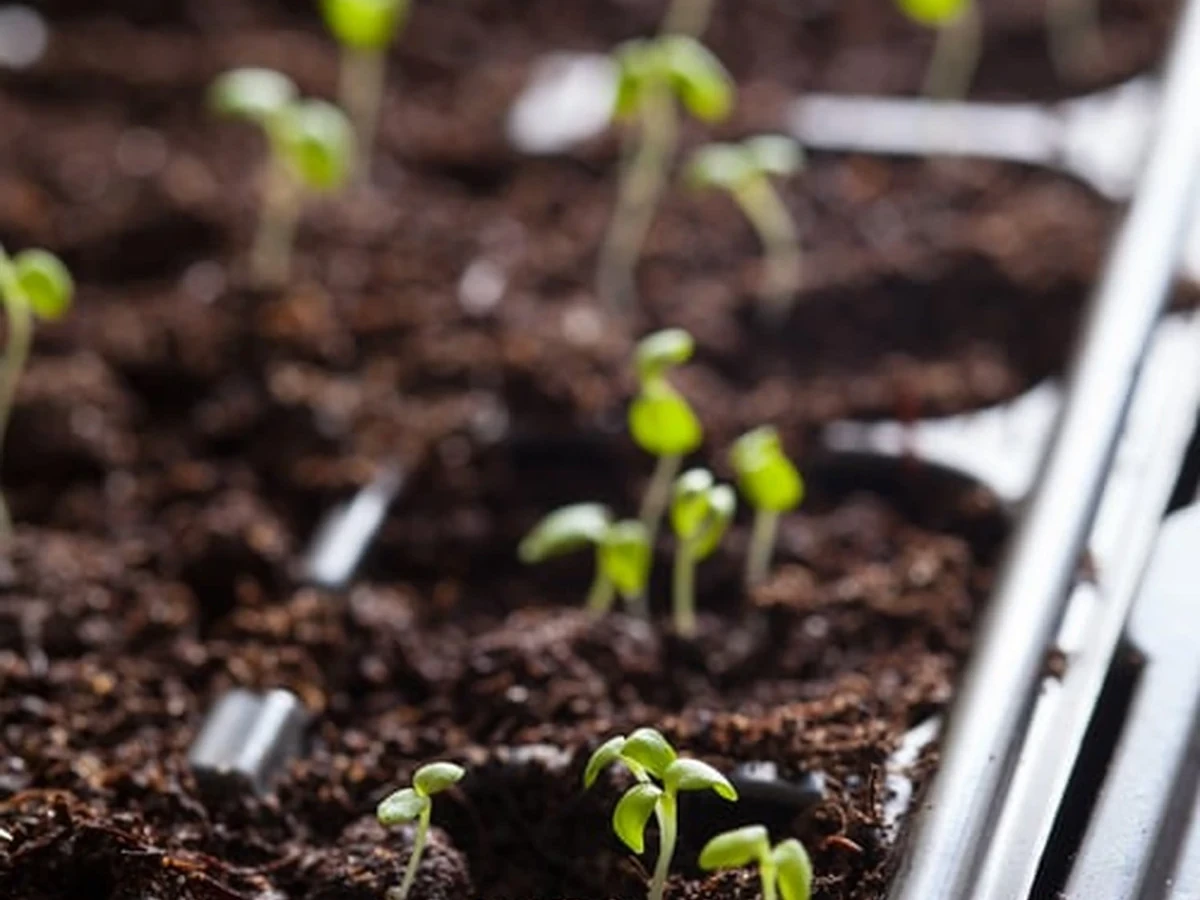
According to seed germination and pathology research from Penn State Extension, maintaining steady bottom heat (70°F to 75°F) and sterile starting media prevents damping-off fungal pathogens (Pythium and Rhizoctonia) from compromising tender juvenile roots.
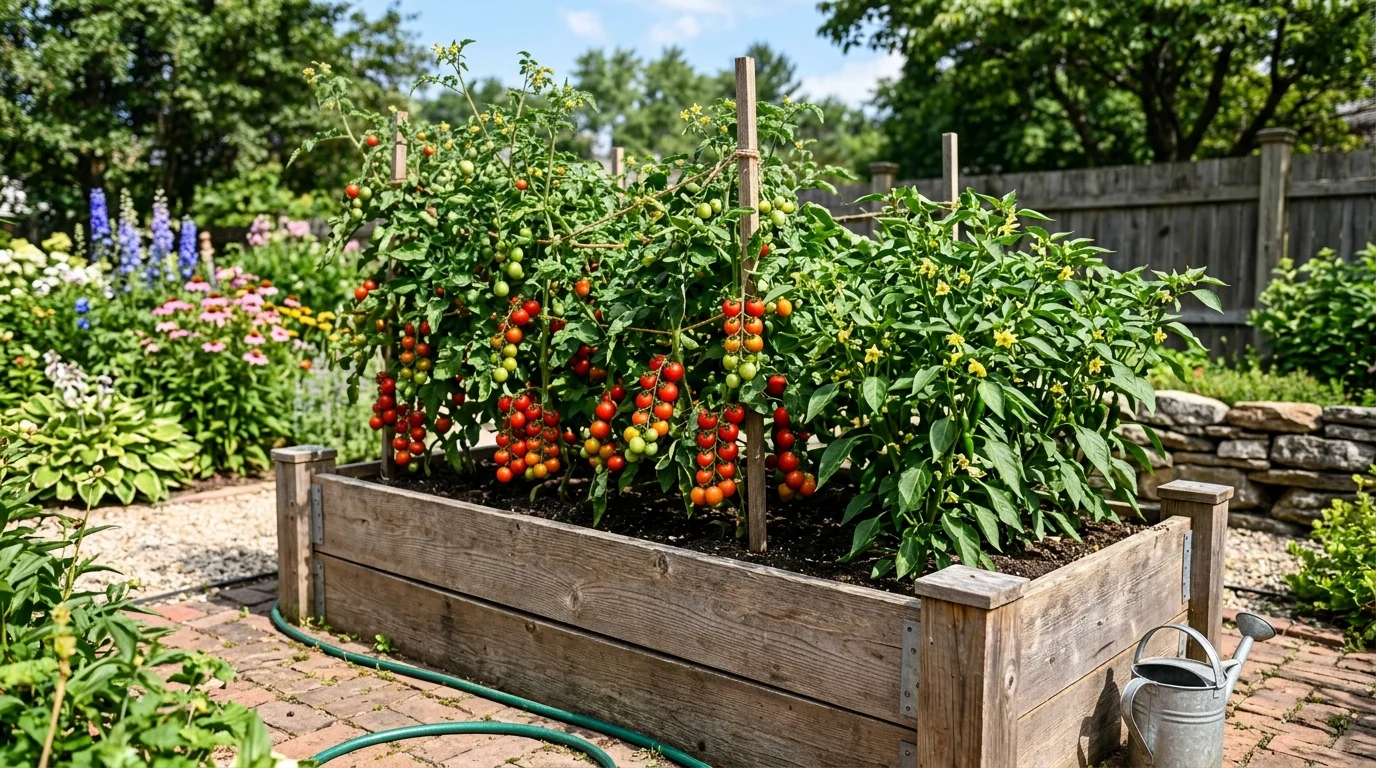
Buying seeds before measuring your garden space is the fastest way to waste money and guarantee a tangled, unproductive garden.
The Problem: You fall in love with individual plant descriptions in a catalog. You buy indeterminate tomatoes, pole beans, pumpkins, zucchini, and cucumbers. When spring arrives, you realize all five of those crops require enormous vertical trellising or twenty square feet of horizontal root space each.
The Agitation: You cram them together into an eight-foot garden box. Within six weeks, the zucchini leaves cast deep shade over the bush beans. Mildew spreads because air cannot circulate through the tangled canopy. The plants exhaust the available soil nutrients, and you spend July fighting fungal blight and untangling vines rather than harvesting vegetables.
The Solution: Reverse the process. Measure your square footage, chart your sunlight, choose your growing structure, and calculate your exact planting capacity before spending a single dollar on seeds.
Calculate your garden in square feet, not in rows. A standard 4×8 foot raised bed provides 32 square feet of growing surface. That space comfortably holds 2 indeterminate tomatoes on trellises, 4 sweet peppers, a 2×4 foot patch of bush beans, and a border of cut-and-come-again salad greens. That is roughly 8 to 12 mature plants total. Ordering 25 packets of large crops for that bed guarantees overcrowded failure.
For beginner home gardeners, raised beds provide the most reliable growing environment. They give you complete control over soil drainage, warm up two to three weeks earlier in spring than in-ground dirt, and keep aggressive turf grasses out of your planting zone. If you have not built or purchased your beds yet, read our hands-on field guide to choosing raised garden beds for comparisons of cedar, corrugated metal, and composite setups.
Custom Milestone Timeline: Indoor Growing Cycle Planner
Track week-by-week milestones from germination to harvest with custom lighting hours, pruning dates, and nutrient schedules for your specific crops.
Understanding Seed Types: Heirloom, Hybrid, Open-Pollinated, and Organic
Seed catalog descriptions throw around botanical terms that confuse new growers. These labels are not marketing buzzwords; they define the genetic origin and performance characteristics of the plant inside that paper packet.
Understanding these four seed categories helps you choose the right balance of reliability and flavor:
The Beginner’s Decision Rule: Do not fall into the trap of believing you must choose 100% heirloom or 100% hybrid. The smartest home gardens use a targeted blend. Rely on tough F1 hybrids for crops prone to regional diseases (like late blight on tomatoes or powdery mildew on cucumbers), and choose open-pollinated heirlooms for crops where flavor reigns supreme (like melons, sweet peppers, and pole beans).
Using Free Seed Catalogs as Research Tools
A reputable seed catalog is not just a sales brochure. It is a comprehensive, free agronomy handbook delivered straight to your door.
Commercial seed houses invest thousands of dollars testing varieties in trial gardens across the country. Their catalog entries compress critical operational data that you cannot easily find on a generic store display rack. To discover which companies ship high-value print editions at zero cost, browse our curated resource on ordering free seed catalogs.
How to Decode a Seed Catalog Entry
When you open a detailed catalog from an established outfit like Johnny’s Selected Seeds or Territorial Seed Company, each variety description contains a dense block of technical abbreviations. Here is how to extract the actionable facts:
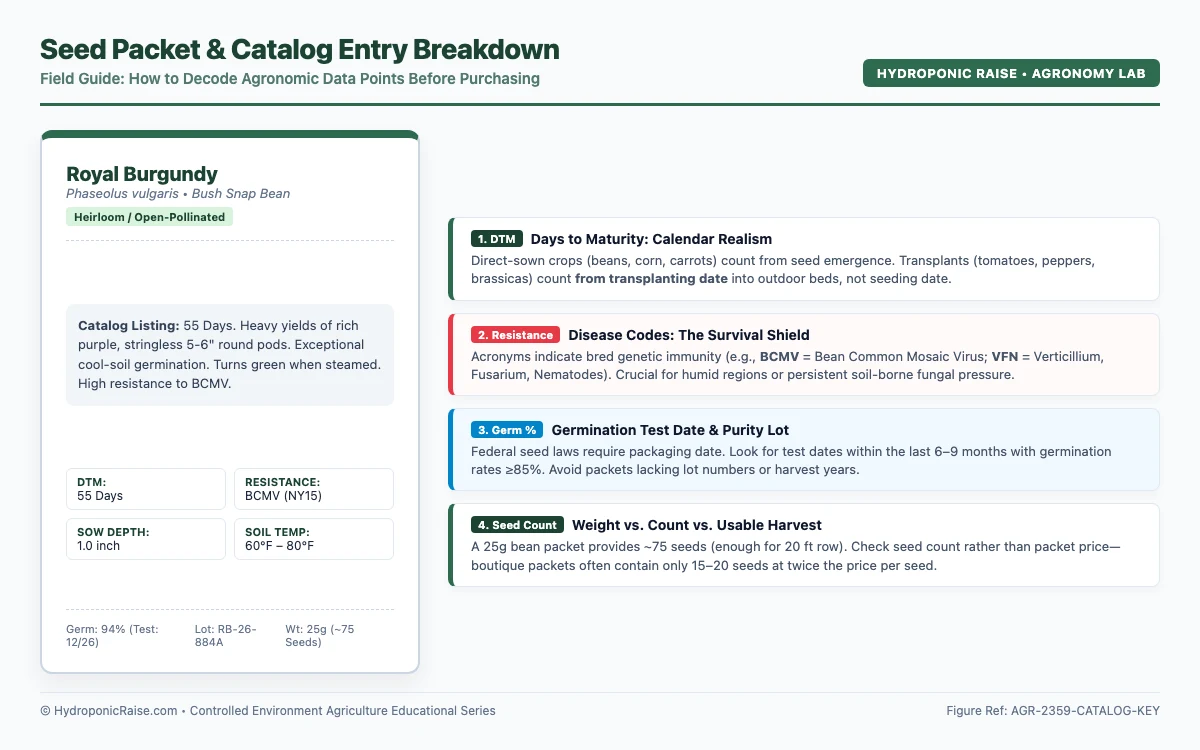
- Days to Maturity (DTM): For direct-seeded crops (like carrots, beans, and radishes), DTM measures days from seed sprouting to first harvest. For transplanted crops (like tomatoes, peppers, and eggplants), DTM measures days from transplanting into the garden to first ripe fruit. If your region has 90 frost-free days and a tomato has a 85 DTM from transplant, direct sowing will never produce ripe fruit.
- Growth Habit (Determinate vs. Indeterminate): On tomatoes, “determinate” means the plant grows to a set height (typically 3 to 4 feet), sets all its fruit over a compact three-week window, and stops growing—ideal for small cages and canning. “Indeterminate” vines continue growing, vining, flowering, and fruiting until frost kills them, demanding heavy 6-foot stakes.
- Disease Resistance Letter Codes: High-end catalogs list letter codes following the variety name. A tomato marked “VFN” possesses genetic resistance to Verticillium wilt (V), Fusarium wilt (F), and root-knot Nematodes (N). If your garden beds struggled with yellowing leaves last summer, selecting varieties carrying these codes solves the problem at the genetic level.
- Seed Count per Packet: Always verify seed count. A two-dollar packet containing 15 seeds costs significantly more per plant than a four-dollar packet containing 250 seeds.
Evaluating Seed Companies: What Actually Matters
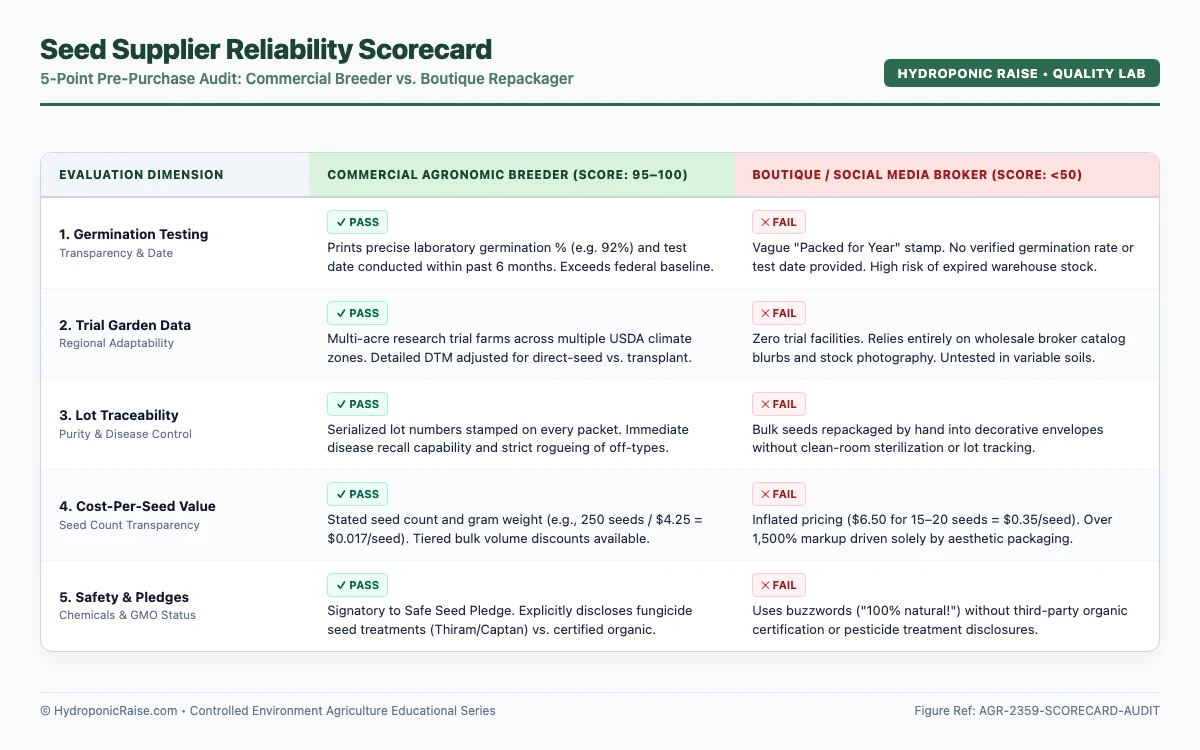
A seed company with 200,000 Instagram followers and pastel packaging is not automatically a reliable seed source. Many boutique seed sellers do not grow their own seeds; they purchase surplus wholesale lots from commercial brokers, repackage them in decorative envelopes, and charge a 300% markup.
Trustworthy seed suppliers differentiate themselves through verifiable germination testing, clear lot tracing, and regional field trials. Explore our tested recommendations in our guide on choosing a seed company.
The Seed Company Scorecard (Audit Before You Buy)
- Germination Rate Transparency: The packet or online listing should clearly state the verified germination percentage and test date. Established suppliers regularly test lots and report germination exceeding 85% to 95%.
- Regional Trial Verification: Choose suppliers who test varieties in climates matching your own. A seed house in Maine trials for cool spring soils and short summers, while a grower in the Southwest requires varieties trialed for intense heat and drought.
- Lot Tracking & Freshness Dates: Every packet must state the packed-for year (e.g., “Packed for 2026”). Avoid suppliers who omit test dates or sell unsealed paper packets without interior moisture barriers.
- Clear Agronomic Guidance: Reliable companies provide exact sowing depths, germination soil temperatures, row spacing, and days to maturity directly on the envelope.
- Customer Service & Replacement Policy: Trustworthy seed companies stand behind their stock and replace compromised or non-germinating seed lots promptly upon request.
Where to Buy Seeds Online: A Practical Purchasing Guide
Buying seeds online gives you access to thousands of open-pollinated heirlooms and specialized disease-resistant hybrids that big-box home improvement stores never carry. However, the online marketplace is flooded with counterfeit seeds, stale warehouse stock, and misleading product photos.
For a detailed breakdown of shipping rates, seed freshness standards, and retailer pros and cons, see our comprehensive guide to buying seeds online.
Place your seed orders in January or early February. High-demand varieties, popular short-season heirlooms, and specialty micro-dwarf vegetables sell out rapidly. Waiting until late March or April leaves you settling for backorders or second-choice substitutes that may not fit your bed dimensions.
Direct Sourcing vs. Third-Party Marketplaces: Always buy directly from the seed producer’s official website rather than third-party storefronts on Amazon or general online auction sites. Third-party marketplace sellers often store seed envelopes in unconditioned, hot fulfillment warehouses for months, degrading germination rates before the packet ever reaches your mailbox.
For beginner home gardeners, Johnny’s Selected Seeds remains a premier benchmark. While their packet prices run slightly higher than discount retailers, their germination rates are rigorously tested, and their website hosts extensive free growing calculators and instructional guides that serve as a complete gardening education.
Selecting Varieties That Actually Earn Their Place
Sourcing clean, high-germination seed from reputable regional suppliers saves you weeks of frustration. Check our comprehensive test of the 15 best places to buy seeds online to compare germination rates, seed counts, and true shipping costs.
Every square foot of garden soil incurs real costs in compost, water, and labor. A vegetable variety must earn its spot in your beds by delivering exceptional flavor, high productivity, or grocery bill savings that justify your time.
The Three-Tier Selection Framework
- Grow What You Truly Eat Daily (4 to 5 Varieties): Do not plant five types of radishes if your household eats radishes twice a year. Fill the majority of your space with everyday kitchen staples: crisp slicing cucumbers, sweet bell or frying peppers, and fresh salad greens.
- Grow What Is Expensive at the Grocery Store (2 to 3 Varieties): Supermarkets charge exorbitant prices for delicate produce that travels poorly. Fresh culinary herbs (basil, cilantro, dill), gourmet heirloom cherry tomatoes, and specialty baby greens yield hundreds of dollars in grocery savings from a single seed packet.
- Grow One or Two Experiments for Fun (1 to 2 Varieties): Reserve 10% of your bed for an exciting curiosity—a dark purple pepper, a heatless habanada, or a rare heirloom bean. If it thrives, promote it to next year’s core list; if it underperforms, you lost very little space.
Worked Example: Royal Burgundy Bush Beans
To understand what a variety that “earns its place” looks like in a home garden, examine Royal Burgundy bush beans. Read our complete grower profile on Royal Burgundy bush beans to see why this heirloom variety consistently outperforms standard green snap beans.
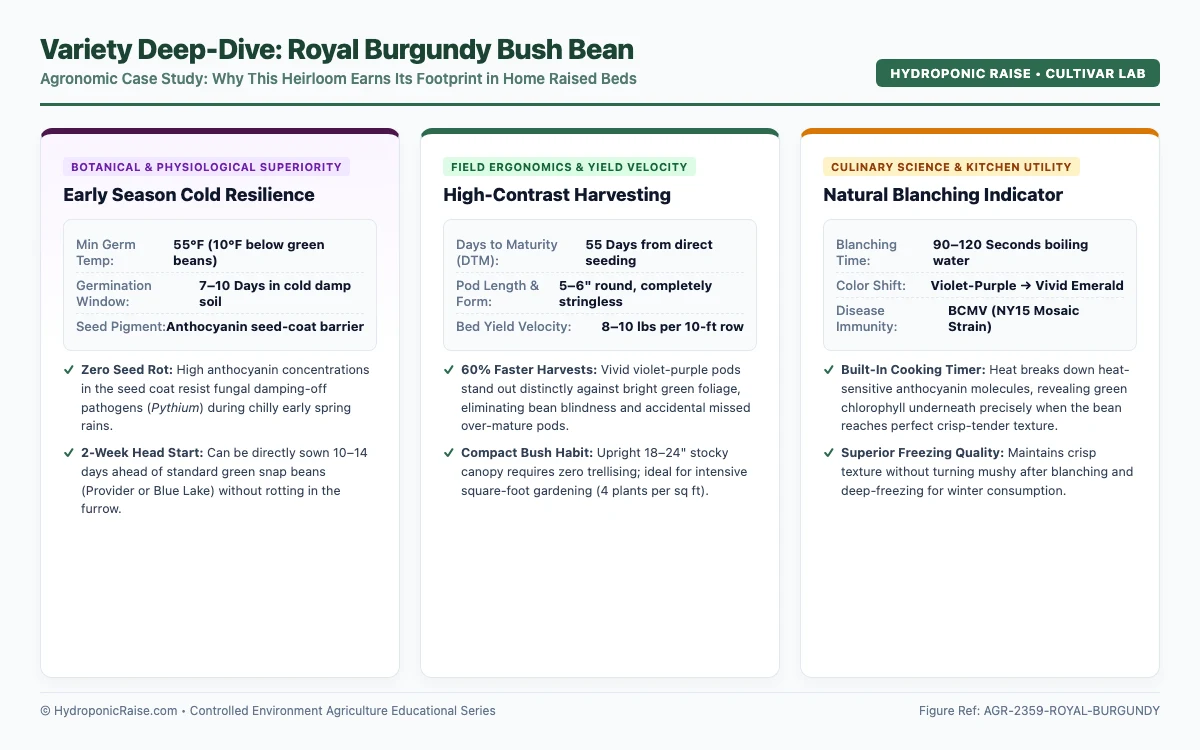
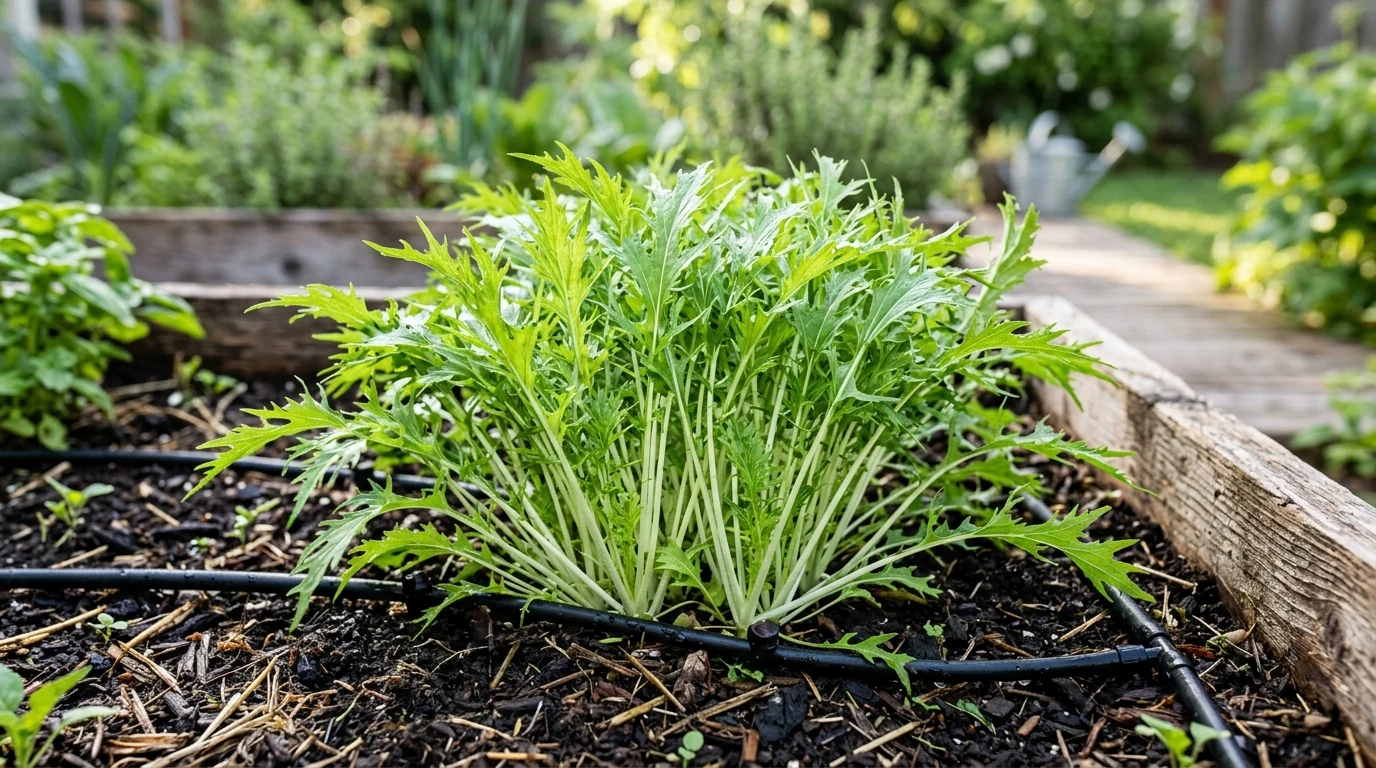
Royal Burgundy earns its garden space through three practical advantages:
- Cold-Soil Germination: Standard green beans rot in cold spring ground. Royal Burgundy seeds germinate reliably in soil temperatures as low as 55°F, allowing you to plant two weeks earlier than your neighbors.
- High-Contrast Harvesting: Standard green beans camouflage perfectly against green leaves, causing you to miss mature pods until they turn tough and stringy. Royal Burgundy produces vibrant violet-purple pods that stand out instantly against green foliage, cutting harvest time in half.
- Built-In Blanching Indicator: In the kitchen, the purple pods turn emerald green the exact second they are blanched to tender-crisp perfection in boiling water, acting as a natural cooking timer.
Common Seed-Buying Mistakes That Waste Money and Seasons
Every experienced grower has made expensive catalog errors. Recognizing these six common missteps before finalizing your online cart keeps your garden productive and saves your budget:
Frequently Asked Questions (FAQ)
What is the difference between heirloom and hybrid seeds?
When should I order seeds for a spring garden?
Are free seed catalogs actually free?
How many seeds do I need for a raised bed?
What is the best seed company for a beginner?
Can I save seeds from hybrid plants?
Seed Germination Temperature, Moisture & Initial Feeding Matrix
Critical botanical thresholds for indoor nursery flats, rockwool germination plugs, and seedling heat mats.
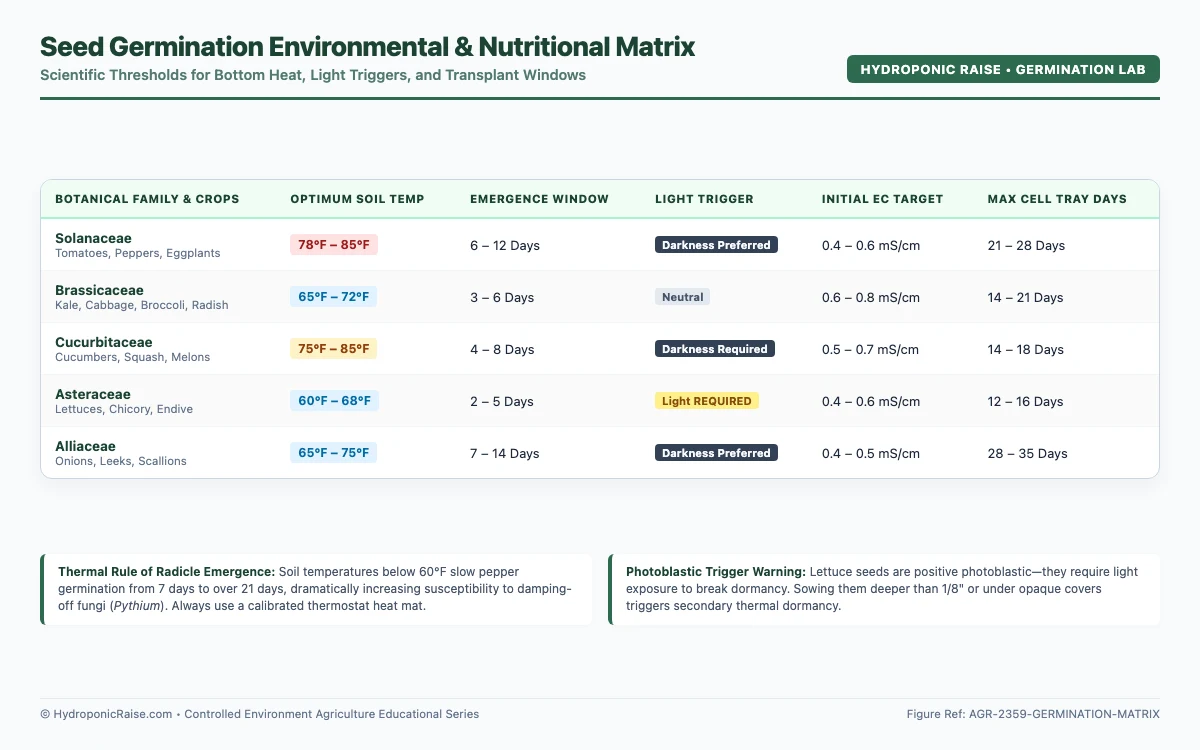
| Botanical Family | Optimal Germ Temp (°F) | Emergence Window | Light Trigger at Sowing | Initial Medium EC | Max Cell Tray Days |
|---|---|---|---|---|---|
| Solanaceae (Tomato, Pepper, Eggplant) | 78°F – 85°F (25°C–29°C) | 6 – 12 Days | Darkness Preferred (Cover lightly) | 0.0 – 0.2 (Dechlorinated RO) | 21 – 28 Days |
| Brassicaceae (Kale, Cabbage, Bok Choy) | 65°F – 72°F (18°C–22°C) | 3 – 6 Days | Light Neutral (Surface Sow) | 0.4 – 0.6 mS/cm | 14 – 20 Days |
| Cucurbitaceae (Cucumber, Zucchini) | 80°F – 88°F (26°C–31°C) | 3 – 5 Days | Darkness Preferred | 0.4 – 0.6 mS/cm | 10 – 14 Days (Fast Taproot) |
| Asteraceae (Lettuce, Endive) | 60°F – 68°F (Heat Dormant >75°F) | 2 – 4 Days | Light Required (Do NOT bury) | 0.4 – 0.8 mS/cm | 10 – 14 Days |
| Alliums (Onion, Leek, Chives) | 65°F – 70°F (18°C–21°C) | 7 – 14 Days | Darkness Preferred | 0.2 – 0.4 mS/cm | 28 – 35 Days |