
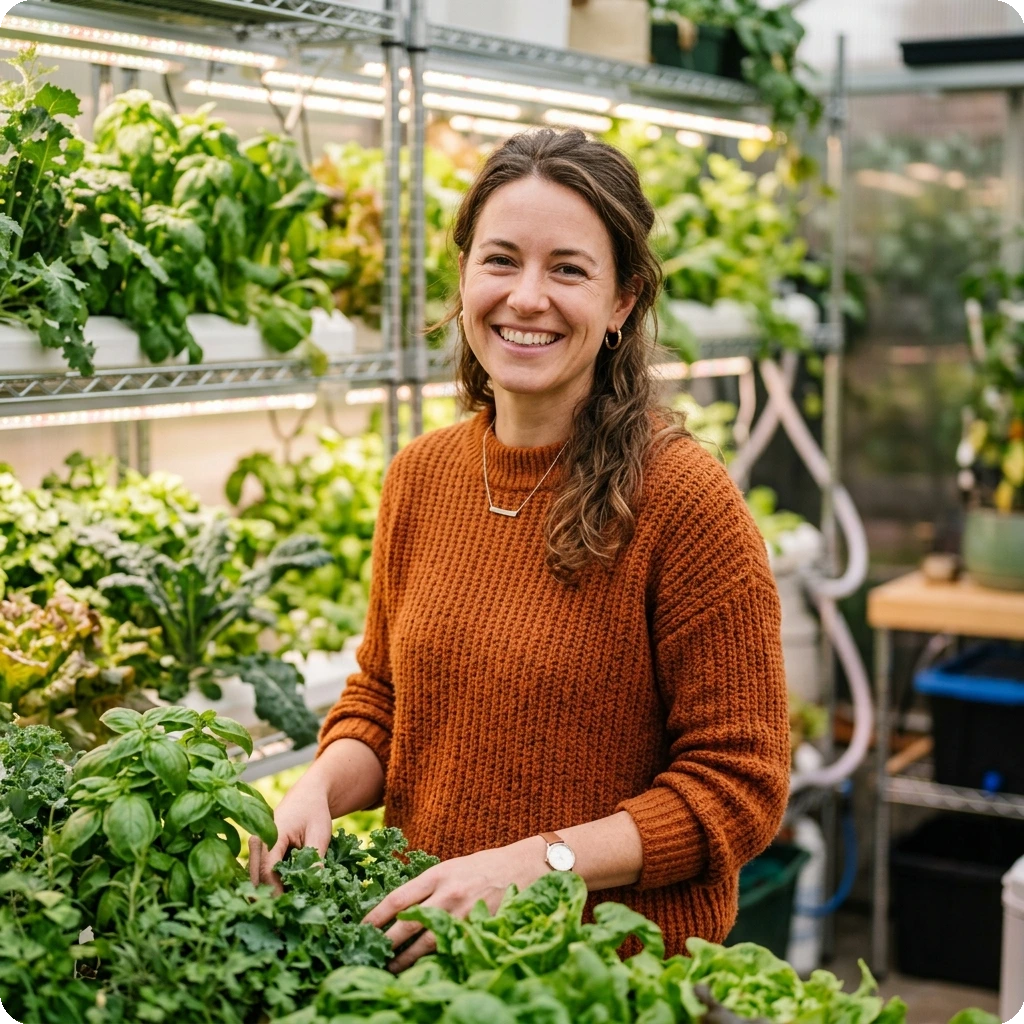
Sophia Reed
Certified Horticulturist & Indoor Cultivation Researcher
Growing food indoors since 2017. American Horticultural Society credentialed. Based in the Pacific Northwest, testing soilless cultivation protocols, photoperiod recipes, and nutrient chemistry.
How I Got Here
I built my first deep water culture system in 2017 using a five-gallon hardware store bucket, a cheap aquarium air pump, and three heads of butterhead lettuce. Two weeks into the cycle, reservoir water temperatures climbed past 76 degrees, pythium root rot took over, and the entire crop collapsed into brown slime. That early disaster taught me more about dissolved oxygen, water chilling, and sterile reservoir maintenance than any textbook ever could.
That failure changed everything. It forced me to stop trusting generic forum advice and start studying the exact chemistry of plant nutrition. I completed my Bachelor of Science in Plant Science, earned professional certification through the American Horticultural Society, and expanded from that single closet bucket to a multi-tier vertical operation with over 400 square feet of canopy.
Over the past eight years, I have grown everything from heavy-feeding Roma tomatoes and hot peppers to culinary herbs and dwarf Meyer lemons indoors. I also consult for small commercial urban farms in Oregon, Washington, and Northern California, helping growers balance macro and micro nutrients while keeping electricity costs sustainable.
Why I Built Hydroponic Raise
Most hydroponic content online is written by affiliate marketing agencies that rewrite manufacturer spec sheets without ever plugging in a water pump. Plants do not care about marketing claims. If a submersible pump rattles loud enough to vibrate your living room floor, if an LED driver runs hot enough to scorch canopy leaves, or if a bottled nutrient solution creates stubborn calcium lockouts in tap water, growers need to know before spending their money.
Every guide, nutrient calculation table, and hardware review on this site comes directly from my own benches. I share the exact EC targets, pH adjustments, and lighting photoperiods that work in real indoor conditions, including the common mistakes that ruin crops.
Core Cultivation Focus Areas
- Deep Water Culture (DWC) and Recirculating DWC: Dissolved oxygen saturation, reservoir temperature mitigation, and sterile root zone management.
- Nutrient Film Technique (NFT): Channel slope angles, flow rate calibration (1 to 2 liters per minute), and root damming prevention.
- Precision Horticultural Lighting: Daily Light Integral (DLI) targets, photosynthetic photon flux density (PPFD) mapping, and diode spectrum tuning.
- Vapor Pressure Deficit (VPD): Balancing leaf temperature, ambient humidity, and transpiration rates to prevent calcium tip burn.
- Nutrient Chemistry: Formulating customized N-P-K ratios, electrical conductivity (EC) tracking, and managing pH drift in municipal tap water.
Credentials & Background
- Bachelor of Science in Plant Science: Focus on plant physiology and controlled environment agriculture.
- Certified Horticulturist: Credentialed member of the American Horticultural Society.
- 7+ Years Practical Experience: Continuous soilless cultivation across active, passive, and vertical configurations.
- Commercial Consulting: Advising commercial microgreen facilities and indoor culinary herb growers on irrigation automation.
- Extensive Hardware Benchmarking: Hands-on operational testing of over 50 residential garden systems, full-spectrum LED fixtures, and digital nutrient meters.
Featured Field Guides by Sophia
Editorial Standards & Review Policy
All cultivation guides and equipment evaluations on Hydroponic Raise reflect hands-on testing. Hardware units undergo multi-week crop cycles under active plant load before receiving a recommendation.
We do not accept paid reviews or sponsored placements. When you purchase through affiliate links on our site, we may earn a referral commission at no additional cost to you, which funds our laboratory testing sensors and nutrient supplies. For details on our mission, visit our About Us page or reach out directly through our Contact page.