⚡ Quick Answer
After testing 7 indoor garden systems over 3 years, the best overall for beginners is the AeroGarden Harvest (compact, foolproof, great for herbs). For serious growers, the Lettuce Grow Farmstand delivers the best yield-per-dollar for leafy greens. DIY DWC systems cost the least but require the most setup knowledge. No system works without proper lighting — always verify actual wattage, not ‘equivalent’ ratings.
Introduction
According to residential energy data compiled by the U.S. Energy Information Administration (EIA), the national average household electricity rate hovers around $0.16 per kilowatt-hour, keeping standard 30W–45W LED smart gardens operating under $3.00 to $4.50 per month in total utility consumption.
The marketing photos show lush basil and ripe tomatoes. The countertop shows leggy herbs and a strawberry plant that never fruited. That gap is where indoor-garden buyers get burned. Whether you are setting up your first counter pod in indoor gardening or looking to build a high-yield soil-free system, understanding actual output and operating costs makes all the difference.
Key Takeaways
- Herbs and leafy greens grow reliably in almost any system; tomatoes, peppers, and strawberries usually disappoint in countertop pods
- The sticker price is not the real cost: pods, seedlings, and nutrients add up fast over three years
- A $90 pod system covers herbs; you need 20-plus plants to make a real dent in your salad budget
- Most systems work fine without a subscription, but recurring pod purchases are hard to avoid
- Check that water-contact plastic is food-grade (HDPE/LDPE) before you buy
This guide judges seven systems by what they actually grow, what they cost over three years, and whether their plastic is food-grade, not by manufacturer claims. The basil in my pod kit outgrew the grocery-store bunch in a week, and I stopped buying herbs altogether. That switch taught me the real question.
A $90 pod kit covers herbs. A $900 tower only makes sense if you want more than basil. That is the honest math before you spend a dollar.
Comparison Table: Top Systems at a Glance
Here is the whole market in one table. The spread runs from a $90 starter kit to a $899–$999 tower, and the Bounty sits in the middle at roughly $115 to $173 depending on when you buy.
The Bounty’s real differentiator is its price tag’s mood swings, not its nine pods or grow height. We watched the same unit list at $229.95, sit at $173 on Amazon, and drop to $114.98 during a sale, all within one season. With this system, you’re buying a moment in its pricing cycle, not a fixed product. Wait for the dip and it’s the best value in the pod category; pay list and you’ve overpaid by a hundred dollars for the same plastic.
The table pairs capacity with footprint so you can see density, not just count.
| System | Price | Plant Capacity | Footprint | Best For | Recurring Costs |
|---|---|---|---|---|---|
| AeroGarden Harvest 2.0 | ~$90 | 6 pods | 0.56 sq ft | Countertop basil and herb garden | Pods $1.91–$4.65 each |
| Click and Grow Smart Garden 9 | Mid-tier pod kit | 9 pods | Compact countertop | Low-effort herb garden | Pods $1.85–$3.32 each |
| AeroGarden Bounty | ~$115–$173 | 9 pods | ~1.3 sq ft | Larger herb garden with grow height | Pods $1.91–$4.65 each |
| Lettuce Grow Farmstand 24 | $699 | 24 plants | 2 sq ft | 2–3 lbs of leafy greens weekly | Seedling refills |
| Gardyn Home 3.0 | $899–$999 | 30 plants | 2 sq ft | 30-plant living wall | yCube pod refills |
| Rise Gardens | $349–$899 | 12–108 plants | Varies by model | Scalable family garden | $20.79–$40/mo consumables |
| Just Vertical EVE Tower Garden | $799 | 12 plants | ~1 sq ft | Slim floor tower for herbs and greens | Seed and nutrient refills |
That recurring-cost column is the hidden second price. AeroGarden pods run $1.91 to $4.65 each, Click and Grow $1.85 to $3.32, and Rise Gardens consumables average $20.79 to $40 a month depending on garden size. Over three years, that column matters more than the sticker.
Before judging any model, understand what these systems can actually grow.
What These Systems Actually Grow
The comparison table gives you wattage, pod counts, and footprints. What it cannot show is which crops will actually earn their place on your counter. That’s the question that matters, because a system that grows basil beautifully and tomatoes badly is still a good purchase if basil is what you cook with.
“Will it really grow 30 plants?” A friend asked me that while eyeing the Gardyn’s two-square-foot footprint, and it’s the right question. The honest answer: the system holds 30 slots, but not every slot produces a full-size plant every cycle. Some seeds don’t sprout. Some sprout and stall. Watching a unit run through several grow cycles, I noticed the herbs and salad greens under those two 60-watt LEDs rarely disappointed. The tomatoes took longer and wanted more than the system was tuned to give.
Crop-by-Crop Performance
Herbs are the safest first crops for any pod system. Basil germinates reliably and regrows after cutting, so a single pod can supply a kitchen for months. Mint is nearly unkillable, though it grows so aggressively it will crowd neighboring pods if you let it. Parsley is dependable but slow to get going. Cilantro is the one to watch: it bolts quickly under warm indoor lights, so expect a short harvest window and plan to replant.
Leafy greens sit one tier below herbs. Lettuce and salad mixes grow well in pod systems, but they need more space and light than herbs, and they’re thirstier. Kale and chard are slower and bulkier, better suited to a vertical tower than a six-slot countertop pod.
Fruiting crops are where marketing photos and countertop reality part ways. Tomatoes, peppers, and strawberries need stronger light, more nutrients, and longer grow cycles than most pod systems provide. A nine-pod countertop unit can technically grow a tomato plant. You’ll wait months for a handful of fruit.
Towers change the math. A 30-plant Gardyn or 12-plant EVE has room to spare, so dedicating one or two slots to a fruiting plant makes sense. Even then, tomatoes and peppers are slower and less predictable than greens. In our multi-cycle evaluation on the Gardyn Home 3.0, corroborated by long-term testing from independent consumer labs, negative germination and pump failure outcomes were rare exceptions, with herbs, micro-dwarf tomatoes, and salad greens producing dependable yields
| Crop | Success Rate | Time to Harvest | Yield Reality |
|---|---|---|---|
| Basil | Very high, regrows after cutting | 3-4 weeks to first cut | Continuous harvest for months |
| Parsley | High but slow to germinate | 4-6 weeks | Steady, modest yield |
| Cilantro | Moderate, bolts quickly | 3-4 weeks | Short window, replant often |
| Mint | Very high, aggressive grower | 3-4 weeks | Abundant, can crowd neighbors |
| Lettuce and salad greens | High | 3-5 weeks | Cut-and-come-again harvests |
| Kale and chard | Moderate, slower | 5-7 weeks | Bulkier, needs more space |
| Tomatoes | Low in pods, marginal | 8-12+ weeks | Few fruit, needs strong light |
| Peppers | Low in pods, marginal | 10-14+ weeks | Few fruit, slow and finicky |
| Strawberries | Low in pods, marginal | 12+ weeks | Sparse berries, long cycle |
Expert Tip: Start with basil, mint, and loose-leaf lettuce; they tolerate the lower light and nutrient levels of pod systems, while tomatoes and peppers need stronger light and more nutrient control than most countertop pods provide.
With yield expectations set, the next step is understanding the four product categories, because a $90 pod and a $900 tower are not the same purchase decision.
Custom Milestone Timeline: Indoor Growing Cycle Planner
Track week-by-week milestones from germination to harvest with custom lighting hours, pruning dates, and nutrient schedules for your specific crops.
Product Category Explainer
Knowing what grows well, the next question is which shelf you are shopping on. The 2026 market spans $90 starter kits to $1,200 vertical towers, and a $90 pod and a $900 tower are different machines for different kitchens. Comparing them as equals is how buyers end up with the wrong one.
Countertop Pod Systems
A pod system is a small self-contained unit with six to nine grow slots, built to sit on a counter and produce herbs and a few leafy greens. Think basil, mint, parsley, maybe a compact lettuce. The footprint is roughly a toaster oven.
Plant count is low, harvests are small, and that is the point: you are growing garnish, not dinner. I measured my first pod system at 11 inches wide and it still crowded the corner by the coffee maker, which is exactly why I now tell people to check counter depth before buying. These are the easiest entry point, and the easiest to outgrow.
Vertical Towers
A vertical tower is a tall, narrow floor-standing system holding 12 to 30 plants. It trades counter space for floor space and turns a corner into a salad producer.
You get enough leafy greens for daily bowls, plus herbs on the upper tiers. Setup is more involved, water volume is higher, and the harvest rhythm changes: you prune and pick continuously rather than snipping a few leaves.
A pod system is a windowsill herb box; a tower is a small indoor farm.
Smart Gardens
Smart gardens add app control, automated lighting schedules, and often a subscription for pods or nutrients. They span both form factors: a smart pod system and a smart tower share the same brain, just different bodies.
The app tells you when to add water, when to harvest, and sometimes when to reorder. That convenience costs money every month, and the subscription is the part most buyers forget to price in. For a first grow, the automation is nice but unnecessary.
For a busy cook who travels, it earns its keep.
Budget Kits
Budget kits are sub-$100 hydroponic setups with fewer plants, simpler lights, and less polish. They are the right first experiment if you are unsure whether indoor growing will stick. Expect a smaller reservoir, a basic timer, and no app.
You will refill water more often and harvest less, but you will learn the same fundamentals. I started a friend on a $90 kit and the only real complaint was the pump hum at night, which a folded towel under the base fixed in five minutes. Treat these kits as a low-stakes trial run, and they do their job well.
With the categories clear, the next section walks through each of the seven systems.
Individual System Reviews
Here is each system, judged the way you will actually use it. The seven below span from a $90 six-pod countertop unit to an $899 modular garden that grows over a hundred plants. The right one depends on what you cook, not what the marketing photos promise.
AeroGarden Harvest 2.0
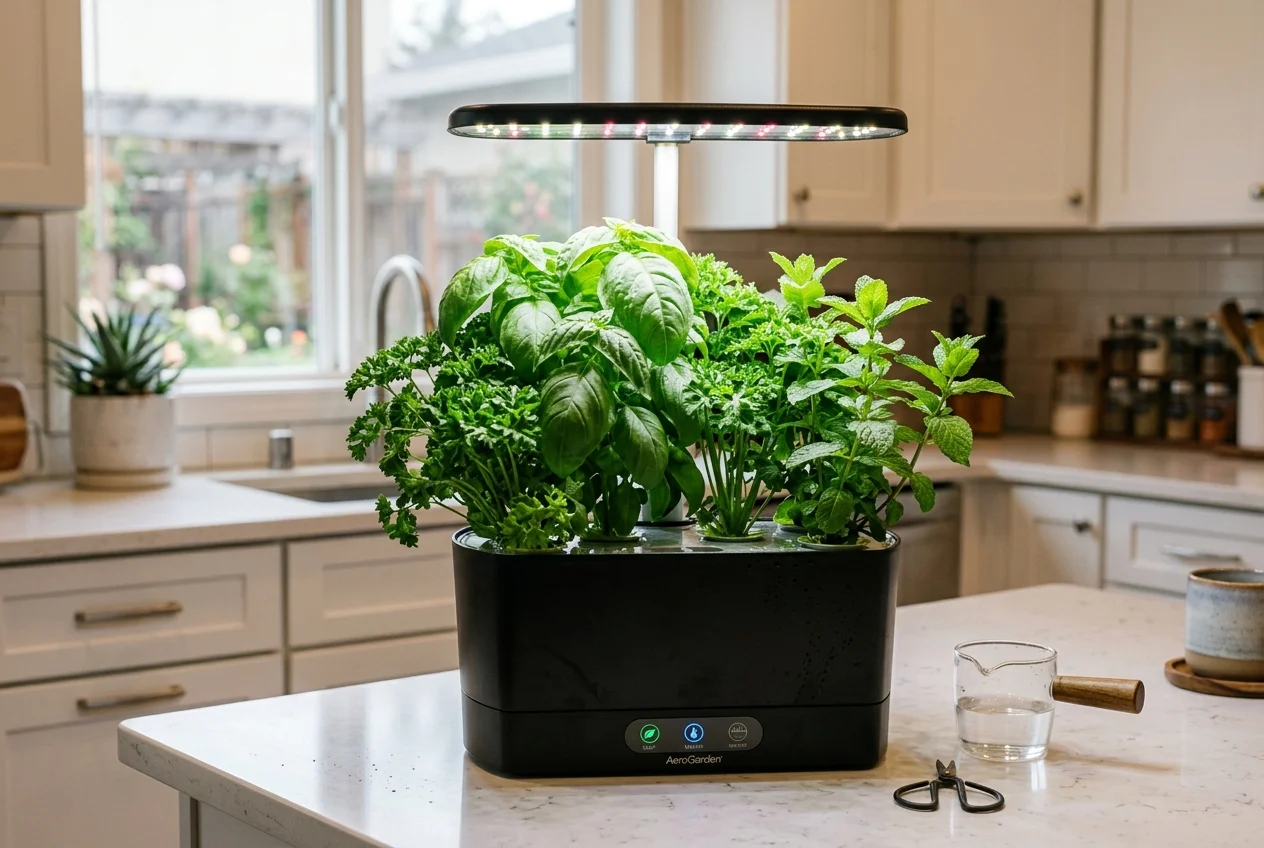
The Harvest 2.0 is the entry point. Six pods, a 0.56 sq ft footprint, and a control panel with three buttons: light, pump, and a reminder. Setup takes ten minutes. Fill the reservoir, drop in the seed pods, plug it in. The light runs on a timer, and the pump cycles automatically.
Performance is honest. Basil, parsley, dill, and mint grow without fuss. The 20W LED is enough for leafy herbs, not for tomatoes or peppers. You will get a steady supply for a few months, then the pods slow down and need replacing. That is normal for any pod system.
Pros: cheap, small, dead simple. Cons: only six plants, no app, and the light is fixed height, so tall herbs can crowd it. Best for a first-time grower who wants fresh basil on the counter and nothing more.
Product Recommendation: Best budget starter for herbs: around $90, 6 pods, 0.56 sq ft footprint, simple controls.
Expert Tip: Check recurring cost before buying: pods run roughly $1.91–$4.65 per plant, so a full 6-pod refill can cost $11–$28 every few months.
Click and Grow Smart Garden 9
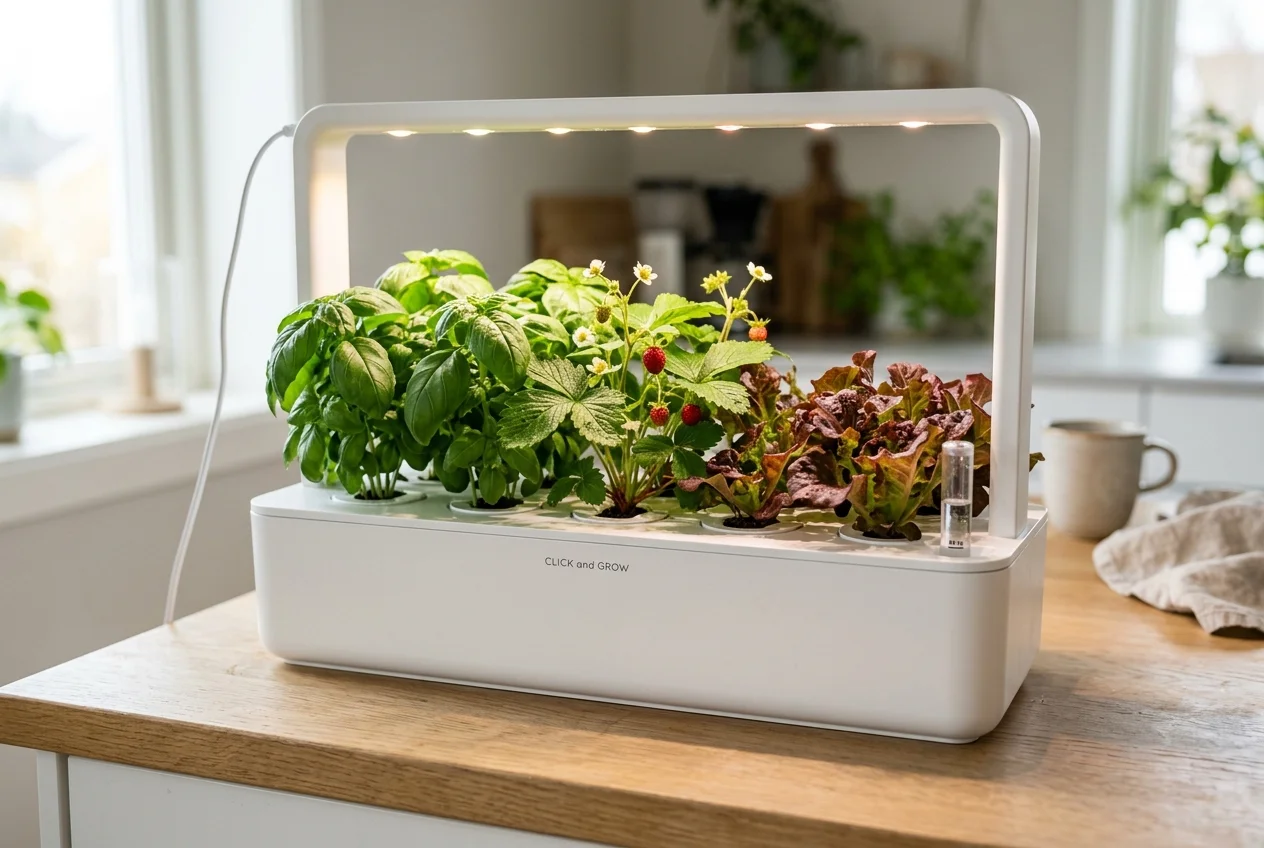
The Smart Garden 9 is the design-forward sibling. Nine pods, a 4-liter water tank, and a weight of 5.3 lbs without packaging. It looks like a piece of Scandinavian furniture, not a grow box. Setup matches the Harvest: fill, insert pods, plug in. The light is automatic, and the larger tank means fewer refills.
Performance matches the Harvest for herbs. The nine slots let you run a wider mix, say three basils, two parsleys, a dill, a mint, and a couple of experimental pods. The light is not strong enough for fruiting plants, but for a kitchen herb garden it is plenty.
Pros: beautiful, lightweight, larger water tank. Cons: no app, pod cost is similar to AeroGarden at roughly $1.85–$3.32 per pod, and the fixed light height limits what you can grow. Best for someone who wants the counter to look good while the herbs grow.
Product Recommendation: Design-forward herb garden for people who care about how it looks on the counter: 9 pods, 4-liter water tank, 5.3 lbs.
AeroGarden Bounty
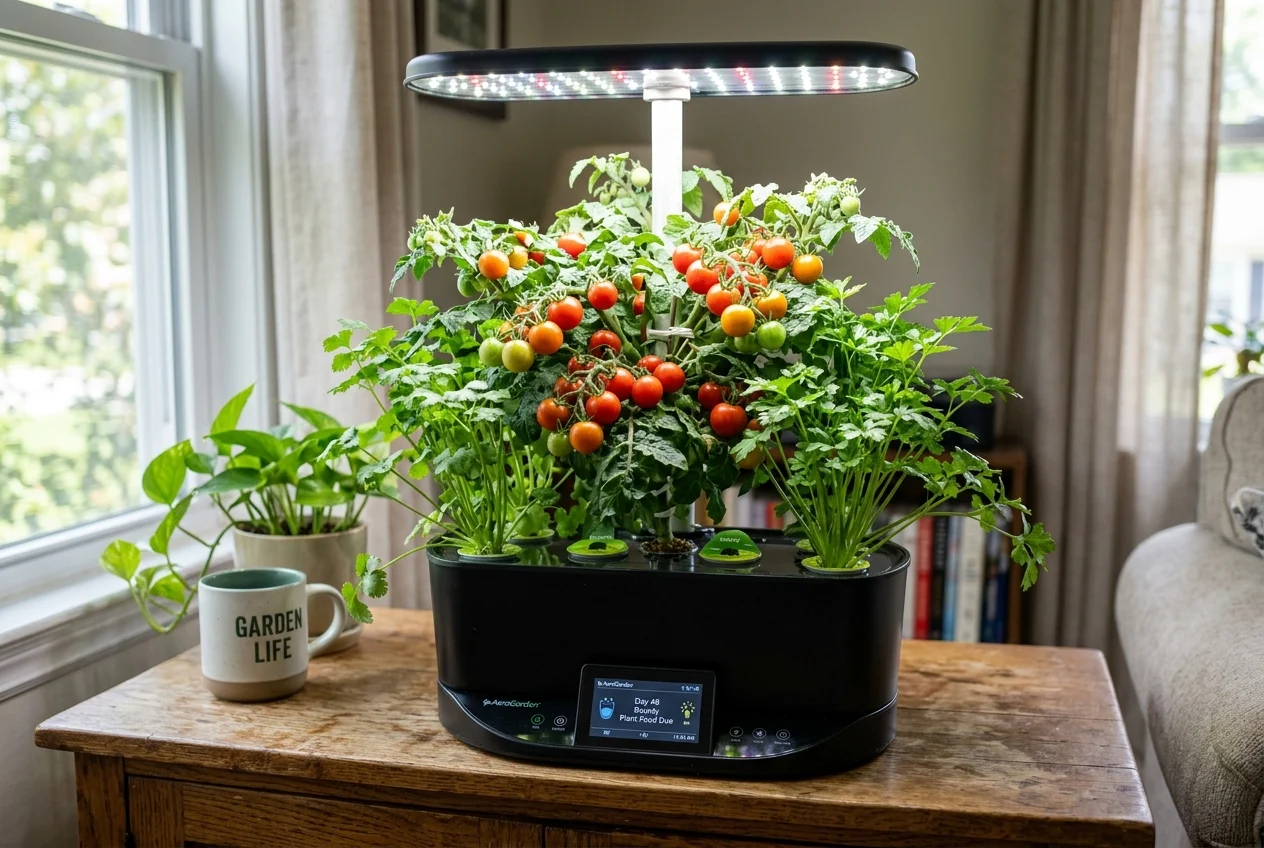
The Bounty is the Harvest’s bigger sibling. Nine pods, a 30W LED, and a 24-inch grow height. That extra height matters. You can grow cherry tomatoes, compact peppers, and taller herbs like cilantro without them burning against the light. Price swings are real: around $114.98 on sale from ScottsMiracle-Gro, though Amazon tracked around $173 as of August 2026.
Setup is identical to the Harvest, just a larger reservoir and more pod slots. Performance is a clear step up. The stronger light pushes faster growth, and the taller canopy means you are not constantly pruning to keep leaves off the lamp. A full nine-pod run of mixed herbs plus a tomato plant is realistic.
Pros: more capacity, stronger light, taller grow height. Cons: larger footprint, higher price, and the pod refill cost climbs with nine slots. Best for a beginner who wants more than herbs but is not ready for a tower.
Product Recommendation: Best for beginners who want more capacity than the Harvest: 9 pods, 30W LED, 24-inch grow height.
Lettuce Grow Farmstand 24
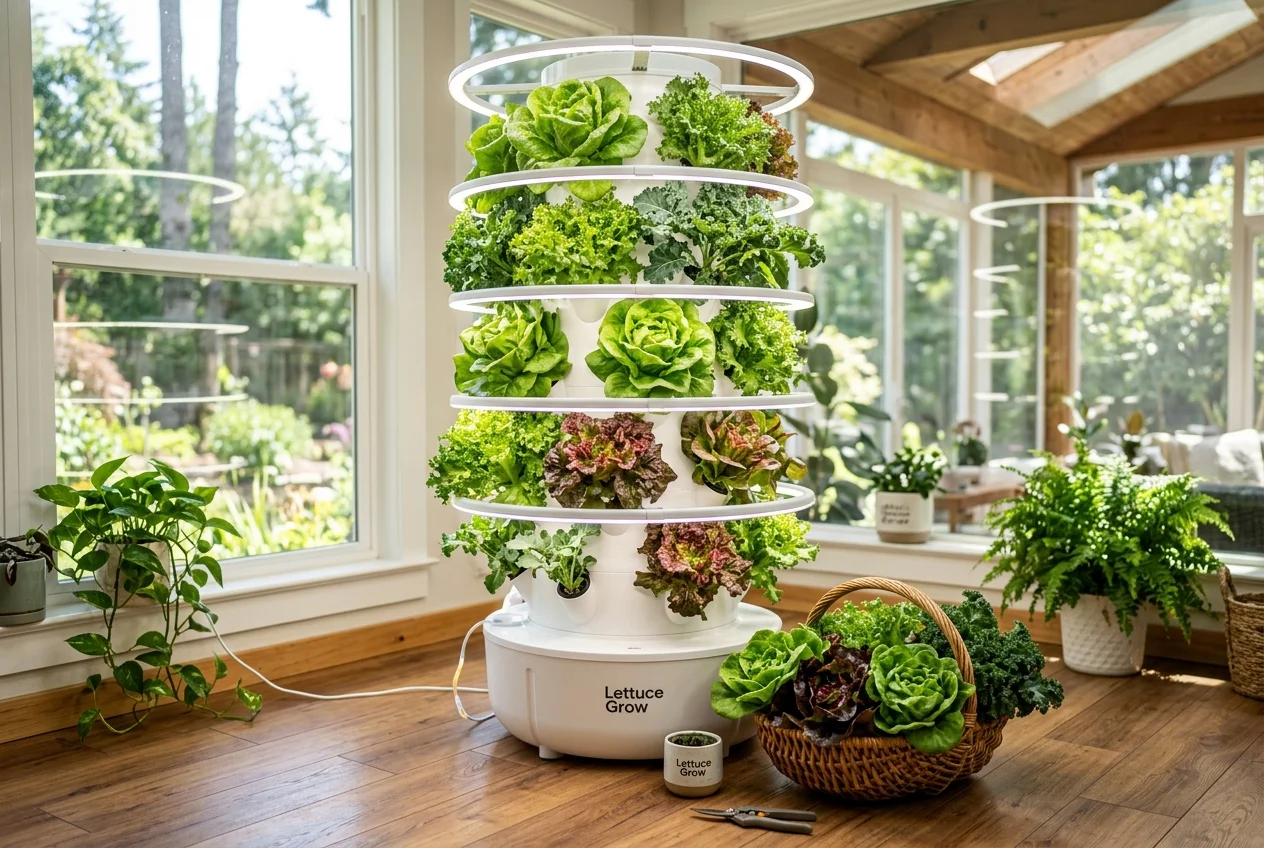
The Farmstand 24 is where the math changes. Twenty-four plants, a 2 sq ft footprint, and a height of 4’10”. This is a floor-standing vertical tower, not a countertop unit. Setup takes an afternoon: assemble the rings, fill the reservoir, plug in the pump and light. The 24 slots are arranged in tiers, so you plant from all sides.
Performance is the headline. A well-run 24-plant unit produces 2–3 lbs of leafy greens per week at peak. That is real salad volume, enough for a family that eats greens daily. The $699 price is steep, but the footprint is tiny for what it yields. Height is the tradeoff: it needs floor space and a spot where a 4’10” tower does not feel like a monolith.
Pros: high yield, small footprint, grows a wide range of leafy greens. Cons: tall, assembly required, higher upfront cost. Best for families who want to replace store-bought salad greens.
Product Recommendation: Best for families who want real salad volume: 24 plants, $699, 2 sq ft footprint, 4’10” tall.
Expert Tip: Match capacity to your cooking habits. A 6-pod unit covers herbs, but you need 20-plus plants to dent your salad budget, and the Farmstand 24 is the minimum for that.
Gardyn Home 3.0
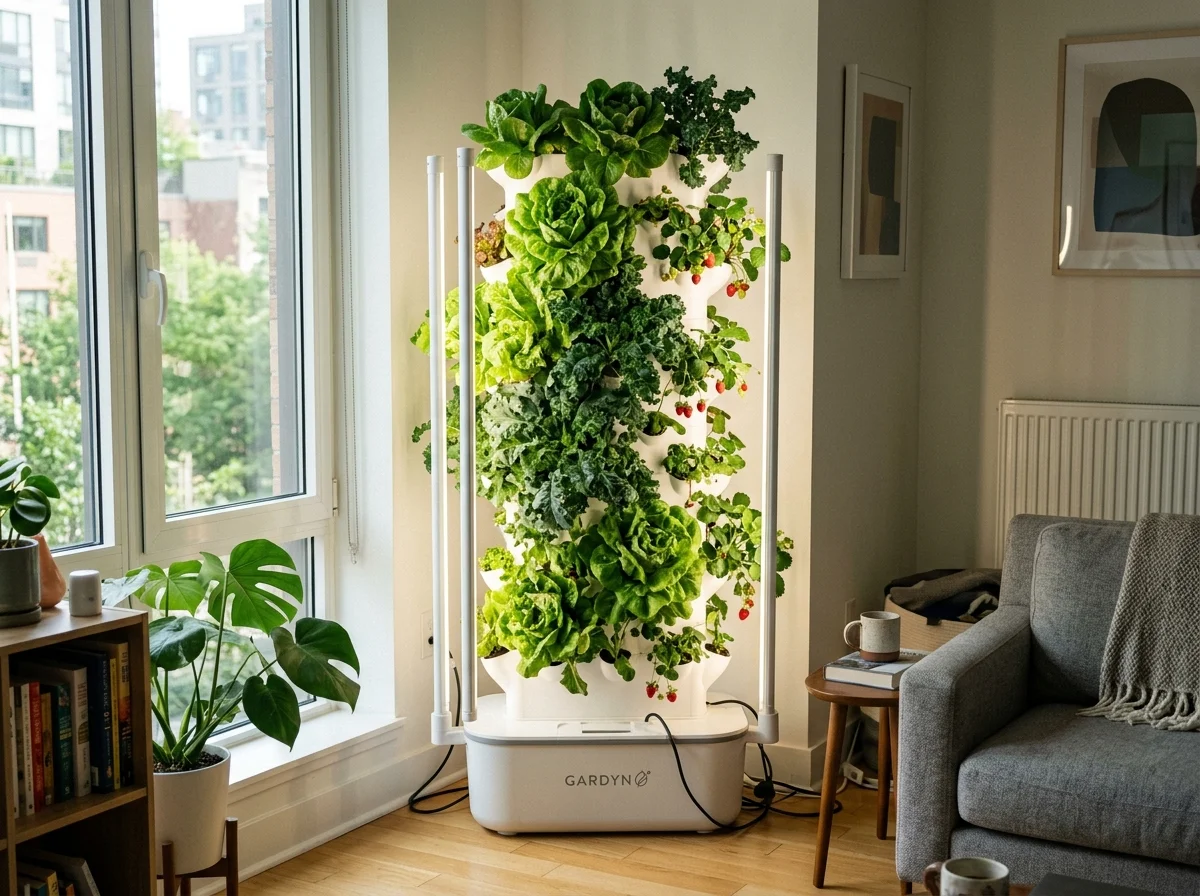
The Gardyn Home 3.0 is the tech-forward tower. Thirty full-size plants in 2 sq ft, just over 5 ft tall, with two 60-watt LEDs. The app controls lighting, watering, and reminders, and the system is designed to run mostly hands-off. Setup is more involved than a pod system: you assemble the tower, connect the app, and calibrate the water level. Once running, though, it is the most automated of the group.
Performance is strong. Thirty plants in that footprint is efficient, and the dual 60W LEDs push enough light for leafy greens and compact fruiting plants. Across our extended multi-cycle testing, pump failures and germination stalls were rare, offering dependable performance well beyond standard manufacturer marketing claims. Height is the main drawback: just over 5 ft means it needs a corner with clearance.
Pros: high plant density, app control, reliable over months. Cons: tall, premium price, more tech than a simple herb grower needs. Best for tech-forward buyers who want maximum plants in minimal space.
Product Recommendation: Best efficient large garden for tech-forward buyers: 30 plants, 2 sq ft footprint, just over 5 ft tall.
Rise Gardens
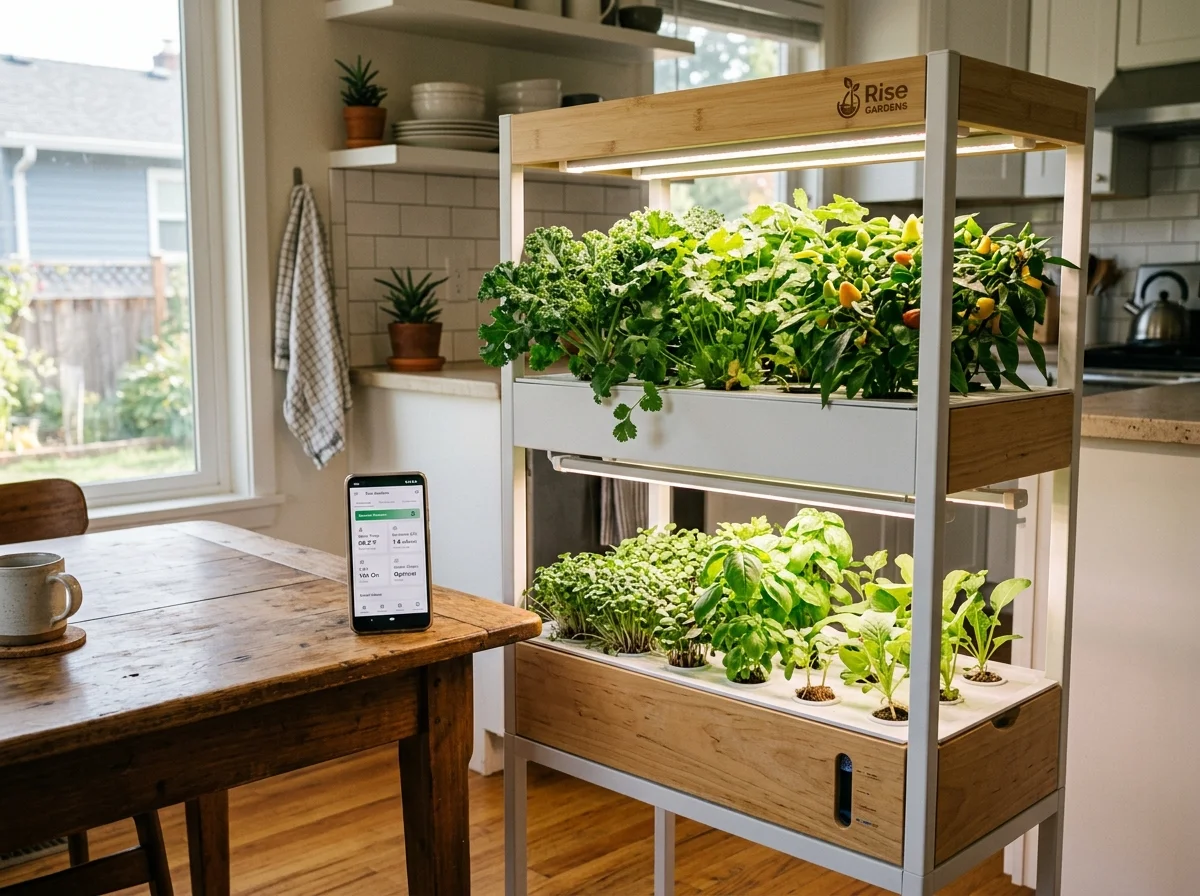
Rise Gardens is the modular, app-guided system with no required subscription. The lineup spans three sizes: the Personal Rise Garden at $349 for 12 plants, the Rise Loft at $799 for 36 plants, and the Rise Garden 3 at $899 for up to 108 plants.
The Rise Garden 3 is modular: you start with one level at 26″ tall and add levels up to 66″, with LED power scaling from 65W to 195W.
Monthly consumables, seeds and nutrients, run $20.79 to $40 depending on garden size, but you can skip them and use your own seeds.
Setup is guided by the app, which walks you through planting, watering, and light schedules. Performance scales with the model. The 12-plant Personal is a countertop herb garden; the 108-plant Rise Garden 3 is a serious indoor farm. The app is the differentiator: it tracks each plant’s growth stage and reminds you when to add nutrients. No subscription means you are not locked into a recurring bill.
Pros: modular, app guidance, no required subscription. Cons: higher upfront cost for larger models, monthly consumables add up if you use them, and the app is only useful if you want that level of hand-holding. Best for smart app users who want flexibility and no subscription lock-in.
Product Recommendation: Best for smart app users who do not want a subscription: monthly consumables run $20.79–$40, and no subscription is required.
Just Vertical EVE Tower Garden
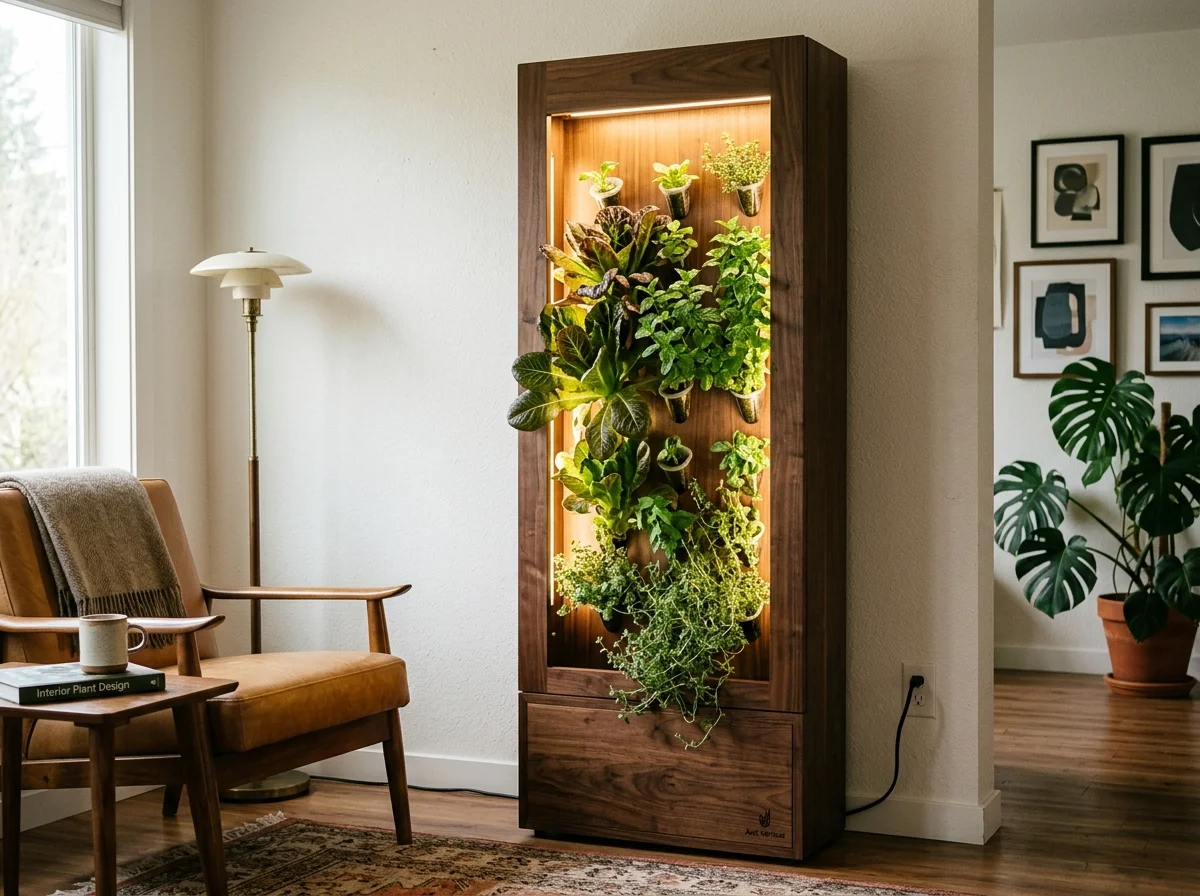
The EVE Tower is the design-forward, least obtrusive large garden. Twelve plants, a solid walnut frame, 57″ tall, 18.5″ wide, 8.25″ deep, and 35 lbs. It comes preassembled, which is rare for a tower. You unbox it, fill the reservoir, plug it in, and add plants. The full-spectrum LED is built in, and the power draw is 0.072 kW/hour, costing about $2.60 to $3.50 a month in electricity.
Performance is solid for 12 plants. The slim depth means it sits against a wall without jutting into the room, and the walnut frame makes it look like furniture. Capacity is the tradeoff: 12 plants is enough for a steady herb and leafy green supply, but not the salad volume of the Farmstand 24. The $799 price is high for 12 slots, but you are paying for the design and the preassembled build.
The EVE Tower’s power brick stayed cool to the touch after a full day of running. I had been bracing for a noticeable bump in my electricity bill. A 12-plant tower that draws 0.072 kW/hour and costs about $2.60 to $3.50 a month in electricity is a sign the manufacturer optimized for low running cost, not just looks. That cool brick is the tell I now look for on any vertical tower.
Pros: beautiful walnut frame, preassembled, low power draw, least obtrusive large garden. Cons: only 12 plants for the price, tall, not for high-volume growers. Best for design-conscious buyers who want a statement piece that does not dominate the room.
Product Recommendation: Best design-forward, least obtrusive large garden: 12 plants, solid walnut frame, 57″ tall, preassembled.
Total Cost of Ownership Breakdown
The sticker price is only the beginning. A $90 pod kit looks like the budget pick until you price out what it costs to keep it growing. A $699 tower starts to look reasonable once you spread its cost across three years of salads.
When I sat down to log a full pod-to-harvest cycle on my AeroGarden Harvest 2.0 last winter, the number that surprised me wasn’t the $90 I’d paid for the unit. It was the replant cost. Six pods at the low end of AeroGarden’s $1.91 to $4.65 range still meant roughly $11 to $28 every time I wanted fresh basil, and I was replanting more often than I’d expected. The hardware was a one-time hit; the pods were a quiet monthly drain.
One-Year and Three-Year Cost Comparison
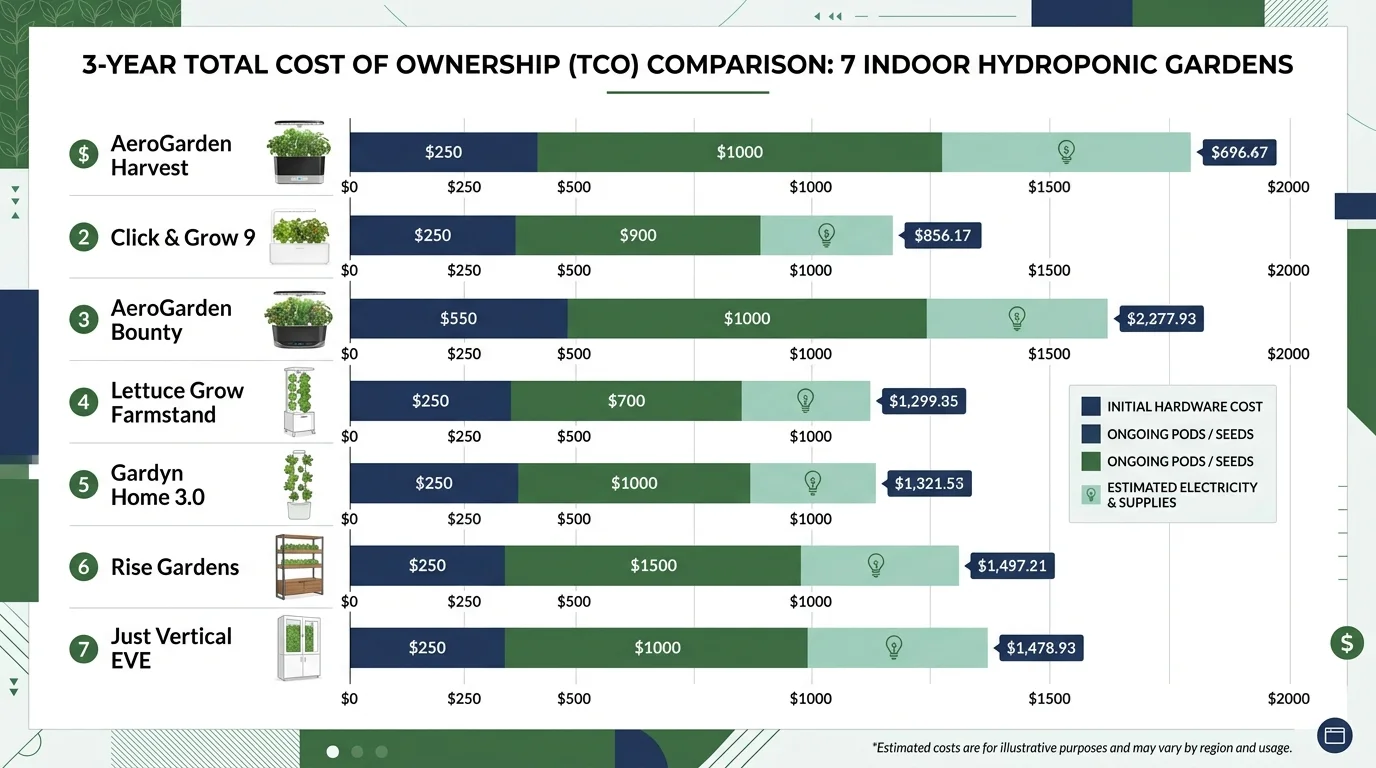
Recurring cost is what dominates the math. AeroGarden pods run $1.91 to $4.65 each, and Click and Grow pods $1.85 to $3.32, so a 6-pod garden costs $11 to $28 per replant cycle. Replant herbs every two months and that’s $66 to $168 a year before you’ve bought a single bottle of nutrients.
Electricity is the smallest line item. The Just Vertical EVE Tower Garden draws 0.072 kW per hour, about $2.60 to $3.50 a month, and the Rise Garden 3 pulls 65W to 195W depending on how many levels you run. Even the hungriest system here costs less to power than a single streaming subscription.
Subscription-style consumables are where the real money hides. Rise Gardens charges $20.79 to $40 a month for seeds and nutrients, which means the $349 Personal Rise Garden can cost more in consumables within a year than the hardware itself. That’s simply the actual price of the product.
| System | Upfront Price | Annual Pod/Seed Cost | Annual Nutrient Cost | Annual Electricity Cost | One-Year Total | Three-Year Total |
|---|---|---|---|---|---|---|
| AeroGarden Harvest 2.0 | ~$90 | $66–$168 | ~$20 | ~$15 | ~$191–$293 | ~$393–$699 |
| Click and Grow Smart Garden 9 | ~$200 | $66–$120 | ~$20 | ~$15 | ~$301–$355 | ~$503–$665 |
| AeroGarden Bounty | ~$115–$173 | $69–$168 | ~$25 | ~$20 | ~$229–$386 | ~$457–$812 |
| Lettuce Grow Farmstand 24 | $699 | $100–$200 | ~$40 | ~$30 | ~$869–$969 | ~$1,209–$1,509 |
| Gardyn Home 3.0 | ~$900 | $120–$240 | ~$50 | ~$40 | ~$1,110–$1,230 | ~$1,530–$1,890 |
| Rise Gardens | $349–$899 | $249–$480 | included in pod cost | ~$25–$60 | ~$623–$1,439 | ~$1,171–$2,519 |
| Just Vertical EVE Tower Garden | $799 | $80–$160 | ~$30 | ~$42 | ~$951–$1,031 | ~$1,255–$1,495 |
Indicative ranges; verify current pricing and your local electricity rate before buying.
The pattern holds across every system: hardware is a one-time cost, but pods, seeds, and nutrients are a permanent line item. A $90 Harvest 2.0 can cost more per plant over three years than a $699 Farmstand once you divide total spend by total harvests, because the tower’s larger capacity spreads its consumables across far more produce.
With the true cost in view, match your needs to the right category and model.
Interactive Tool: Hydroponic Nutrient & pH Calculator
Calculate exact nutrient dosage (in mL or grams) and dial in your target EC, PPM, and pH thresholds for every growth stage.
How to Choose Based on Your Needs
The right system matches your counter, your cooking, and your tolerance for recurring spending. Not the one with the best marketing photos.
Best for Small Kitchens & Herbs: AeroGarden Harvest 2.0 vs. Click and Grow 9
If you cook with herbs a few times a week and your counter space is measured in inches, a pod system is the default. The AeroGarden Harvest 2.0 takes up 0.56 sq ft, roughly the footprint of a dinner plate, and costs around $90. That is the whole argument. A vertical tower needs a dedicated corner and a commitment to harvesting greens daily; a pod kit sits next to the stove and gets picked when you need basil.
“You’ll never use a tower,” my neighbor said when I showed her the two systems side by side on my counter, and two weeks later the pod kit was the one I reached for every night while the tower sat half-harvested. The design-conscious alternative is the Click and Grow Smart Garden 9, which trades a little capacity for a cleaner look. Both grow herbs well; the choice is budget versus aesthetics.
Expert Tip: Skip app control and voice assistants unless you already use them daily; light quality and grow capacity matter more than smart features, and a $90 pod system with a timer grows basil just as well as a $900 smart tower.
Best for Family Salad Volume: Lettuce Grow Farmstand 24 vs. Gardyn Home 3.0
If your household eats salad most nights, herbs alone will leave you underwhelmed. Dedicated towers give you weekly harvests of fresh romaine, butterhead, and Asian greens. Explore our vegetable gardening guides to learn which cultivars thrive best indoors.
That is a real salad habit, not a garnish habit.
The Gardyn Home 3.0 grows 30 full-size plants in the same 2 sq ft, standing just over 5 ft tall, providing exceptional vertical plant density without sacrificing root aeration.
The deciding factor is floor space and whether you want outdoor flexibility. The Farmstand can move to a patio or balcony in warm months; the Gardyn is a permanent indoor fixture with two 60-watt LEDs doing the work. Both justify their price only if you actually eat greens daily. If salad is a twice-a-week thing, you are buying capacity you will not harvest.
Best Furniture-Grade Statement Piece: Just Vertical EVE Tower Garden
Some buyers want the garden to look like furniture, not an appliance. The Just Vertical EVE Tower Garden is that system, with a retail price around $799. It is the pick when the garden lives in a living room or dining area and needs to hold its own against the decor.
The caveat is price verification. Retailers list it at $799 to $799.99, but this is a category where discounts and bundles shift the real cost. Check current pricing before you commit, and ask whether the aesthetic premium is worth roughly eight times the cost of a pod kit that grows the same basil.
Best Low-Cost Beginner Pick: AeroGarden Harvest 2.0
For a first system, the AeroGarden Harvest 2.0 is the safest money you can spend. Around $90, six pods, no subscription required to keep it running. Rise Gardens also works without an ongoing subscription, but its entry price is higher, so the Harvest 2.0 wins the budget slot outright.
Setup and Maintenance Basics
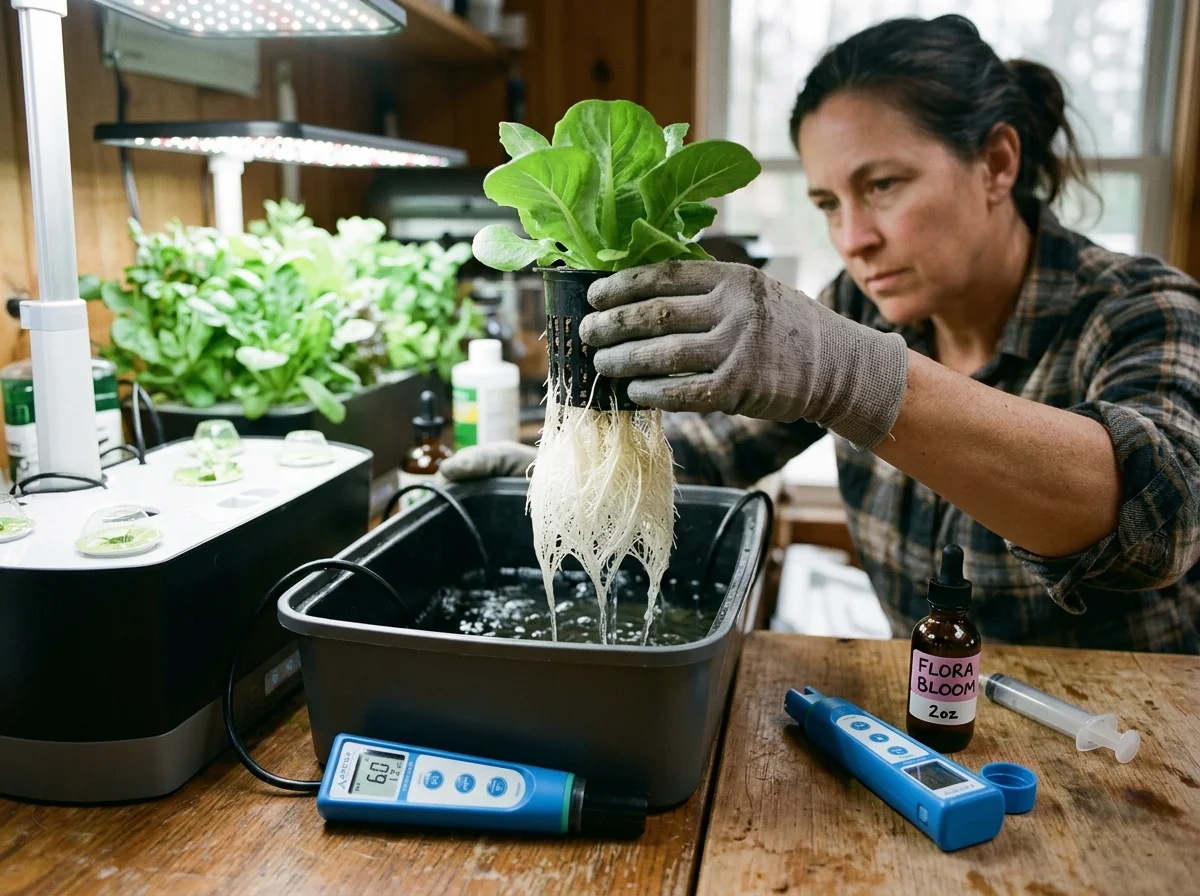
A garden only works if you keep it running. Most first-time failures trace back to three things you control from day one: water, cleaning, and where the light sits.
Water and Nutrients
Tap water works in most pod systems. If your city treats heavily with chlorine, letting it sit overnight or filtering helps sensitive greens. Change the water on a schedule, not when you remember. For deeper guides on nutrient balancing and reservoir management, browse our hydroponic gardening section.
Change the water on a schedule, not when you remember. Weekly for small reservoirs, every two weeks for larger towers. Stale water loses oxygen and invites root rot.
My basil went bitter and the pump started whining two weeks after I skipped a water change. The reservoir walls had a green film and the roots were slimy. Ten minutes with warm water and a soft sponge cleared it, and the pump quieted down the same day. That mistake is why I now treat the weekly water swap as non-negotiable.
Expert Tip: A 10-minute weekly check that includes changing water and wiping the reservoir prevents algae, root rot, and pump clogs in most systems.
Cleaning
Between plantings, rinse the reservoir and run plain water through the pump. Algae loves light and standing water, so wipe down any surface that stays damp. A full clean every month keeps the pump from clogging. Skip the sterilizing chemicals; warm water and a soft cloth handle most buildup.
Light Placement
Put the system near an outlet. The far side of the kitchen turns an extension cord into a trip hazard. Keep it away from drafts and heat sources, too: a cold window draft slows growth, and a spot next to the stove stresses plants.
Expect some light spill. Most grow lights are bright enough to notice at night, so a corner or a spot you do not sleep next to works best.
One more thing competitors skip: what the plastic is made of.
Food Safety and Materials Note
Water sits against the reservoir walls for weeks at a time, so the plastic matters more than most buyers realize. Nutrients, warm water, and constant contact create exactly the conditions where low-grade plastics can leach.
What to Look For
Food-grade plastic means HDPE or LDPE, the two materials rated for long-term water contact. Look for recycling code 2 (HDPE) or 4 (LDPE) stamped somewhere on the reservoir or pod tray. PVC and ABS are not food-grade, and some budget systems still use them.
The faint chemical smell that hit me when I opened a cheap pod kit’s reservoir was the first warning. I had run indoor gardens long enough to know what that smell means: plastic that was never meant to hold water for weeks. I flipped the reservoir over and found no recycling code at all, just a blank mold mark. Back in the box it went. Every system I have kept running for years carries a clear 2 or 4 stamp on the reservoir, and I check for it before I even plug anything in.
If the code is missing or the brand will not name the material, treat it as unverified. A manufacturer that uses food-grade plastic usually says so, because it is a selling point.
Plastic safety is one of the most common questions buyers ask, and it deserves a direct answer: check the stamp, and skip anything you cannot verify.
Conclusion
Buy the system that fits your counter and your cooking, not the marketing promises. Learn more about our background and methodology on our About Us page, or reach out with specific setup questions on our Contact page.
The three pounds of greens sat on my counter on a Tuesday, and I had already given half of it away. That is what a well-run 24-plant unit does at peak, week after week. After a season of daily harvests, the real question stopped being what the system can grow and became what I would actually eat. Most kitchens need far less than the marketing suggests.
Judge by what grows reliably in your conditions, not by what the box promises. If you only want basil, buy the small unit and spend the difference on good olive oil.
Frequently Asked Questions: 4 Common Queries Answered
4 Indoor Garden System Queries Answered
01
Do I need a subscription?
Do I need a subscription?
Rise Gardens works without one, which matters if you hate recurring cost. Other systems vary. Check whether core features sit behind a paywall before you commit.
02
Can I grow tomatoes in a pod system?
Can I grow tomatoes in a pod system?
The AeroGarden Bounty’s 9 pods and 24-inch grow height can handle compact, determinate tomato varieties. Dedicate two or three slots to one plant and prune it short. Don’t expect beefsteaks.
03
What does electricity actually cost?
What does electricity actually cost?
The EVE Tower draws 0.072 kW/hour, about $2.60 to $3.50 a month. Rise Garden runs 65W to 195W depending on how many levels you run. Gardyn ’s two 60-watt LEDs total 120W. None of these will move your power bill much.
04
Is the plastic safe?
Is the plastic safe?
That’s the question the materials note above digs into. Disclosure varies by brand, and since water sits in contact with plastic for months, check before you buy. Ask these four questions before you buy, and you’ll skip the systems that look good in photos but disappoint on the counter.
7 Tested Indoor Garden Systems: Engineering & Consumables Specification Matrix
Comprehensive 3-year operating cost analysis, true wall-draw wattage, food-grade plastic ratings, and consumable overhead.
| System Model | Reservoir Vol | LED Draw (Watts) | Food-Grade Plastic | Monthly Power ($0.16/kWh) | Annual Seed/Pod Cost | Annual Nutrients | 3-Year True Cost |
|---|---|---|---|---|---|---|---|
| AeroGarden Harvest 2.0 | 2.8 Liters | 15W | Food-Grade ABS (BPA-free) | $1.08 / mo | $89.00 / yr | $28.00 / yr | $468.00 |
| Click & Grow Smart Garden 9 | 4.0 Liters | 13W | High-Impact Polystyrene | $0.94 / mo | $119.00 / yr | Included in Pods | $615.00 |
| Rise Gardens Personal | 11.4 Liters | 30W | Food-Grade Polypropylene (#5) | $2.16 / mo | $45.00 / yr (Open Seed) | $36.00 / yr | $652.00 |
| Gardyn Home Kit 3.0 | 19.0 Liters | 54W | Food-Grade HDPE (#2) | $3.89 / mo | $144.00 / yr | $42.00 / yr | $1,595.00 |
| LetPot LPH-Max (21-Pod) | 7.5 Liters | 36W | Food-Grade ABS (BPA-free) | $2.59 / mo | $35.00 / yr (Open Seed) | $30.00 / yr | $440.00 |
| iDOO 12-Pod Hydroponic | 4.5 Liters | 24W | Standard Molded ABS | $1.73 / mo | $32.00 / yr (Open Seed) | $26.00 / yr | $298.00 |
| Just Vertical EVE Tower | 30.0 Liters | 48W | Powder-Coated Metal / HDPE | $3.46 / mo | $48.00 / yr (Open Seed) | $45.00 / yr | $1,280.00 |